
Sweet Corn Identification Guide
How to identify sweet corn (Zea mays) by its tall jointed stalk, long strap leaves, tassels, and silk-tipped ears.
Read the full Sweet Corn encyclopedia entry →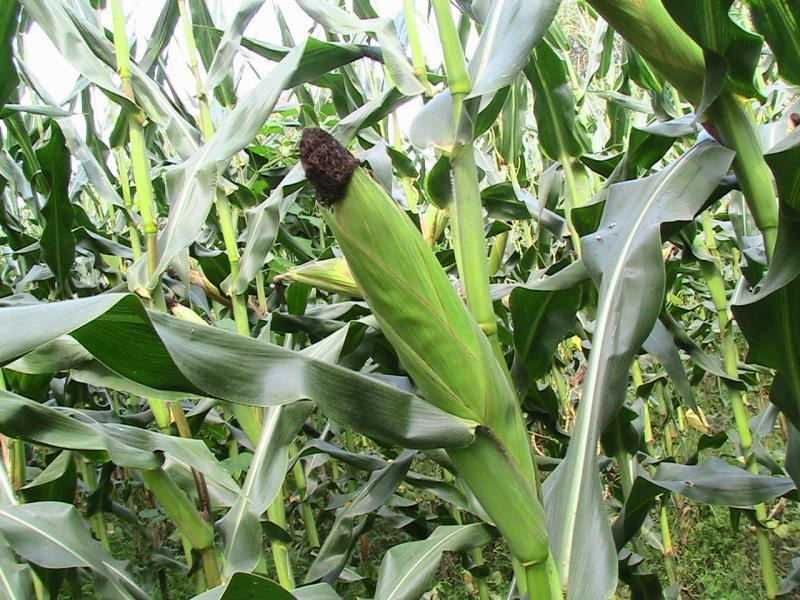
Key Identifying Features
Sweet corn (Zea mays var. saccharata/rugosa) is a tall annual grass grown for its sugary kernels. Recognize it by the single thick jointed stalk, long arching strap-like leaves, a feathery tassel at the top, and husk-wrapped ears with silky threads emerging from the leaf joints.
- Tall, unbranched jointed (noded) stalk, 5-8 ft
- Long, strap-shaped leaves with wavy edges and a white midrib
- Tassel of pollen flowers crowning the top
- Ears in leaf axils, sheathed in husks with protruding silk
Leaves & Stems
The stalk (culm) is solid, thick, and divided into distinct nodes (joints), with a single leaf arising at each node, alternating sides up the stem. Leaves are long (2-4 ft) and strap-like, with smooth-to-wavy margins, a prominent pale midrib, and a clasping sheath that wraps the stalk. Stilt-like prop roots often emerge from the lowest nodes at the soil line. Sweet corn seedlings show the parallel-veined, blade-like leaves typical of grasses.
Flowers & Fruit
Corn is monoecious with separated male and female flowers. The tassel at the very top is the male flower cluster, branching and releasing yellow pollen. The female flowers form the ears lower on the stalk, wrapped in green leafy husks; each kernel-to-be sends out a long silk thread that catches pollen. Pollinated ears fill with rows of plump kernels. Sweet corn kernels are typically yellow, white, or bicolor and look wrinkled/translucent when dry (the "sugary" gene), distinguishing them from the smooth dented kernels of field corn.
How to Tell It Apart from Look-Alikes
- Field/dent corn: identical plant form, but kernels dry hard with a dented top; sweet corn kernels shrivel and stay glossy. Sweet corn is also usually shorter and harvested at the milky stage.
- Sorghum: similar tall grass, but it has a dense seed head (panicle) at the top instead of an ear in the leaf axil and a tassel.
- Large grasses (sugarcane, Johnson grass): lack the husked ear and silk; the ear with silk is unique to corn.
Where You'll Find It
Grown in home gardens and farm fields in full sun and warm weather, usually planted in blocks of several rows to aid wind pollination. Sweet corn is a summer crop across temperate and subtropical regions and is a staple of farm stands and roadside markets.
Quick ID Checklist
- Tall, unbranched jointed stalk with prop roots
- Long strap leaves with white midrib and clasping sheath
- Feathery tassel at the top (male flowers)
- Husked ears with silk in the leaf joints
- Kernels wrinkle/glossy when dry (sweet, not dent)
Frequently asked questions
How can I tell sweet corn from field corn in the garden?
The plants look the same, but the kernels differ. Sweet corn kernels are harvested plump and milky and shrivel to a glossy, translucent wrinkle when dried, while field (dent) corn kernels dry hard with a dented top and a starchy interior.
What is the tassel at the top of a corn plant?
The tassel is the male flower cluster. It releases pollen that drifts down to the silks on the ears below, which are the female flowers. Each silk strand connects to one developing kernel.
Why are there roots growing above the soil on my corn?
Those are prop or brace roots that emerge from the lower stalk nodes. They anchor the tall plant against wind and help take up water and nutrients. They are completely normal.
Why is sweet corn planted in blocks rather than long single rows?
Corn is wind-pollinated, so planting in a block of several short rows lets pollen from the tassels reach the silks of neighboring plants, producing fuller, well-filled ears.