
Torrey Pine Identification Guide
How to identify Torrey pine (Pinus torreyana) by its very long needles in bundles of five, heavy chocolate-brown cones, and rare coastal Californian range. Covers needles, cones, bark, and look-alikes.
Read the full Torrey Pine encyclopedia entry →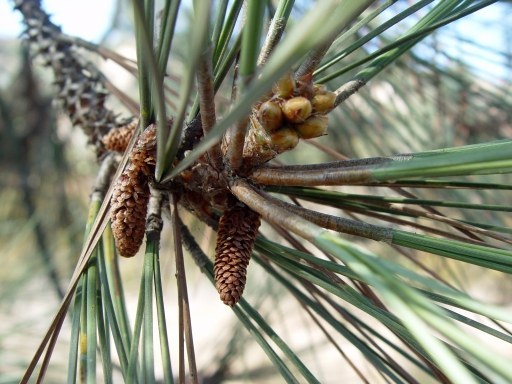
Key Identifying Features
Torrey pine (Pinus torreyana) is North America's rarest pine, a coastal Californian species recognized by its long needles bundled in fives, heavy, chocolate-brown cones with large seeds, and an open, often windswept crown. The combination of five very long needles and a coastal southern-California setting is distinctive.
- Needles in bundles of five, very long (15–30 cm)
- Stout, grey-green needles, sparse and tufted at branch ends
- Cones heavy, broad, chocolate-brown, holding big seeds
- Rare, windswept coastal tree, often gnarled
Leaves & Stems
Needles are long (15–30 cm), stout and stiff, grey-green to dark green, held five per bundle—unusual, since most long-needled pines have two or three. They are clustered toward the ends of stout shoots, giving an open, tufted look. Twigs are thick. The bark is reddish-brown to grey, deeply furrowed into broad scaly ridges. In its exposed coastal home the tree is often low, leaning, and contorted by wind, though sheltered or cultivated specimens grow tall and straight.
Flowers & Fruit
Cones are large, heavy, broadly egg-shaped (8–15 cm), chocolate to reddish-brown, with thick woody scales each bearing a small prickle. They mature over three years, open to release large, hard, wingless-to-short-winged seeds, and can persist on the branches. The weight and dark color of the cones are good clues. Male cones are small and yellowish at shoot bases in spring.
How to Tell It Apart from Look-Alikes
- Other long-needled pines (Coulter, Jeffrey, Ponderosa): Needles in threes, not fives; Coulter pine has even larger spiny cones.
- Sugar pine (P. lambertiana): Also five needles but much shorter (8–10 cm) and very long cylindrical cones.
- Monterey pine (P. radiata): Needles in threes; widely planted along the coast.
- The pairing of five long needles + heavy brown cones + San Diego-area coast essentially confirms Torrey pine.
Where You'll Find It
Extremely restricted in the wild to two populations: the coastal bluffs near San Diego (Torrey Pines State Reserve) and Santa Rosa Island, California. It is also planted as an ornamental and street tree in mild climates worldwide. Look for it on sandy coastal bluffs, sculpted by ocean wind.
Quick ID Checklist
- Needles five per bundle, very long (15–30 cm), grey-green
- Needles tufted at the ends of stout twigs
- Heavy, broad, chocolate-brown cones with big seeds
- Furrowed reddish-grey bark; windswept coastal form
- Rare, native to the San Diego coast / Santa Rosa Island
A pine with very long needles in fives and heavy brown cones on a southern-California coastal bluff is Torrey pine.
Frequently asked questions
How many needles does Torrey pine have per bundle?
Five, which is unusual for such long needles. Most pines with needles 15–30 cm long carry them in twos or threes, so five long needles per bundle is a strong clue.
Why is Torrey pine considered so rare?
In the wild it survives in only two small natural populations: coastal bluffs near San Diego (Torrey Pines State Reserve) and on Santa Rosa Island, making it North America's rarest pine.
How do I tell Torrey pine from Coulter or Ponderosa pine?
Those have needles in bundles of three, whereas Torrey pine has five; Coulter pine also has enormous, very spiny cones, unlike Torrey's heavy but rounder chocolate-brown cones.
What do Torrey pine cones look like?
They are large, heavy, broadly egg-shaped cones 8–15 cm long, chocolate to reddish-brown, with thick woody scales each bearing a small prickle. They take about three years to mature and can persist on the branches.