Tree Philodendron Identification Guide
Identify the Tree Philodendron (Thaumatophyllum/Philodendron bipinnatifidum) by its huge, deeply lobed glossy leaves and stout self-heading trunk.
Read the full Tree Philodendron encyclopedia entry →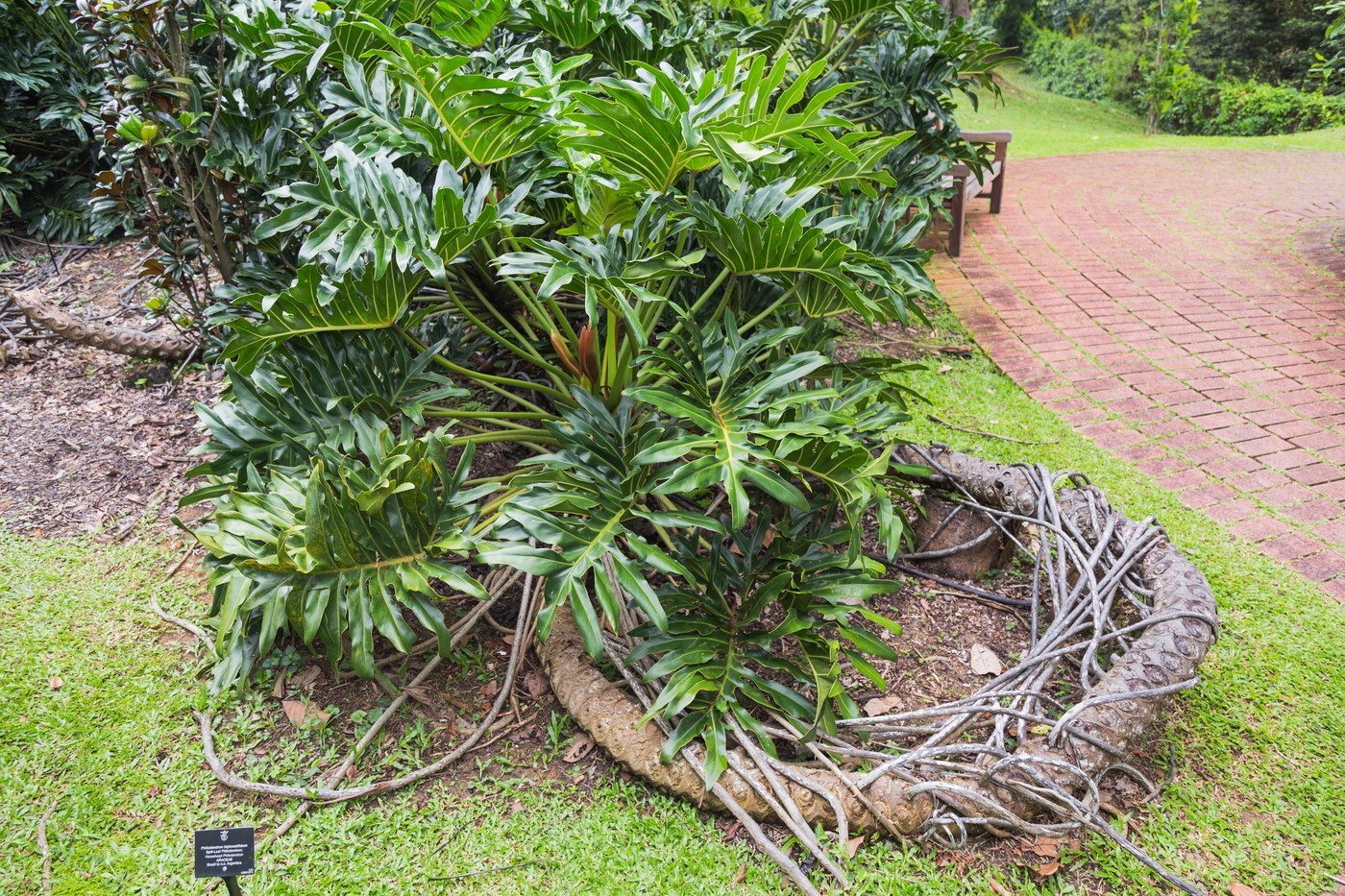
Key Identifying Features
The Tree Philodendron (Thaumatophyllum bipinnatifidum, formerly Philodendron bipinnatifidum/selloum) is a large, non-climbing aroid recognized by its huge, deeply cut, glossy green leaves radiating from a thick, self-supporting trunk.
- Large leaves (45–90 cm) that are deeply lobed and ruffled along the edges
- Self-heading (clumping) habit — a stout central trunk, not a climbing vine
- Prominent leaf scars ringing the woody stem
- Glossy, leathery, dark-green foliage
Leaves & Stems
Mature leaves are broadly heart-shaped in outline but deeply pinnately lobed, with each lobe further cut and wavy — giving a feathery, sculptural silhouette. They are dark green, glossy, thick and leathery, held on long sturdy petioles. The plant builds a thick trunk-like stem marked with eye-shaped leaf scars, and old plants often produce finger-like aerial roots that arch into the soil for support. Unlike vining philodendrons it does not climb; it forms a wide, fountain-like clump that can reach 1.5–3 m across.
Flowers & Fruit
Mature outdoor plants produce the typical aroid inflorescence: a creamy-white spathe surrounding a spadix, sometimes warm to the touch and fragrant at night. Indoors flowering is rare, so it is not a primary ID feature.
How to Tell It Apart from Look-Alikes
- vs. Split-leaf Philodendron / Monstera deliciosa: monstera leaves have holes (fenestrations) within the leaf blade and it climbs with a vining stem; tree philodendron leaves are cut from the edge inward (lobed) with no interior holes and it self-heads
- vs. Philodendron 'Xanadu': a smaller, more compact relative with the same lobed-leaf style but tidier, sub-1 m form
- vs. true climbing philodendrons: those vine up supports with smaller heart-shaped leaves
Key test: look for interior holes (monstera) versus edge lobes only (tree philodendron), and whether the plant climbs (monstera) or stands self-supported (tree philo).
Where You'll Find It
A popular landscape plant in warm climates (zones 9–11) and a large floor houseplant elsewhere. Native to South America (Brazil, Paraguay, Argentina), growing in humid forest.
Quick ID Checklist
- Large leaves deeply lobed/ruffled at the edges, no interior holes
- Self-supporting clump with a thick trunk
- Eye-shaped leaf scars on the stem
- Glossy, leathery dark-green foliage
- Finger-like aerial roots on mature plants
Frequently asked questions
How is Tree Philodendron different from a Monstera?
Monstera leaves have holes inside the leaf blade and it climbs as a vine. Tree Philodendron leaves are lobed only from the edges (no interior holes) and it forms a self-supporting clump.
Does the Tree Philodendron climb?
No. It is a self-heading philodendron that builds a thick trunk and grows as a wide clump, unlike the vining heartleaf philodendrons.
What are the thick roots growing out of the stem?
Those are aerial roots that help anchor and feed the heavy plant. They are normal and can be guided into the soil or pot.
Why has the botanical name changed?
It was reclassified from Philodendron bipinnatifidum/selloum into the genus Thaumatophyllum, but in the trade it is still sold as Tree or Split-leaf Philodendron.
Tree Philodendron identified by the community
Recent Tree Philodendron specimens identified with Plant Identifier.