
Wandering Dude Identification Guide
Identify Wandering Dude (Tradescantia zebrina and relatives) by its purple-and-silver striped leaves, fleshy trailing stems, and three-petaled flowers.
Read the full Wandering Dude encyclopedia entry →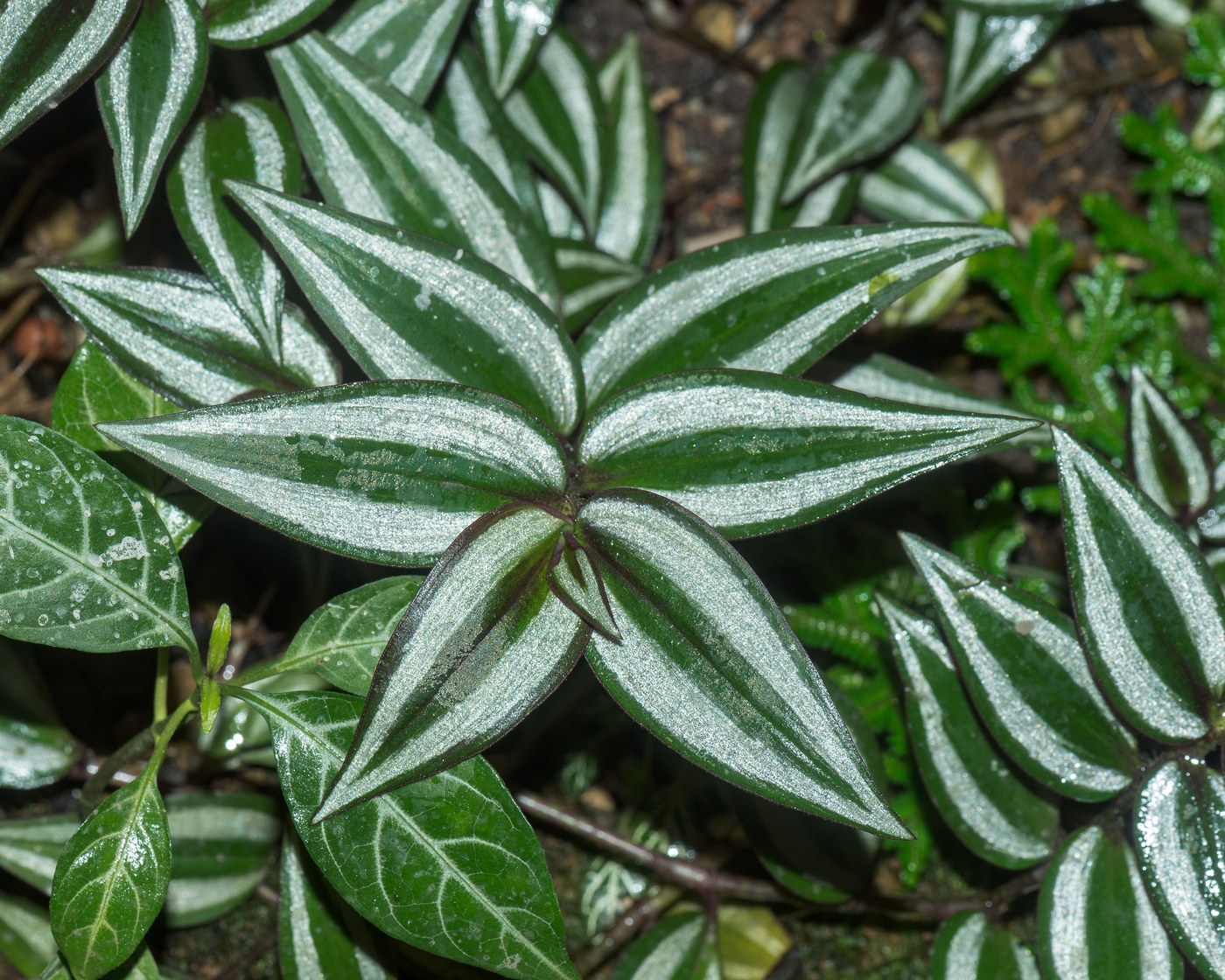
Key Identifying Features
"Wandering Dude" (the modern name replacing an older offensive term) usually refers to Tradescantia zebrina, and sometimes its cousins T. fluminensis and T. pallida. The classic zebrina shows:
- Striped leaves: two silvery bands over a green-to-purple background on top, solid purple underneath
- Fleshy, jointed, trailing stems that root easily at the nodes
- Small three-petaled flowers, usually pink to magenta
- A fast-spreading, cascading habit
Leaves & Stems
Tradescantia zebrina leaves are oval to lance-shaped, pointed, and clasp the stem at swollen nodes. The upper surface has a striking pattern of two broad silver-gray stripes flanking a green or purple midline, and the underside is uniformly rich purple — the most reliable ID trait. Leaves have a slightly metallic sheen and fine hairs.
Stems are succulent, brittle, and segmented (jointed); they snap at nodes and root readily wherever they touch soil, which is why the plant 'wanders.' Related species differ: T. fluminensis has plain green (or cream-variegated) leaves with purple undersides, and T. pallida ('Purple Heart') has solid deep-purple, narrow leaves.
Flowers & Fruit
Flowers are small but distinctive: three rounded petals in pink, lavender, or magenta (white in fluminensis), with bright yellow anthers, emerging from a pair of leaf-like bracts at the stem tips. They open for a single day. Fruit is a small inconspicuous capsule; in houseplants seed is rarely set.
How to Tell It Apart from Look-Alikes
- Tradescantia fluminensis (Small-leaf Spiderwort): green leaves (sometimes cream-striped) with purple undersides and white flowers; lacks the bold silver banding of zebrina.
- Tradescantia pallida (Purple Heart): entirely deep purple, narrow, fuzzy leaves; no silver stripes.
- Callisia repens (Turtle Vine): much smaller, rounder leaves, also trailing — but tiny and tightly packed compared to zebrina.
- Coleus or other striped foliage: upright, square stems, scalloped leaves — not the fleshy jointed trailing stems of Tradescantia.
The silver-striped top + solid purple underside + jointed fleshy trailing stems confirm classic Wandering Dude (T. zebrina).
Where You'll Find It
Native to Mexico and Central America, it's grown globally as a houseplant and hanging-basket plant, and outdoors as a vigorous groundcover in warm climates (USDA 9-11). It can become invasive in frost-free regions, spreading from broken stem fragments. It thrives in bright indirect light, which intensifies the purple and silver coloring.
Quick ID Checklist
- Leaves with two silver stripes on top, solid purple underneath
- Fleshy, jointed stems that root at the nodes
- Trailing/cascading or sprawling habit
- Small three-petaled pink to magenta flowers
- Leaves clasp the stem at swollen joints
Frequently asked questions
Is Wandering Dude the same as Wandering Jew?
Yes. 'Wandering Dude' (and 'Inch Plant' or 'Spiderwort') is the modern, preferred name for Tradescantia zebrina and its relatives, replacing the older term now considered offensive.
What is the most reliable way to identify Tradescantia zebrina?
Check the leaf underside. T. zebrina has two silver stripes on top and a solid rich purple underside, paired with fleshy jointed stems that snap and root at the nodes.
Why are my plant's leaves more green than purple?
Color depends on light. In bright indirect light the silver and purple are vivid; in low light the leaves turn greener and the stems stretch. Move it brighter (but out of harsh midday sun) to restore color.
Can Wandering Dude become invasive?
Yes. In frost-free climates it spreads aggressively from broken stem fragments and is considered invasive in parts of the world, so contain it and dispose of cuttings responsibly.