
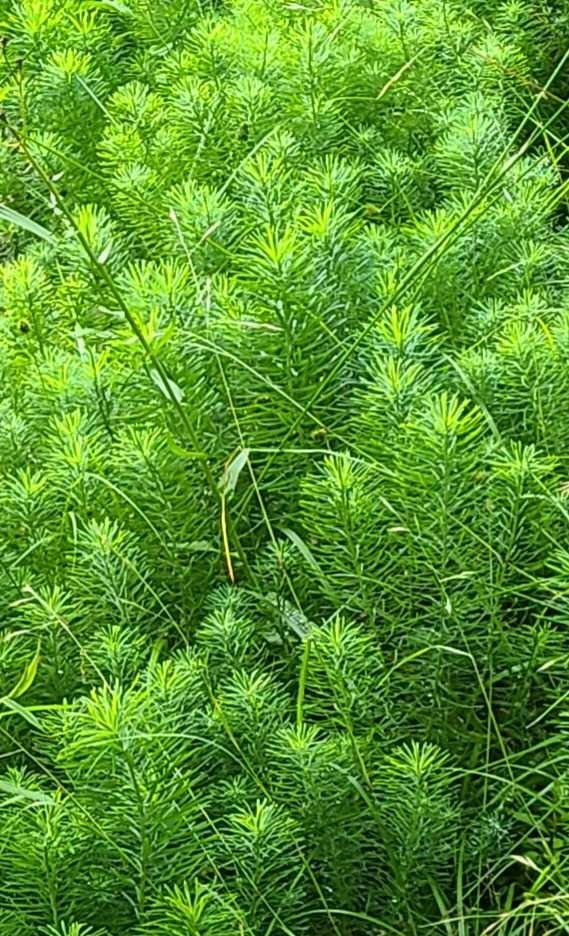
Field Horsetail
Equisetum arvense
A non-flowering, primitive perennial plant characterized by hollow, jointed, green stems with whorls of thin, needle-like branches, resembling a horse's tail.
- Light
- Full sun to partial shade, approximately 4-8 hours of daylight.
- Water
- High; prefers moist to wet conditions but can tolerate temporary drought once established. It is often found in wetlands or areas with high water tables.
- Growth
- Rhizomatous perennial with two types of stems: sterile green branched stems (10-60 cm) and fertile brownish unbranched stems that appear in early spring.
Care instructions
It prefers full sun to partial shade and wet or poorly drained soils. In a garden, it requires little attention other than containing its aggressive spread through root barriers.
Growing details
Sunlight
Full sun to partial shade, approximately 4-8 hours of daylight.
Watering
High; prefers moist to wet conditions but can tolerate temporary drought once established. It is often found in wetlands or areas with high water tables.
Soil
Adaptable to various soils but thrives in poor drainage and sandy or gravelly loam with a pH of 6.0 to 8.0.
Hardiness zone
3-9
Growth habit
Rhizomatous perennial with two types of stems: sterile green branched stems (10-60 cm) and fertile brownish unbranched stems that appear in early spring.
Bloom season
Non-flowering; produces spores in cone-like structures (strobili) at the tips of fertile stems in early spring.
Propagation
Primarily through underground rhizome fragments and spores; it is notoriously difficult to eradicate once established.
Common pests & issues
Virtually pest-free; its main cultural problem is its invasive nature in garden settings.
Similar species
Marsh Horsetail (Equisetum palustre), which is more toxic and has fewer, larger branches; and Great Horsetail (Equisetum telmateia), which is much taller.