
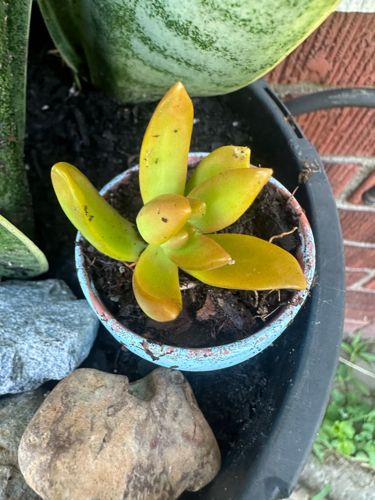
Given the appearance, it is likely a type of succulent, possibly from the genus Sedum (e.g., Sedum adolphi 'Golden Glow'), Graptosedum, or Pachyphytum, but it's hard to be certain without more specific features. The yellowish hue could be its natural coloration or a sign of stress.
A precise scientific name cannot be given without a clearer view of specific botanical features. However, based on its characteristics, it might be a species within the genus Sedum, Graptosedum, or possibly Pachyphytum. For example, it bears some resemblance to Sedum adolphi 'Golden Glow' but the color suggests it might be struggling or is a less common cultivar.
The plant in the image appears to be a succulent, characterized by thick, fleshy, obovate to spatulate leaves that are yellow-green, possibly indicating a need for more light or issues with watering or nutrients, as healthy specimens usually have more vibrant green colors, sometimes with red or orange tips when sun-stressed. The leaves are arranged in a rosette.
Learn more about Given the appearance, it is likely a type of succulent, possibly from the genus Sedum (e.g., Sedum adolphi 'Golden Glow'), Graptosedum, or Pachyphytum, but it's hard to be certain without more specific features. The yellowish hue could be its natural coloration or a sign of stress. in the encyclopedia →Care instructions
This succulent likely requires well-draining soil and plenty of sunlight (at least 6 hours of direct sun per day), as its yellowing might suggest insufficient light. Water thoroughly only when the soil is completely dry, typically every 2-4 weeks, depending on environmental conditions. Ensure the pot has drainage holes to prevent root rot. Protect from frost. Fertilize sparingly during the growing season with a diluted succulent fertilizer.