
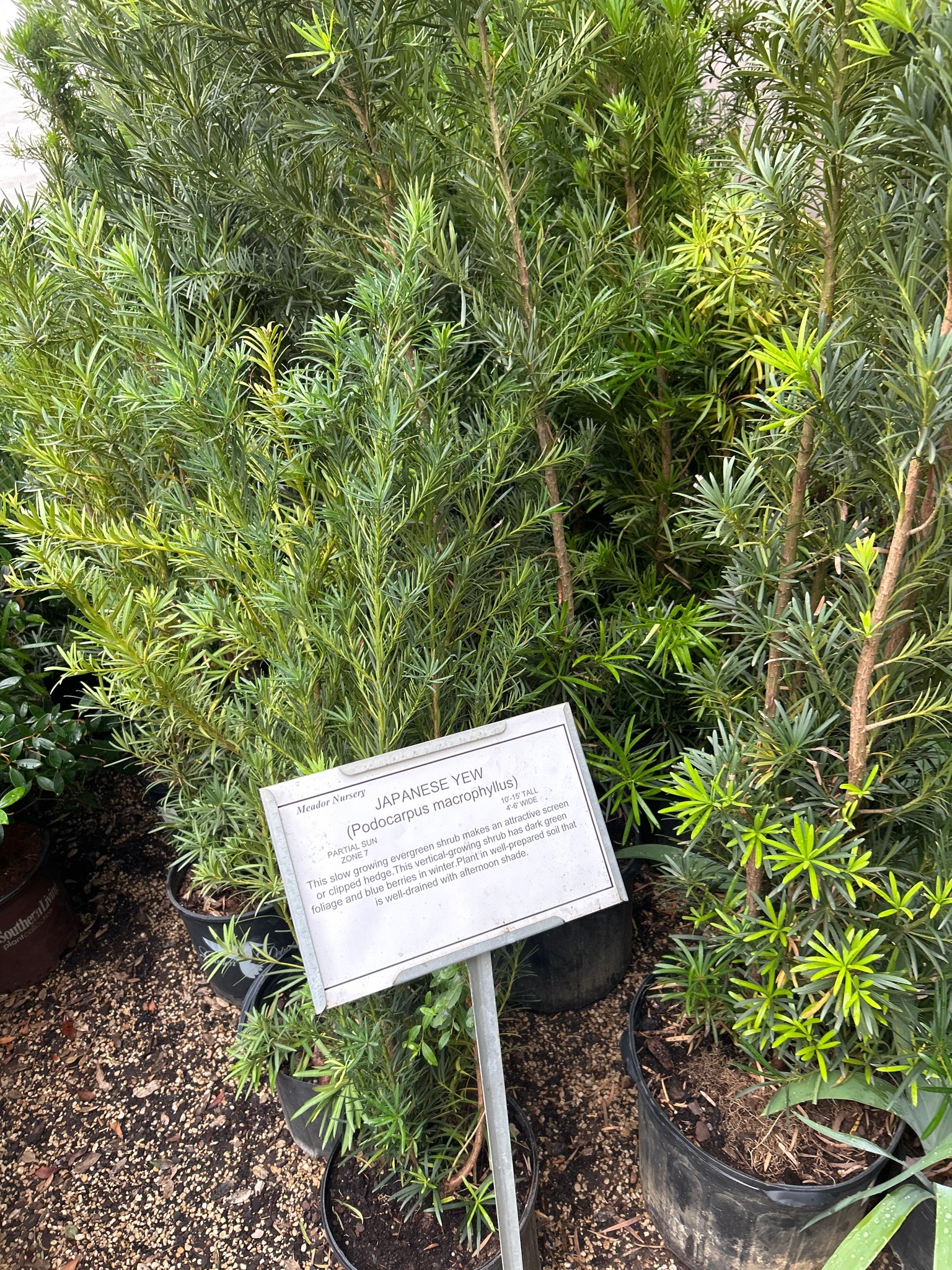
Japanese Yew / Buddhist Pine
Podocarpus macrophyllus
An evergreen conifer with dense, narrow, strap-like dark green leaves arranged spirally. It has a slow-growing, upright habit and is often used for screens or hedges.
- Light
- Full sun to partial shade (4-6+ hours of light). Afternoon shade is beneficial in very hot climates.
- Water
- Moderate watering; keep soil moist but not soggy. Once established, it is moderately drought-tolerant. Yellowing leaves can indicate overwatering.
- Growth
- Slow-growing evergreen perennial. In cultivation, it typically reaches 10-15 feet as a shrub, but can grow to 40 feet as a tree in the wild.
Care instructions
Thrives in partial sun with well-drained, fertile soil. Water regularly until established; fertilize in spring with a balanced evergreen food. Pruning is easily tolerated to maintain shape.
Growing details
Sunlight
Full sun to partial shade (4-6+ hours of light). Afternoon shade is beneficial in very hot climates.
Watering
Moderate watering; keep soil moist but not soggy. Once established, it is moderately drought-tolerant. Yellowing leaves can indicate overwatering.
Soil
Rich, slightly acidic, well-draining soil. Does not tolerate highly alkaline soils which may cause chlorosis.
Hardiness zone
USDA Zones 7 - 11; can tolerate some frost but not prolonged freezing.
Growth habit
Slow-growing evergreen perennial. In cultivation, it typically reaches 10-15 feet as a shrub, but can grow to 40 feet as a tree in the wild.
Bloom season
Non-flowering (Gymnosperm). Tiny male cones or female seeds with purple-blue fleshy bases appear in late spring/summer.
Propagation
Propagate by semi-hardwood cuttings in summer or by sowing seeds in late winter/early spring.
Common pests & issues
Susceptible to aphids, scale, and mealybugs. Root rot can occur in poorly drained soil; magnesium deficiency may cause needle browning.
Similar species
Taxus cuspidata (True Japanese Yew), which has shorter needles. Cephalotaxus harringtonia (Plum Yew) has broader, softer leaves.