
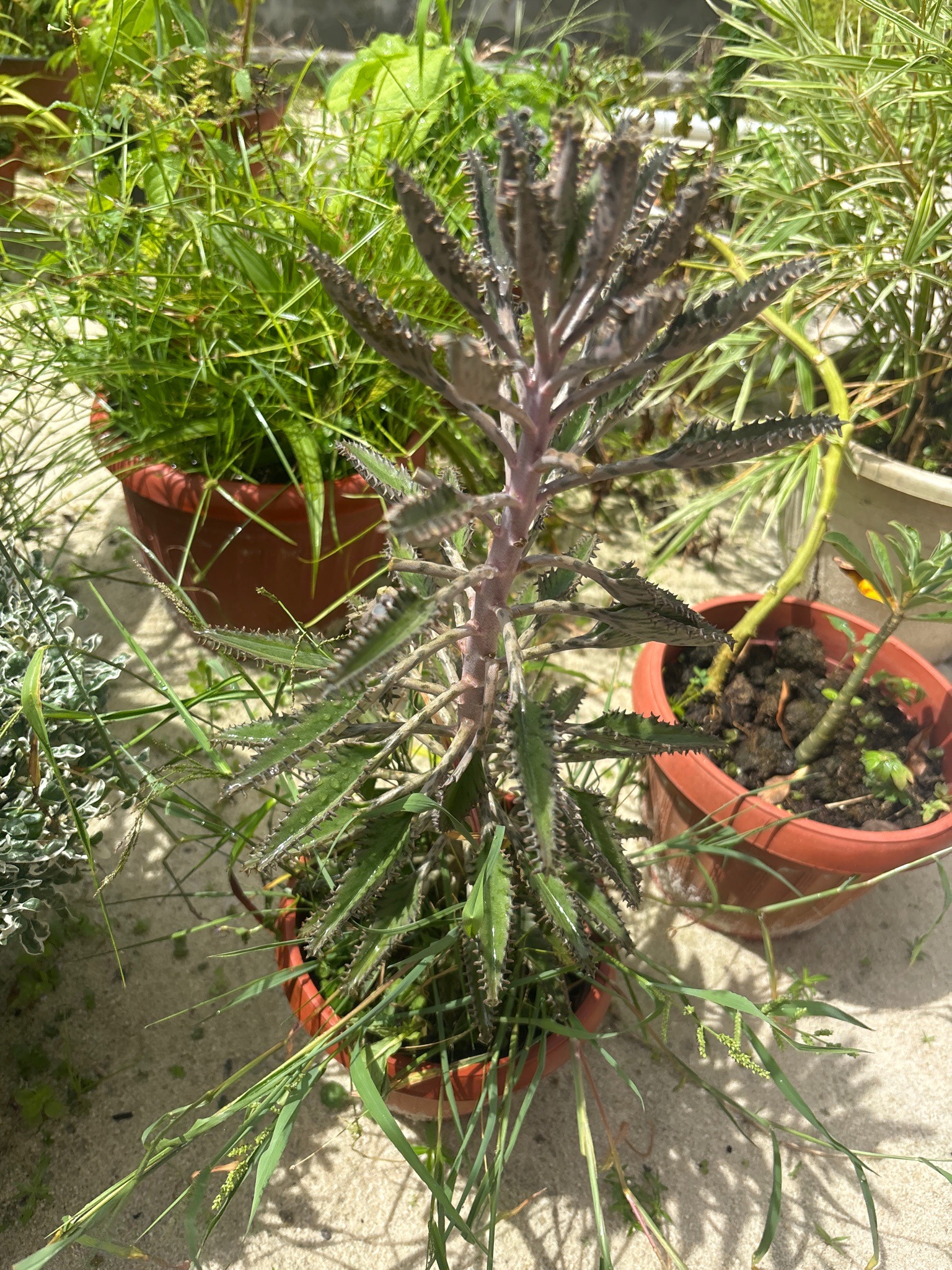
Mother of Thousands
Kalanchoe daigremontiana
A succulent perennial with upright stems and opposite, fleshy, lance-shaped leaves. It is most notable for the many tiny plantlets that grow along the serrated margins of its mottled, bluish-green leaves.
- Light
- Full sun to partial shade; prefers bright, direct light for 4-6 hours daily for best leaf coloration.
- Water
- Drought tolerant; water deeply once the soil has dried out entirely. Over-watering easily leads to root rot. Leaves may pucker slightly when the plant is thirsty.
- Growth
- Upright succulent perennial reaching 2 to 3 feet in height and 8 to 12 inches in width. It has a moderate to fast growth rate.
Care instructions
Provide bright, direct light for several hours a day and plant in a very well-draining succulent mix. Water only when the soil is completely dry, and reduce watering significantly during the winter months. Use a balanced fertilizer sparingly during the growing season.
Growing details
Sunlight
Full sun to partial shade; prefers bright, direct light for 4-6 hours daily for best leaf coloration.
Watering
Drought tolerant; water deeply once the soil has dried out entirely. Over-watering easily leads to root rot. Leaves may pucker slightly when the plant is thirsty.
Soil
Well-draining cactus or succulent potting mix with a slightly acidic to neutral pH (6.0 to 7.0).
Hardiness zone
USDA zones 9b to 11; not frost tolerant, must be moved indoors if temperatures drop below 40°F (4°C).
Growth habit
Upright succulent perennial reaching 2 to 3 feet in height and 8 to 12 inches in width. It has a moderate to fast growth rate.
Bloom season
Late autumn or winter; produces drooping, bell-shaped, pinkish-orange or greyish-purple flowers on a tall stalk, though it rarely blooms when kept indoors.
Propagation
Self-propagating via plantlets that fall from the leaf margins and take root in the soil below; can also be grown from stem cuttings.
Common pests & issues
Highly susceptible to root rot if soil is kept damp. Common pests include mealybugs and scale insects. It can become invasive in warm climates due to its prolific plantlets.
Similar species
Kalanchoe delagoensis (Mother of Millions), which has narrower, cylindrical leaves, whereas K. daigremontiana has broader, flatter leaves.