
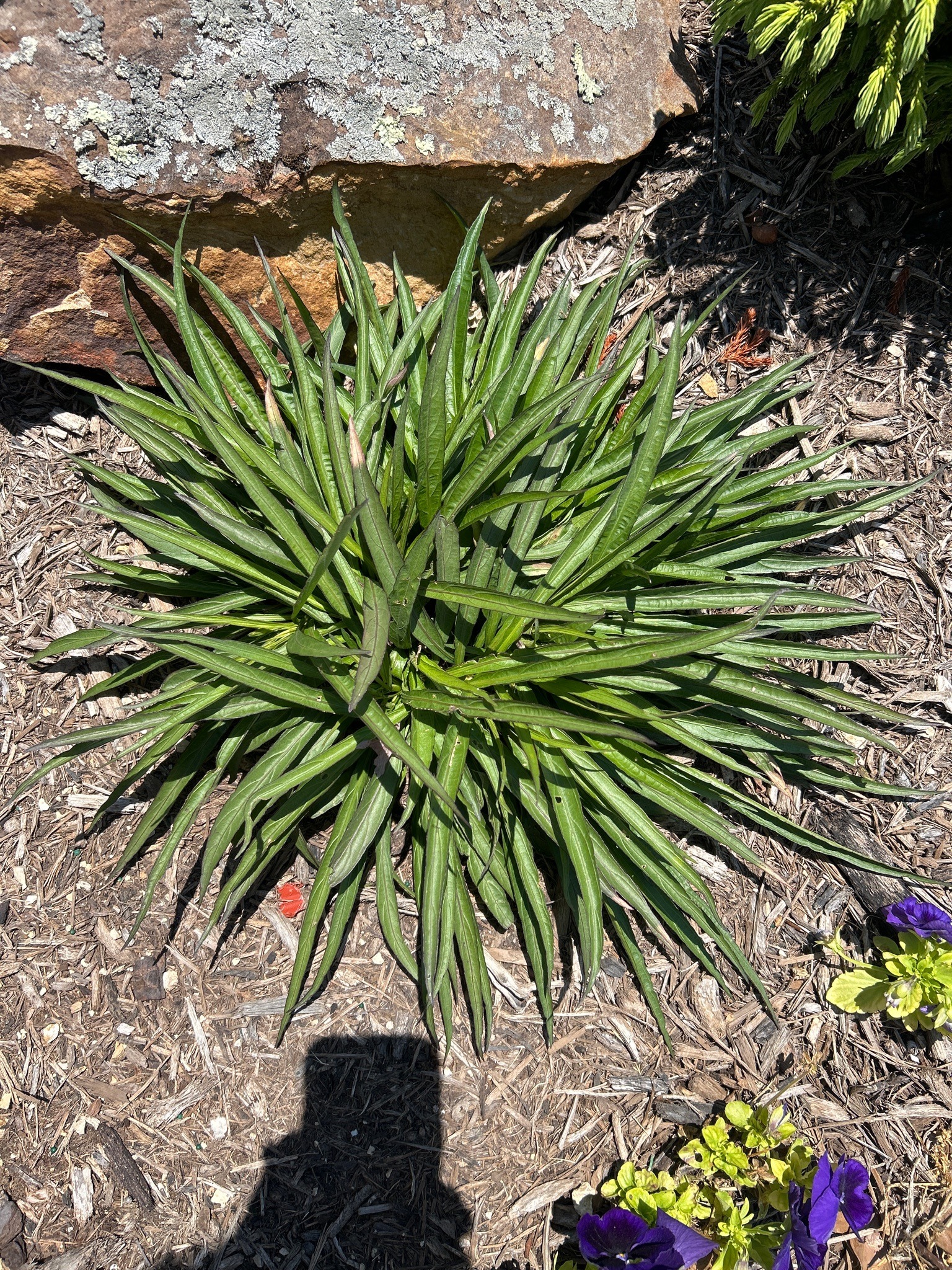
Purple Coneflower
Echinacea purpurea
A herbaceous perennial forming a dense basal rosette of lance-shaped, dark green leaves with prominent veins. While only leaves are visible here, it eventually produces tall stems topped with daisy-like flowers with reflexed purple petals and spiny orange-brown centers.
- Light
- Full sun (6+ hours per day) for best flowering, though it can tolerate partial shade.
- Water
- Medium to low. Water regularly during the first growing season. Once established, it is very drought-tolerant; only water during prolonged dry spells.
- Growth
- Clump-forming perennial. Reaches a mature height of 2-4 feet and a spread of 1.5-2 feet. Moderate growth rate.
Care instructions
Low-maintenance. Provide full sun and well-draining soil. Once established, they are drought-tolerant and require little fertilizer; a light application of compost in spring is sufficient.
Growing details
Sunlight
Full sun (6+ hours per day) for best flowering, though it can tolerate partial shade.
Watering
Medium to low. Water regularly during the first growing season. Once established, it is very drought-tolerant; only water during prolonged dry spells.
Soil
Prefers well-drained loamy soil but is adaptable to clay and rocky soils; pH 6.0 to 7.0.
Hardiness zone
3 to 8
Growth habit
Clump-forming perennial. Reaches a mature height of 2-4 feet and a spread of 1.5-2 feet. Moderate growth rate.
Bloom season
Mid-summer to early fall. Large, showy purple-pink ray florets around a conical, spiny central disk.
Propagation
Best propagated by seed (requires cold stratification) or by dividing established clumps in early spring or fall.
Common pests & issues
Generally pest-free, but may occasionally suffer from Japanese beetles or Aster Yellows (a viral-like disease that causes stunted, green growth). Avoid overwatering to prevent root rot.
Similar species
Echinacea angustifolia (shorter with narrower leaves) and Rudbeckia hirta (Black-eyed Susan, which has hairier leaves and yellow flowers).