
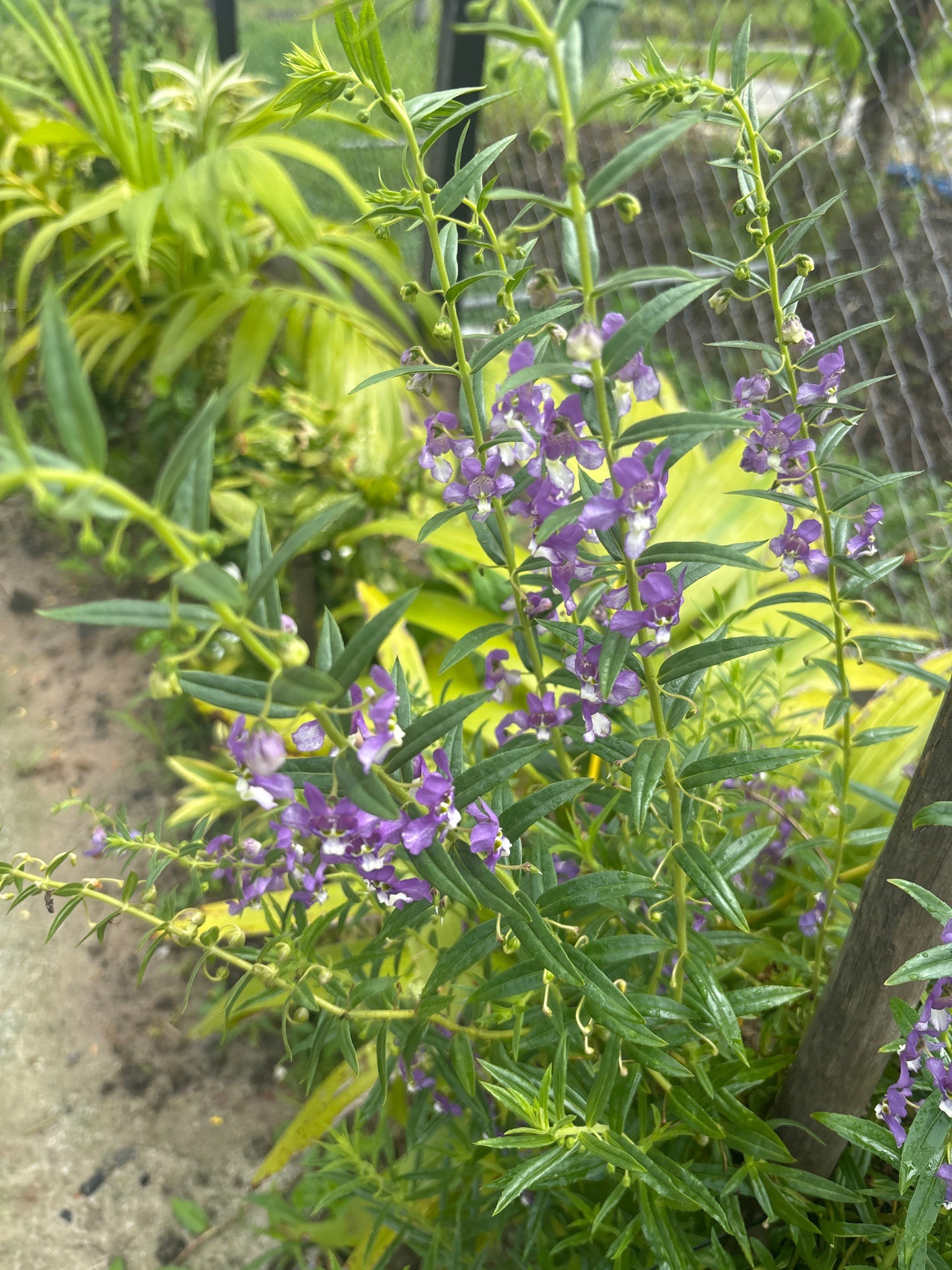
Summer Snapdragon
Angelonia angustifolia
A popular herbaceous perennial or annual characterized by upright stems, narrow willow-like green leaves, and snapdragon-like flowers that bloom in clusters along the top of the plant.
- Light
- Full sun, requiring at least 6 to 8 hours of direct light per day for optimal flowering.
- Water
- Moderate watering; keep the soil consistently moist but not waterlogged while the plant is young. Once established, it is quite drought tolerant, but blooms better with regular moisture.
- Growth
- Herbaceous perennial reaching 12 to 18 inches in height and 12 inches in spread with an upright, mounding growth rate.
Care instructions
Requires full sun and well-draining soil. Water regularly while establishing, then moderately once mature as it is heat and drought tolerant. Feed monthly with a balanced liquid fertilizer during the growing season.
Growing details
Sunlight
Full sun, requiring at least 6 to 8 hours of direct light per day for optimal flowering.
Watering
Moderate watering; keep the soil consistently moist but not waterlogged while the plant is young. Once established, it is quite drought tolerant, but blooms better with regular moisture.
Soil
Prefers fertile, well-draining loamy or sandy soil with a slightly acidic to neutral pH (5.5 to 7.0).
Hardiness zone
USDA zones 9-11 as a perennial; grown as an annual in cooler climates.
Growth habit
Herbaceous perennial reaching 12 to 18 inches in height and 12 inches in spread with an upright, mounding growth rate.
Bloom season
Late spring through fall; flowers are orchid-like in shape, appearing in shades of purple, pink, white, or blue along terminal racemes.
Propagation
Propagated via softwood cuttings in spring or summer, or by seed started indoors 6-8 weeks before the last frost.
Common pests & issues
Susceptible to aphids and spider mites in dry conditions; powderly mildew can occur if air circulation is poor or if foliage remains wet.
Similar species
Antirrhinum majus (Common Snapdragon), which has larger, tubular flowers that require 'pinching' to snap open, and Torenia (Wishbone Flower), which prefer more shade and have different flower structures.