
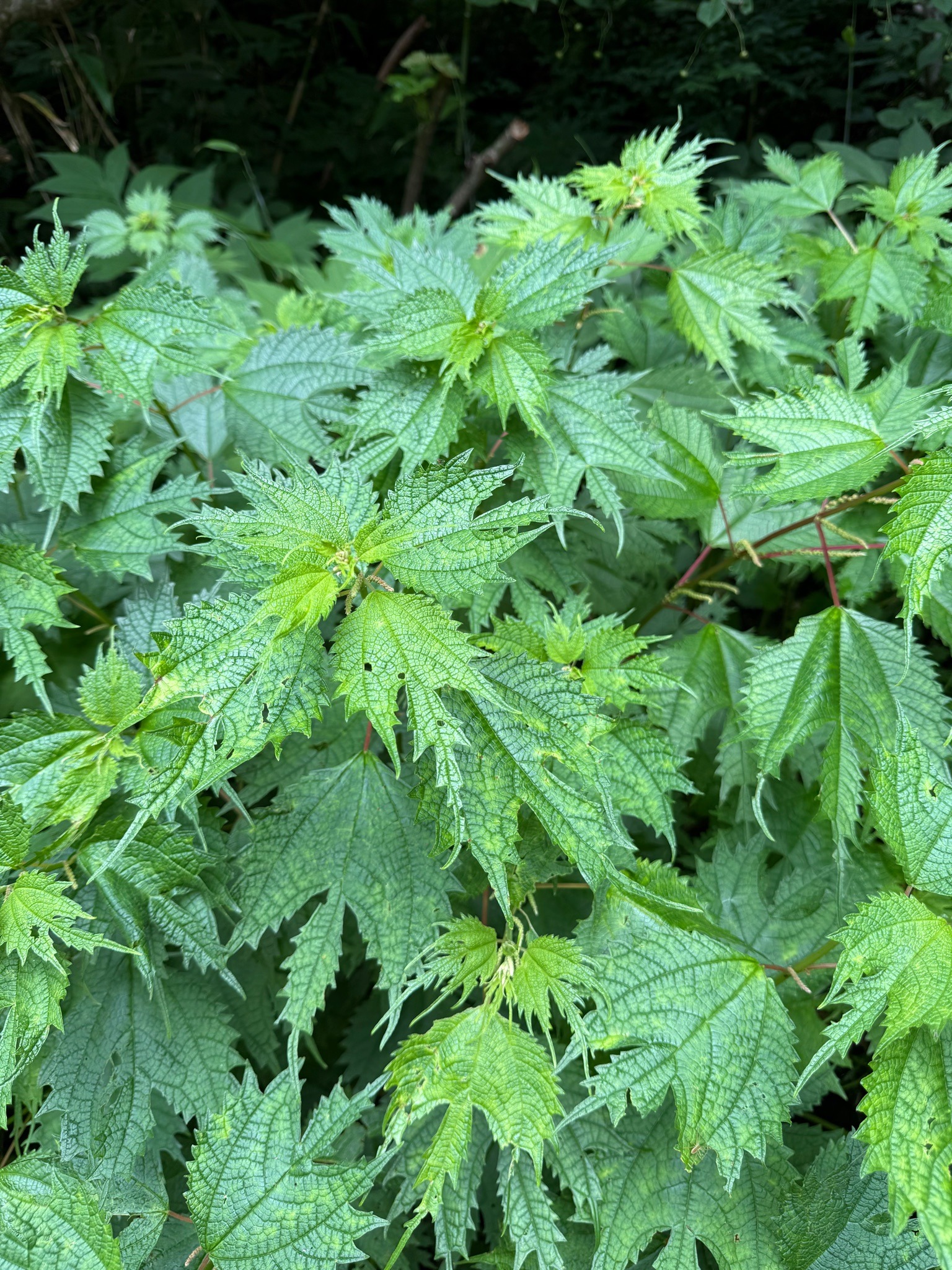
Wood Nettle
Laportea canadensis
A herbaceous perennial found in moist forest settings. It features alternate, ovate to heart-shaped leaves with deeply serrated margins and prominent veining. The plant is covered in fine, needle-like hairs along the stems and leaves.
- Light
- Partial shade to full shade; approximately 2-4 hours of indirect light per day.
- Water
- High; prefers consistently moist to wet soil. It is not drought-tolerant and will wilt if the soil dries out completely.
- Growth
- Perennial herb growing in colonies via rhizomes; reaches 2-4 feet in height with a similar spread.
Care instructions
This plant thrives in shady, wooded environments with consistent moisture. It requires minimal fertilization if grown in rich forest loam. Best positioned in a naturalized area where it can spread undisturbed.
Growing details
Sunlight
Partial shade to full shade; approximately 2-4 hours of indirect light per day.
Watering
High; prefers consistently moist to wet soil. It is not drought-tolerant and will wilt if the soil dries out completely.
Soil
Rich, loamy, organic soil with a slightly acidic to neutral pH (6.0-7.0) and high moisture retention.
Hardiness zone
3-9
Growth habit
Perennial herb growing in colonies via rhizomes; reaches 2-4 feet in height with a similar spread.
Bloom season
Mid-summer to early fall; features small, inconspicuous greenish-white flower clusters in the leaf axils.
Propagation
Propagated via seed sown in autumn or by dividing the creeping rhizomes during the dormant season in early spring.
Common pests & issues
Subject to browsing by deer. It can be aggressive in optimal conditions, spreading widely through its root system and self-seeding.
Similar species
Urtica dioica (Stinging Nettle), which has opposite leaves, whereas Laportea canadensis (Wood Nettle) has alternate leaves.