
African Tulip Tree Identification Guide
How to identify the African Tulip Tree by its flame-orange tulip-shaped flowers, velvety brown buds, and large pinnate glossy leaves.
Read the full African Tulip Tree encyclopedia entry →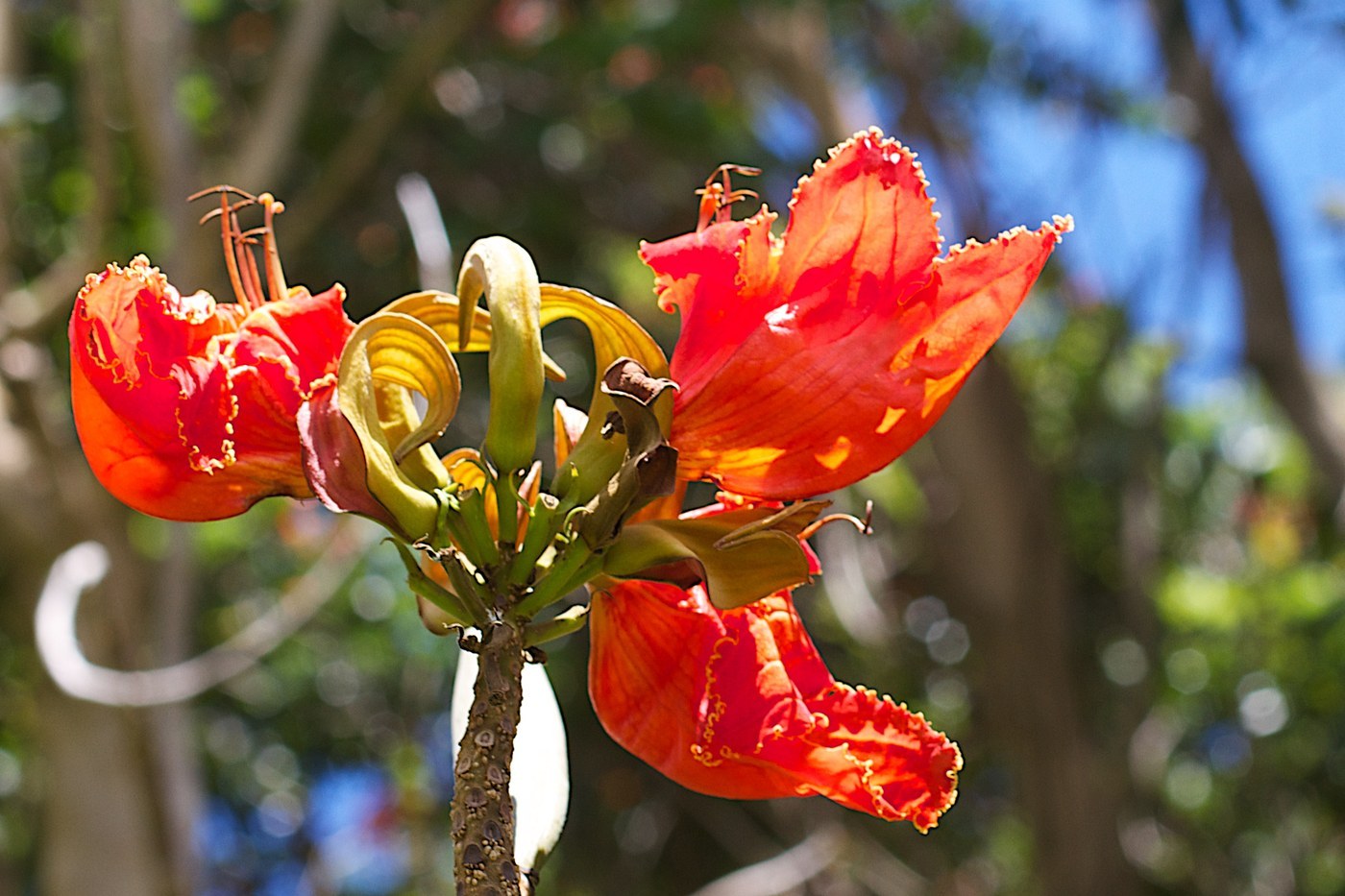
Key Identifying Features
The African Tulip Tree (Spathodea campanulata) is a striking tropical tree topped with clusters of brilliant orange-red, tulip- or cup-shaped flowers. Its bold blooms and large glossy leaves make it unmistakable in the tropics.
- Flame-orange to scarlet, cup-shaped flowers in dense terminal clusters
- Curved, velvety brown flower buds filled with water
- Large pinnate (compound) leaves with glossy leaflets
- Fast-growing evergreen tree, 7-25 m tall, with a rounded dense crown
Leaves & Stems
Leaves are opposite and pinnately compound, 30-50 cm long, each bearing 9-17 leaflets. Individual leaflets are oval, 5-15 cm long, glossy dark green, with smooth margins and a pointed tip. Young leaflets and shoots may be slightly hairy. The foliage is dense and gives the tree a lush, leafy crown.
The trunk is straight with smooth to slightly fissured pale gray-brown bark. Wood is soft and brittle, so branches break easily in storms. The tree is evergreen in wet climates and briefly deciduous in drier seasons.
Flowers & Fruit
- Flowers form rounded clusters at branch tips. The outer buds open first into a ring while the center buds remain closed. Each open flower is a 5-10 cm wide bell or tulip shape, orange-red to scarlet with a crinkled yellow margin. The unopened buds are banana-shaped, brown, and velvety, holding water that squirts when squeezed — a classic identifying party trick.
- Fruit is a boat-shaped woody capsule 15-25 cm long, held upright, splitting open to release many flat, papery, transparent-winged seeds that scatter on the wind.
How to Tell It Apart from Look-Alikes
- Royal Poinciana (Delonix regia) also has orange-red flowers but they are flat, spreading, with separate petals and fern-like bipinnate leaves — very different from the African Tulip's cupped flowers and broad pinnate leaflets.
- Flame of the Forest (Butea) has clawed orange flowers and trifoliate leaves.
- The combination of velvety water-filled curved buds + cup-shaped scarlet flowers + upright boat-like pods is unique to Spathodea.
Where You'll Find It
Native to tropical West and Central Africa, it is now planted pantropically as an ornamental and is naturalized (and invasive) in Hawaii, the Pacific Islands, and parts of the Caribbean and Australia. Look for it in tropical gardens, parks, and roadsides at low to middle elevations where there is no frost.
Quick ID Checklist
- Cup/tulip-shaped orange-red flowers in rounded terminal clusters
- Curved, velvety brown buds that squirt water when pressed
- Pinnate leaves with 9-17 glossy oval leaflets
- Upright boat-shaped woody seed pods with winged seeds
- Fast-growing tropical tree with dense rounded crown
Frequently asked questions
Why do the flower buds squirt water?
The unopened buds hold a watery sap reservoir. Squeezing a bud releases a jet of liquid, a well-known feature that helps confirm identification and gives the tree the nickname 'fountain tree.'
Is the African Tulip Tree invasive?
Yes, in many tropical regions. Its lightweight winged seeds spread widely and it grows fast, so it is listed as invasive in Hawaii, parts of the Pacific, and other tropical areas where it crowds out native plants.
How is it different from a Royal Poinciana?
Both have orange flowers, but the African Tulip Tree has cup-shaped flowers and large pinnate leaves with broad leaflets, while the Royal Poinciana has flat spreading flowers and delicate fern-like bipinnate foliage.
Does it flower year-round?
In wet tropical climates it can flower nearly continuously, with peak blooming in the warm season. The persistent clusters of orange flowers make it easy to spot at almost any time of year.