
African Violet Identification Guide
Identify the African Violet (Saintpaulia/Streptocarpus ionanthus) by its fuzzy rosette of rounded leaves and clusters of velvety five-petaled flowers.
Read the full African Violet encyclopedia entry →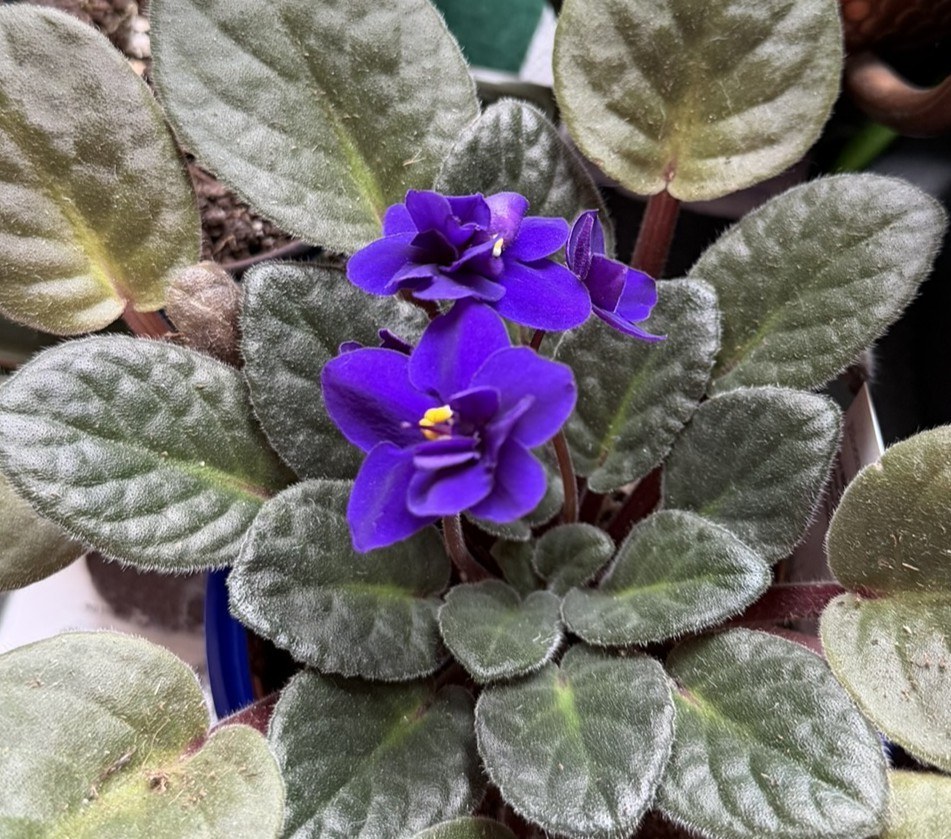
Key Identifying Features
The African Violet (Saintpaulia, now classified in Streptocarpus) is a small, low-growing houseplant famous for blooming nearly year-round. It forms a flat rosette of fuzzy, rounded leaves topped by clusters of velvety violet, purple, pink, or white flowers.
- Compact rosette habit, usually under 15 cm (6 in) across
- Leaves are thick, hairy, and rounded with a quilted texture
- Flowers have five petals and a soft, velvety surface
Leaves & Stems
The foliage is a reliable ID even when the plant is not blooming:
- Leaves are oval to nearly round, 3-8 cm long, with a slightly scalloped or heart-shaped base
- Surface is densely covered in fine hairs, giving a fuzzy, soft feel
- Color is medium to dark green on top, often purple-tinged underneath
- Leaves grow on short, succulent, hairy stalks radiating from a central crown — the plant is essentially stemless, hugging the soil
Flowers & Fruit
Flowers are the showcase feature:
- Borne in small clusters on slender stalks rising just above the leaves
- Each bloom has five rounded petals (two upper, three lower) and may be single, double, or ruffled
- Colors span violet-blue, purple, pink, magenta, white, and bicolors
- Bright yellow anthers form an eye at the center
- Capable of blooming continuously in good light; fruit is a small capsule, rarely seen indoors
How to Tell It Apart from Look-Alikes
- True violets (Viola): are unrelated garden/wild plants with smooth, not fuzzy, leaves and spurred flowers.
- Gloxinia and Streptocarpus relatives: are larger gesneriads; African Violets are smaller, rosette-forming, and far fuzzier.
- The combination of a tight fuzzy rosette + velvety five-petaled clustered flowers + stemless habit is uniquely African Violet.
Where You'll Find It
The African Violet is one of the world's most popular flowering houseplants, grown on windowsills and under grow lights by enthusiasts. Its wild ancestors grow in the misty mountain forests of Tanzania and Kenya (the Eastern Arc Mountains), clinging to shaded, humid rock faces.
Quick ID Checklist
- Flat rosette of leaves, mostly stemless
- Fuzzy, rounded, quilted leaves, often purple beneath
- Five-petaled velvety flowers in clusters
- Colors: violet, purple, pink, white
- Compact size, blooms year-round indoors
A fuzzy little rosette covered in velvety purple blooms is the textbook African Violet.
Frequently asked questions
Is the African Violet related to true violets?
No. Despite the name, it is not a Viola at all but a gesneriad, now placed in the genus Streptocarpus. The fuzzy rosette and five-petaled velvety flowers distinguish it from true violets, which have smooth leaves.
Why are the leaves so fuzzy?
African Violet leaves are densely covered in fine hairs, an adaptation from their misty African mountain habitat. This soft, fuzzy texture combined with the rounded, quilted leaf shape is a key ID feature.
How can I identify it when it is not flowering?
Look for the flat, stemless rosette of thick, hairy, rounded leaves that are often purple-tinged on the underside. This distinctive foliage identifies the plant even without blooms.
What do the flowers look like up close?
Each flower has five velvety petals arranged as two upper and three lower lobes, with bright yellow anthers at the center, and they appear in small clusters on slender stalks above the leaves.