
Agrimony Identification Guide
Recognize common agrimony (Agrimonia eupatoria) by its toothed, interrupted-pinnate leaves, tall slender spike of small yellow flowers, and hooked burr seeds.
Read the full Agrimony encyclopedia entry →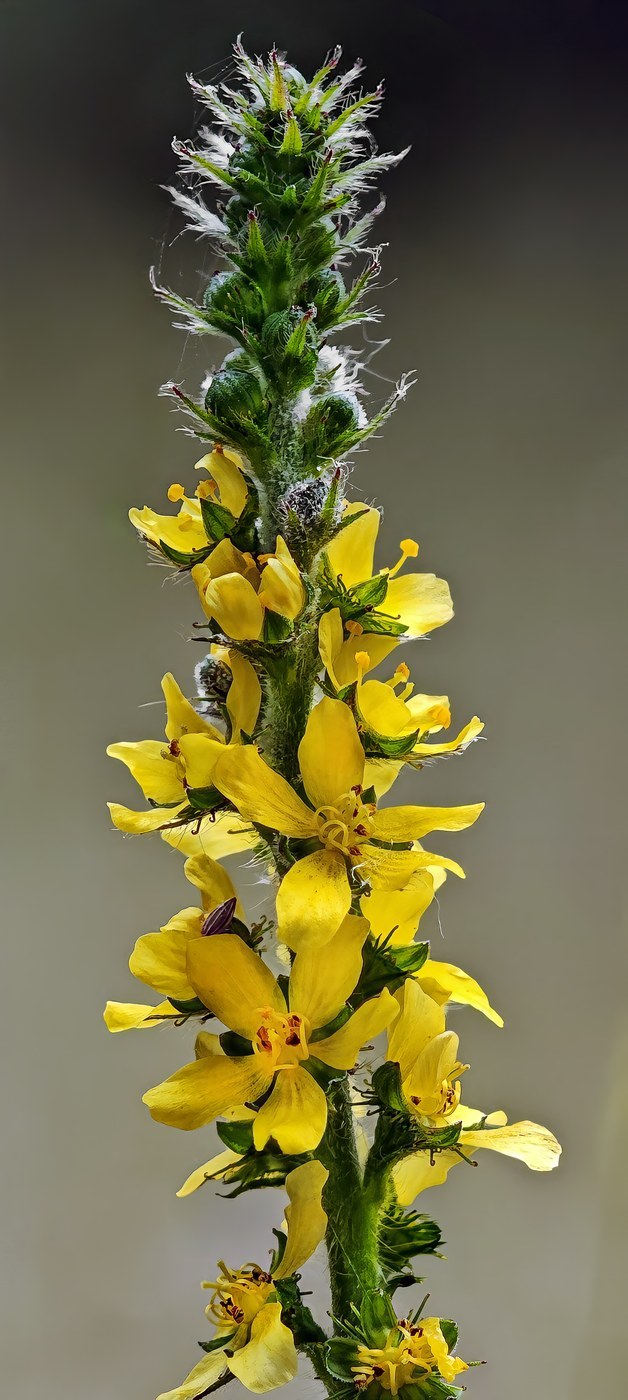
Key Identifying Features
Common agrimony (Agrimonia eupatoria) is an upright perennial of the rose family identified by its slender, tapering spike of small yellow flowers above pinnate, sharply toothed leaves, followed by clinging, bristly burr-shaped seed pods. The whole plant is softly hairy and faintly apricot-scented.
- Single, mostly unbranched stems 1-2 ft (30-60 cm) or taller
- Soft hairs throughout
- Distinctive interrupted pinnate leaf pattern
Leaves & Stems
Leaves are pinnate (feather-like), made of 3-6 pairs of larger leaflets with smaller leaflets interspersed between them - the 'interrupted' pattern that is a key clue. Each leaflet is oblong, deeply saw-toothed, dark green above and grayish-hairy beneath. Leaves cluster toward the base and lower stem, becoming smaller upward. Stems are round, reddish, and covered in soft and bristly hairs. There are small leafy stipules at the leaf bases.
Flowers & Fruit
From early to late summer, agrimony bears a long, narrow, tapering flower spike with small yellow 5-petaled flowers about 1/4-1/2 in (5-8 mm) across opening from the bottom upward. The flowers are widely spaced near the top. After flowering, each forms a distinctive top- or bell-shaped fruit (hypanthium) ringed with rows of hooked bristles. These burrs cling to clothing and animal fur, and their grooved, spiny shape is one of the most reliable identification features.
How to Tell It Apart from Look-Alikes
- Fragrant agrimony (Agrimonia procera): Very similar but larger, more strongly scented, with the fruit bristles not deeply furrowed and spreading rather than erect.
- Wood avens / herb bennet (Geum urbanum): Also yellow rose-family flowers with hooked seeds, but flowers are solitary, not in a long spike, and leaves differ.
- Great burnet or salad burnet: Pinnate leaves but very different flower heads.
- The combination of an erect yellow flower spike, interrupted-pinnate toothed leaves, and grooved hooked burrs is diagnostic.
Where You'll Find It
Agrimony grows in grasslands, hedge banks, roadside verges, field margins, woodland edges, and rough pastures, favoring well-drained, often calcareous soils in sun. It is native across Europe and widely naturalized.
Quick ID Checklist
- Interrupted pinnate leaves with large and small leaflets alternating
- Leaflets sharply saw-toothed, hairy beneath
- Long, slender, tapering spike of small yellow 5-petaled flowers
- Grooved, hook-bristled burr fruits that cling
- Softly hairy, faint apricot scent
- Grassy banks and verges in summer
Frequently asked questions
What is the most reliable way to identify agrimony?
Combine the slender tapering spike of small yellow flowers with interrupted-pinnate, sharply toothed leaves and, after flowering, the grooved burr-like fruits ringed with hooked bristles.
What does 'interrupted pinnate' mean for agrimony leaves?
It means the leaf has pairs of large leaflets with smaller leaflets inserted in the gaps between them, giving an irregular feathery pattern that helps distinguish agrimony.
Why do agrimony seeds stick to clothing?
The bell-shaped fruits are ringed with hooked bristles that catch on fabric and fur, dispersing the seeds - similar to small burrs.
How do I tell common agrimony from fragrant agrimony?
Fragrant agrimony is larger and more strongly sweet-scented, and its fruit bristles are not deeply grooved and spread outward rather than standing erect.