
Amaranth Identification Guide
Identify amaranth (Amaranthus) by its upright stems, alternate veined leaves, and dense tassels or plumes of tiny chaffy flowers.
Read the full Amaranth encyclopedia entry →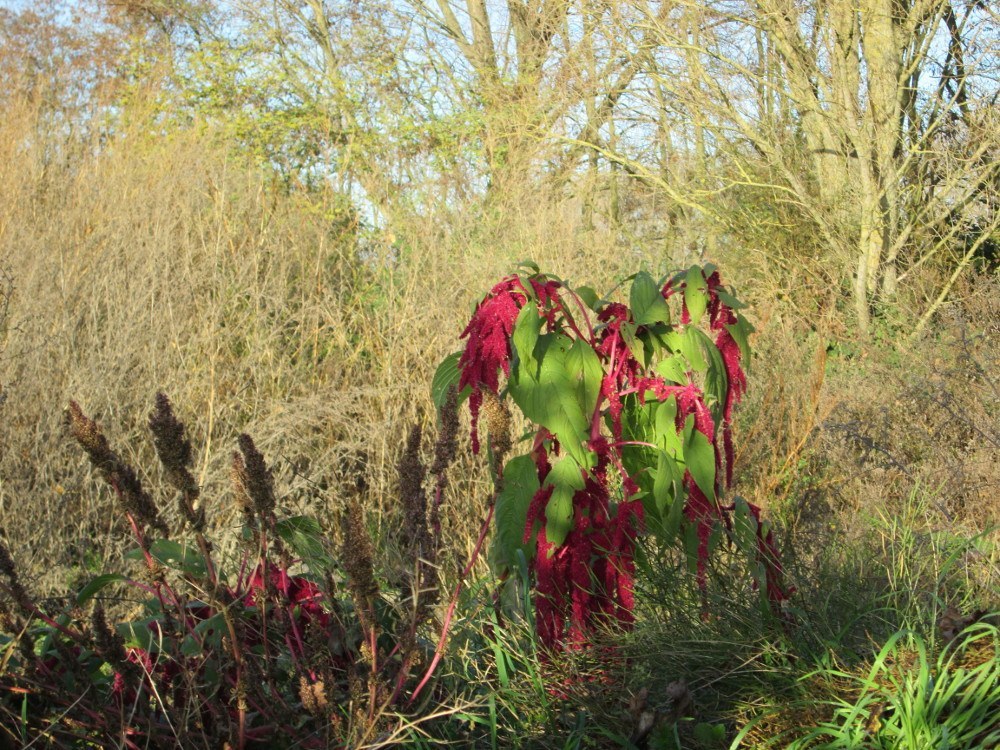
Key Identifying Features
Amaranth (genus Amaranthus) covers a wide group of annual herbs grown as grain crops and ornamentals, plus several common weeds. The unifying traits are dense clusters of tiny, chaffy flowers packed into spikes, tassels, or plumes, and alternate, simple leaves on usually stout, often reddish stems. Ornamental types like A. caudatus (love-lies-bleeding) and A. cruentus are dramatic, while weedy pigweeds (A. retroflexus, A. palmeri) are coarser.
- Upright to bushy annual, ranging from 1 to 6+ feet
- Tiny flowers in dense spikes, ropes, or feathery plumes
- Leaves alternate, oval to diamond-shaped, prominently veined
- Stems frequently flushed red, pink, or burgundy
Leaves & Stems
Leaves are alternate, simple, and entire (untoothed or barely wavy), oval to lance- or diamond-shaped, with a pointed tip and a long stalk (petiole). Veins are conspicuous on the underside, often tinged red or purple. Many varieties have green leaves splashed with red, bronze, or magenta. Stems are erect, ridged or grooved, sometimes hairy near the top, and commonly reddish. Crushed foliage has a mild, beet-like smell.
Flowers & Fruit
Flowers are minute and lack showy petals; each is subtended by small bristly or papery bracts that give flower clusters a rough, chaffy feel. Inflorescences vary from drooping tassels (love-lies-bleeding) to upright crimson plumes or branched green-to-red spikes. Fruit is a tiny capsule holding a single small, shiny lens-shaped seed, ranging from pale (grain types) to black.
How to Tell It Apart from Look-Alikes
- Celosia (cockscomb) has glossier, brighter, velvety flower heads and is related but more uniform in color; amaranth clusters feel chaffier.
- Lamb's quarters (Chenopodium) has a whitish, mealy coating on young leaves and a more diamond-shaped, toothed leaf; amaranth leaves are usually not mealy.
- Pigweed amaranths are distinguished from each other by spine presence (A. spinosus has paired leaf-axil spines) and spike density.
Where You'll Find It
Amaranths grow worldwide in gardens, farm fields, and disturbed ground. Ornamental and grain types appear in sunny beds and vegetable plots; weedy species colonize roadsides, cultivated fields, and waste areas in warm seasons. They tolerate heat and poor soil and grow rapidly.
Quick ID Checklist
- Upright annual with alternate, oval to diamond leaves
- Tiny chaffy flowers in spikes, tassels, or plumes
- Stems and veins often reddish or purple
- Small, shiny lens-shaped seeds
- Fast-growing in warm, sunny, disturbed sites
When you find a vigorous summer annual topped with dense, chaffy flower clusters and reddish stems, you are looking at an amaranth.
Frequently asked questions
Is amaranth the same as pigweed?
Pigweeds are weedy species of Amaranthus, so they are amaranths, but ornamental and grain amaranths are different cultivated species in the same genus selected for color, plumes, or seed.
How do I tell amaranth from celosia?
Celosia flower heads are brighter, glossier, and velvety, while amaranth clusters are chaffier and bristly; both are related but amaranth seeds are tiny shiny lenses.
Why are the stems red?
Many amaranths produce red and purple pigments (betalains) in stems, veins, and leaves, which is a normal and useful identifying trait rather than a sign of stress.
Why do some amaranths droop and others stand upright?
Inflorescence shape varies by species: love-lies-bleeding (A. caudatus) has long drooping rope-like tassels, while other types form upright crimson plumes or branched green-to-red spikes.