
American Holly Identification Guide
How to recognize American Holly (Ilex opaca) by its stiff spine-tipped evergreen leaves, gray bark, and bright red winter berries.
Read the full American Holly encyclopedia entry →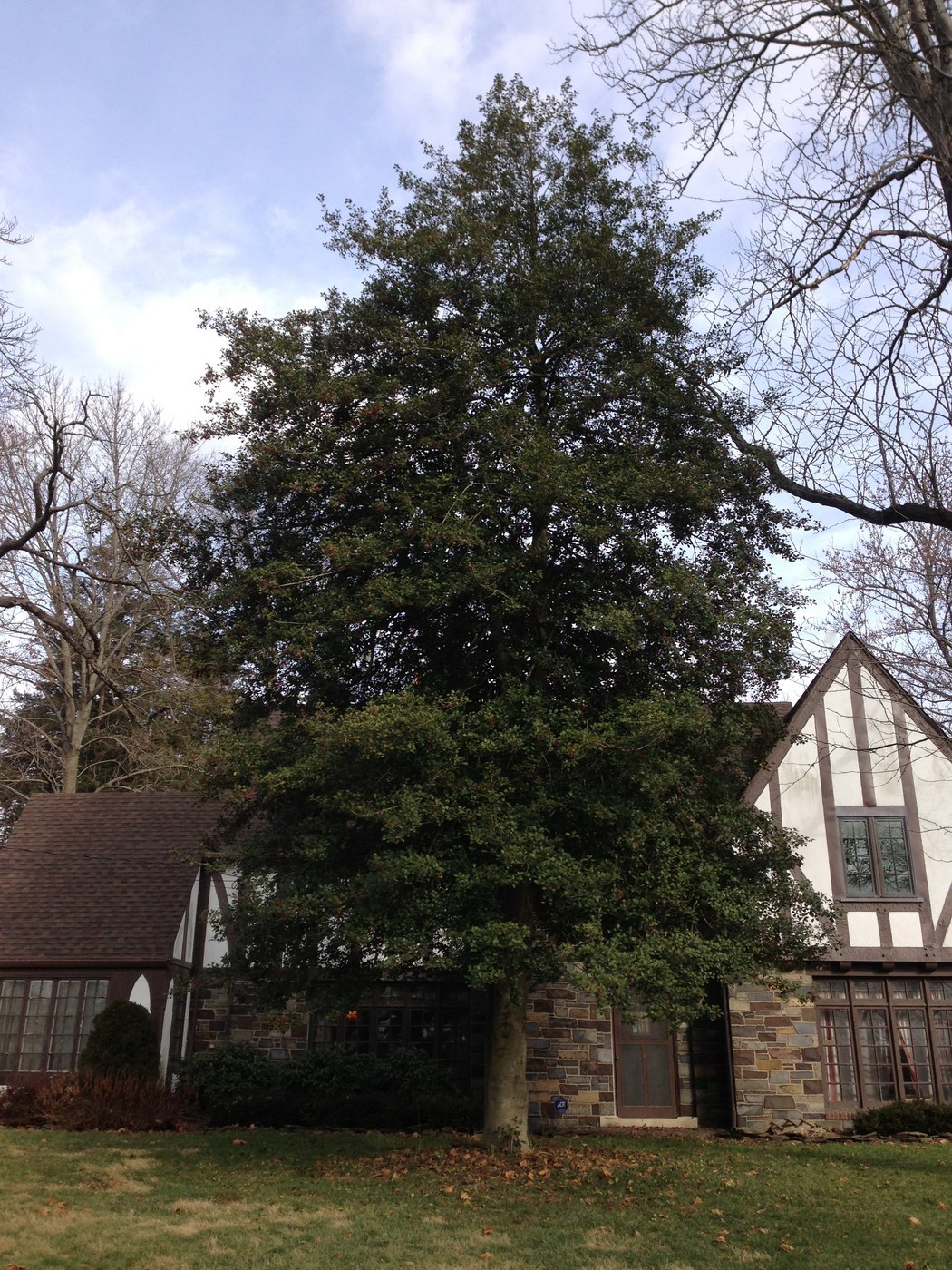
Key Identifying Features
American Holly (Ilex opaca) is a slow-growing evergreen tree of the eastern and southeastern United States, typically 30-50 ft tall with a narrow, pyramidal crown. Look for the classic combination of stiff, spiny-edged evergreen leaves and (on female trees) bright red berries clustered along the twigs in fall and winter.
- Evergreen, leathery leaves with sharp marginal spines
- Smooth, light gray bark that stays relatively unbroken with age
- Dense, conical or pyramidal habit when grown in the open
- Dull (matte) leaf surface, not glossy
Leaves & Stems
Leaves are alternate, 2-4 inches long, oval to elliptical, and thick/leathery. The margins bear several stout, spine-tipped teeth, though leaves higher in the crown may be nearly smooth-edged. A key trait separating it from English holly is the leaf surface: Ilex opaca leaves are dull olive-green and matte, not shiny. The undersides are paler yellow-green. Young twigs are green and finely hairy, becoming brown.
Flowers & Fruit
Holly is dioecious — male and female flowers grow on separate trees, so only female plants bear fruit. Small, greenish-white, 4-petaled flowers appear in late spring. Female trees develop bright red, pea-sized berries (drupes) that ripen in fall and persist through winter, an important wildlife food. Berries grow singly or in small clusters on short stalks. Yellow-fruited forms exist but are uncommon.
How to Tell It Apart from Look-Alikes
- English Holly (Ilex aquifolium): leaves are glossy and dark, often with wavier, more aggressively spined margins. American Holly leaves are matte.
- Yaupon Holly (Ilex vomitoria): much smaller leaves (under 1.5 in) with rounded, scalloped teeth and no spines.
- Oregon Grape (Mahonia): superficially spiny leaflets but they are compound and produce blue, not red, fruit.
- Live Oak: evergreen but leaves lack spines and bear acorns, not berries.
The matte leaf, gray bark, and single-tree (dioecious) red berries reliably point to American Holly.
Where You'll Find It
Native from Massachusetts south to Florida and west to Texas. It favors moist, well-drained, acidic soils in understory and forest-edge habitats, including bottomlands, coastal plains, and mixed hardwood forests. It is shade-tolerant and frequently planted as an ornamental and seasonal greenery source.
Quick ID Checklist
- Evergreen tree, narrow pyramidal shape
- Matte (not glossy) leathery leaves with spiny teeth
- Smooth light gray bark
- Bright red berries on female trees in winter
- Eastern/southeastern US woodlands
If the leaf is dull green with spines and the bark is smooth gray, you almost certainly have American Holly.
Frequently asked questions
How do I tell American Holly from English Holly?
American Holly leaves are dull and matte olive-green, while English Holly leaves are dark and very glossy. American Holly also has a more open, pyramidal form and slightly less aggressively spined leaves.
Why doesn't my holly have berries?
Holly is dioecious, meaning male and female flowers grow on separate trees. Only female trees produce berries, and they need a male tree nearby for pollination.
Is American Holly evergreen?
Yes. It keeps its leathery, spiny leaves year-round, dropping older leaves gradually rather than all at once.
How is American Holly different from Yaupon Holly?
Yaupon holly has much smaller leaves (under 1.5 inches) with rounded, scalloped teeth and no spines, while American holly has larger leaves with sharp marginal spines.