
American Sycamore Identification Guide
Identify American sycamore (Platanus occidentalis) by its mottled, peeling camouflage bark with white upper trunk, large maple-like leaves, and dangling round seed balls.
Read the full American Sycamore encyclopedia entry →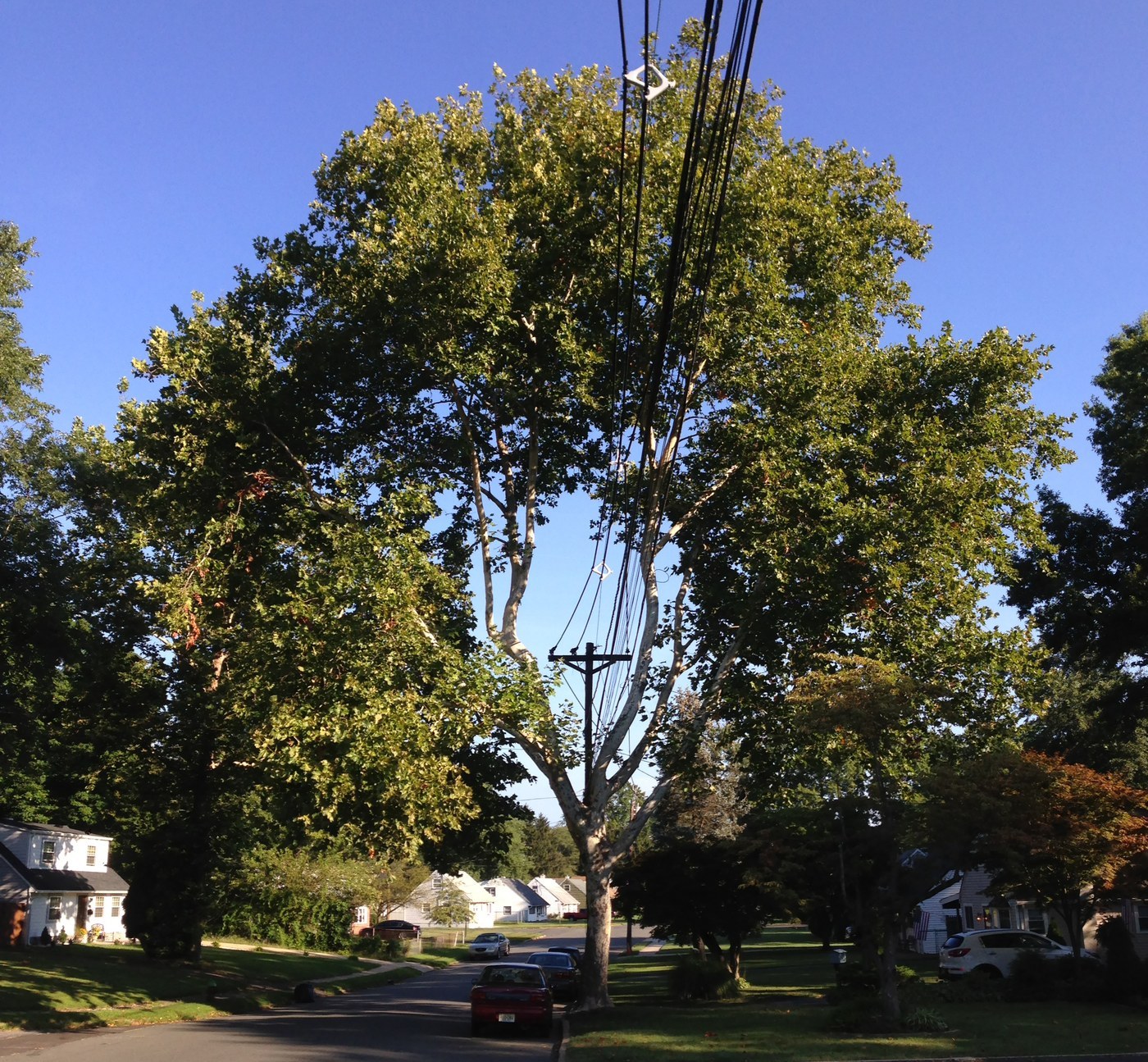
Key Identifying Features
American sycamore (Platanus occidentalis) is one of the most massive trees of eastern North America, instantly known by its patchwork, peeling bark that flakes off in puzzle-like pieces to reveal a smooth, creamy-white to greenish upper trunk. Add very large, maple-like leaves and hanging round seed balls and the ID is straightforward.
- Huge tree, often 75-100 ft (23-30 m) or more, with a massive trunk
- Mottled camouflage bark, white and smooth high up
- Round, ball-shaped seed clusters dangling from twigs
Leaves & Stems
Leaves are broad and palmate, 4-9 in across, with 3-5 shallow, pointed lobes and coarse teeth - superficially maple-like, but arranged alternately, not opposite (a key distinction from maples). The leaf base is broad and the underside is paler with fuzz when young. The leaf stalk base is hollow and encloses the next year's bud - a unique sycamore trait. Twigs zigzag slightly. At leaf bases there are conspicuous leafy stipules ringing the twig.
Flowers & Fruit
Flowers appear in spring as small, dense, rounded heads. The distinctive fruit is a solitary, spherical seed ball about 1 in (2.5 cm) across hanging on a long stalk - usually one ball per stalk in American sycamore. These persist through winter and break apart in spring into fluffy, wind-borne tufted seeds (achenes). The dangling brown 'buttonballs' give the tree its other name, buttonwood.
How to Tell It Apart from Look-Alikes
- London plane (Platanus x acerifolia): A common hybrid street tree that usually bears two (or more) seed balls per stalk and has more deeply cut leaves; American sycamore typically has single balls.
- Maples: Have opposite leaves and paired winged samaras, not alternate leaves and seed balls.
- Oriental plane: More deeply lobed leaves and multiple seed balls.
- The decisive cues: white mottled flaking bark, alternate maple-like leaves, hollow leaf-stalk base, and single hanging seed balls.
Where You'll Find It
American sycamore favors moist, rich soils along streams, rivers, floodplains, and bottomlands across eastern and central North America, and is also widely planted in parks and along streets. Its great size and ghostly white upper limbs make it stand out, especially in winter.
Quick ID Checklist
- Mottled, peeling bark with smooth white/cream upper trunk
- Large, alternate, palmate maple-like leaves with 3-5 lobes
- Hollow leaf-stalk base covering the bud
- Single round seed balls hanging on long stalks
- Massive size, often near water
Frequently asked questions
What is the most distinctive feature of American sycamore?
Its bark - it peels in irregular puzzle-like flakes to expose a smooth, ghostly white to greenish upper trunk, making the tree stand out, especially in winter.
How do I tell American sycamore from a maple?
Although the leaves look maple-like, sycamore leaves are arranged alternately, not opposite, and it bears round dangling seed balls instead of paired winged samaras.
How is American sycamore different from London plane tree?
American sycamore usually carries a single seed ball per stalk, while the London plane hybrid typically bears two or more balls per stalk and has more deeply cut leaves.
What are the brown balls hanging from a sycamore?
They are spherical seed clusters (buttonballs) that persist through winter and break apart in spring into fluffy, wind-dispersed seeds.