
Angelica Identification Guide
Identify angelica (Angelica) by its tall hollow stems, large divided leaves with inflated sheathing bases, and dome-shaped greenish-white flower umbels.
Read the full Angelica encyclopedia entry →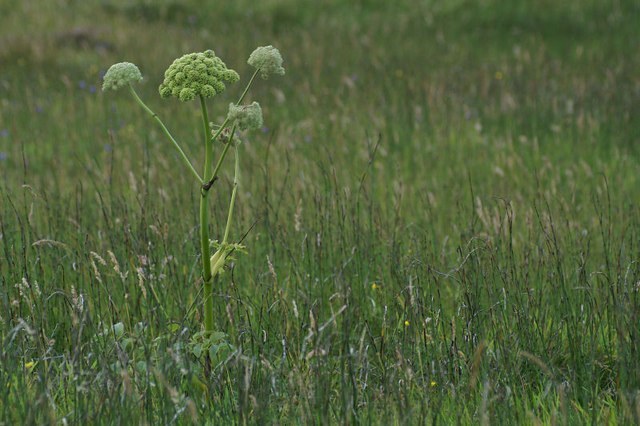
Key Identifying Features
Angelica (genus Angelica, including garden angelica A. archangelica and wild angelica A. sylvestris) is a stout biennial or perennial in the carrot family (Apiaceae). Key marks:
- A tall, hollow, ridged stem, often flushed purplish, reaching 1-2.5 m.
- Large, 2-3 times divided leaves with broad inflated, sac-like sheaths wrapping the stem at the leaf bases.
- Dome-shaped (rounded) umbels of small greenish-white to white flowers.
The ballooning leaf sheath and globe-like flower clusters are especially helpful.
Leaves & Stems
Leaves are alternate and divided into many oval, toothed leaflets; the terminal leaflets are often three-lobed. Where each leaf joins the stem, the stalk widens into a conspicuous swollen, inflated sheath that clasps the stem — a hallmark of angelica. The stout stem is hollow, grooved, and smooth, frequently purple-tinged, especially at the nodes. The whole plant has a sweet, somewhat musky-aromatic scent when bruised.
Flowers & Fruit
Flowers appear in summer in large compound umbels that are rounded or dome-shaped rather than flat, made of many tiny greenish-white to creamy-white (sometimes pink-tinged) flowers. The fruit are flattened, broadly winged schizocarps that split into two corky-winged halves, aromatic when ripe.
How to Tell It Apart from Look-Alikes
The carrot family includes several similar-looking species, so check these botanical details:
- Hemlock (Conium maculatum) has finely lacy, fern-like leaves, smaller white flat umbels, purple-spotted smooth stems, and a foul mousy smell — not the broad leaflets, dome umbels, sweet scent, or inflated sheaths of angelica.
- Cow parsnip / hogweed (Heracleum) is also tall but has much larger, broad, maple-like leaf lobes and flat white umbels.
- Giant hogweed is enormous with white-bristly purple-blotched stems.
The inflated sheathing leaf bases, dome-shaped greenish-white umbels, and sweet aroma point to angelica; lacy leaves with purple stem spots and a foul smell point to hemlock.
Where You'll Find It
Angelica favors damp, fertile ground: wet meadows, riverbanks, ditches, fen edges, and moist woodland, across Europe and Asia and naturalized elsewhere. Garden angelica is also cultivated as an ornamental herb.
Quick ID Checklist
- Tall, hollow, ridged stem, often purple-tinged
- Large 2-3x divided leaves with inflated sheathing bases
- Dome-shaped greenish-white flower umbels
- Sweet/musky aroma, not a foul smell
- No fine fern-like leaves or purple stem spots (rules out hemlock)
Frequently asked questions
How do I distinguish angelica from hemlock?
Angelica has broad oval toothed leaflets, swollen sheathing leaf bases, dome-shaped greenish-white umbels, and a sweet musky scent. Hemlock has finely lacy fern-like leaves, purple-spotted stems, flat white umbels, and a foul mousy smell.
What is the inflated sheath on angelica?
At each leaf base the stalk widens into a balloon-like, sac-shaped sheath that clasps the stem. This swollen sheath is one of the most reliable identifying features of the genus Angelica.
Are angelica flower clusters flat or rounded?
They are rounded or dome-shaped compound umbels of tiny greenish-white to creamy flowers, which helps separate angelica from the flat-topped umbels of hogweed and hemlock.
Where does angelica grow?
It prefers damp, fertile habitats such as wet meadows, riverbanks, ditches, fen margins, and moist woodland, and garden angelica is also cultivated as an ornamental herb.