
Anthurium Clarinervium Identification Guide
Identify Anthurium clarinervium by its velvety dark-green heart-shaped leaves with bold silvery-white vein networks.
Read the full Anthurium Clarinervium encyclopedia entry →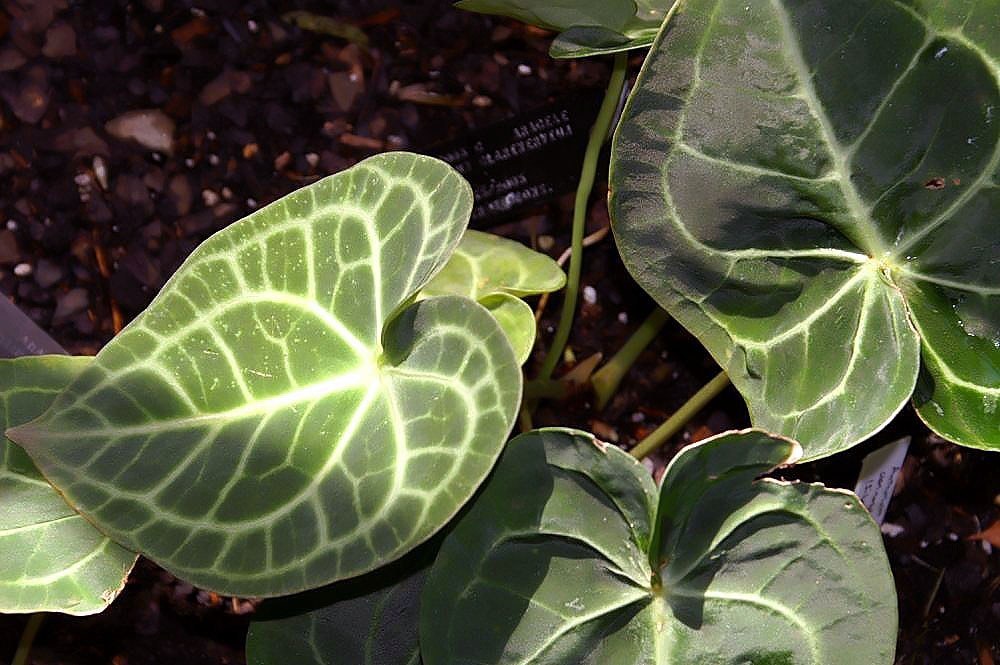
Key Identifying Features
Anthurium clarinervium is a Mexican "velvet cardboard" anthurium grown for its dramatic foliage. Identify it by:
- Thick, stiff, velvety dark-green heart-shaped leaves
- Bold, contrasting silvery-white veins forming a striking network
- A compact, clumping rosette habit (not a climbing vine)
- Leathery, almost rigid "cardboard" leaf texture
The emerald leaf laced with bright white veins is its signature and instantly recognizable.
Leaves & Stems
Leaves are broadly heart-shaped (cordate) with deep basal lobes, 6-10+ inches long, held on short petioles from a central crown. The upper surface is a deep, matte-velvet green with a conspicuous, raised network of pale silvery-white primary and secondary veins. The leaf is thick and stiff, earning the "cardboard" nickname; new leaves emerge a coppery-bronze before darkening. The underside is paler green. The plant grows as a short-stemmed clump (epiphytic/lithophytic), not a trailing climber.
Flowers & Fruit
Flowers are typical anthurium but modest: a narrow green-to-purplish spathe and a slender spadix, not showy. It's grown for leaves, not bloom. Berries may follow on the spadix.
How to Tell It Apart from Look-Alikes
- Anthurium crystallinum is very similar but has thinner, more elongated (oval-heart) leaves with slightly less rigid texture and often a more pronounced sheen; clarinervium leaves are rounder, thicker, and stiffer with broader basal lobes.
- Anthurium magnificum has larger leaves with squared petioles and a more matte surface.
- Anthurium 'Dark Mama' / hybrids blend traits; clarinervium stays compact with very stiff, near-round white-veined leaves.
The rounded, very thick "cardboard" leaf with crisp white veins points to clarinervium over the longer-leaved crystallinum.
Where You'll Find It
It's native to limestone outcrops in the rainforests of Chiapas, Mexico, growing as a lithophyte. As a houseplant it's prized worldwide and kept in bright indirect light with high humidity and a chunky, airy mix.
Quick ID Checklist
- Velvety, matte dark-green heart-shaped leaves
- Bright silvery-white vein network standing out boldly
- Thick, stiff "cardboard" texture
- Compact clumping rosette (not climbing)
- Bronze-copper new leaves
- Modest green/purple spathe flowers
Match these and you have Anthurium clarinervium. To distinguish from the similar crystallinum, check leaf shape and thickness — clarinervium is rounder, stiffer, and more rigid.
Frequently asked questions
How do I tell clarinervium from Anthurium crystallinum?
Clarinervium has rounder, thicker, stiffer 'cardboard' leaves with broad basal lobes, while crystallinum has thinner, more elongated heart-shaped leaves; both have silver-white veins.
Why are the veins so bright?
The pale silvery-white primary and secondary veins contrast sharply against the dark velvet-green leaf surface, a natural feature that makes the foliage so striking.
Does it climb like a philodendron?
No. It grows as a compact, short-stemmed clumping rosette (a lithophyte on limestone in the wild), not as a trailing or climbing vine.
What color are new leaves?
New leaves emerge a coppery-bronze and darken to deep green as they mature and harden into the stiff cardboard texture.