
Apricot Tree Identification Guide
A practical guide to identifying the apricot tree (Prunus armeniaca) by its rounded leaves, early pink-white blossoms, and fuzzy orange stone fruit.
Read the full Apricot Tree encyclopedia entry →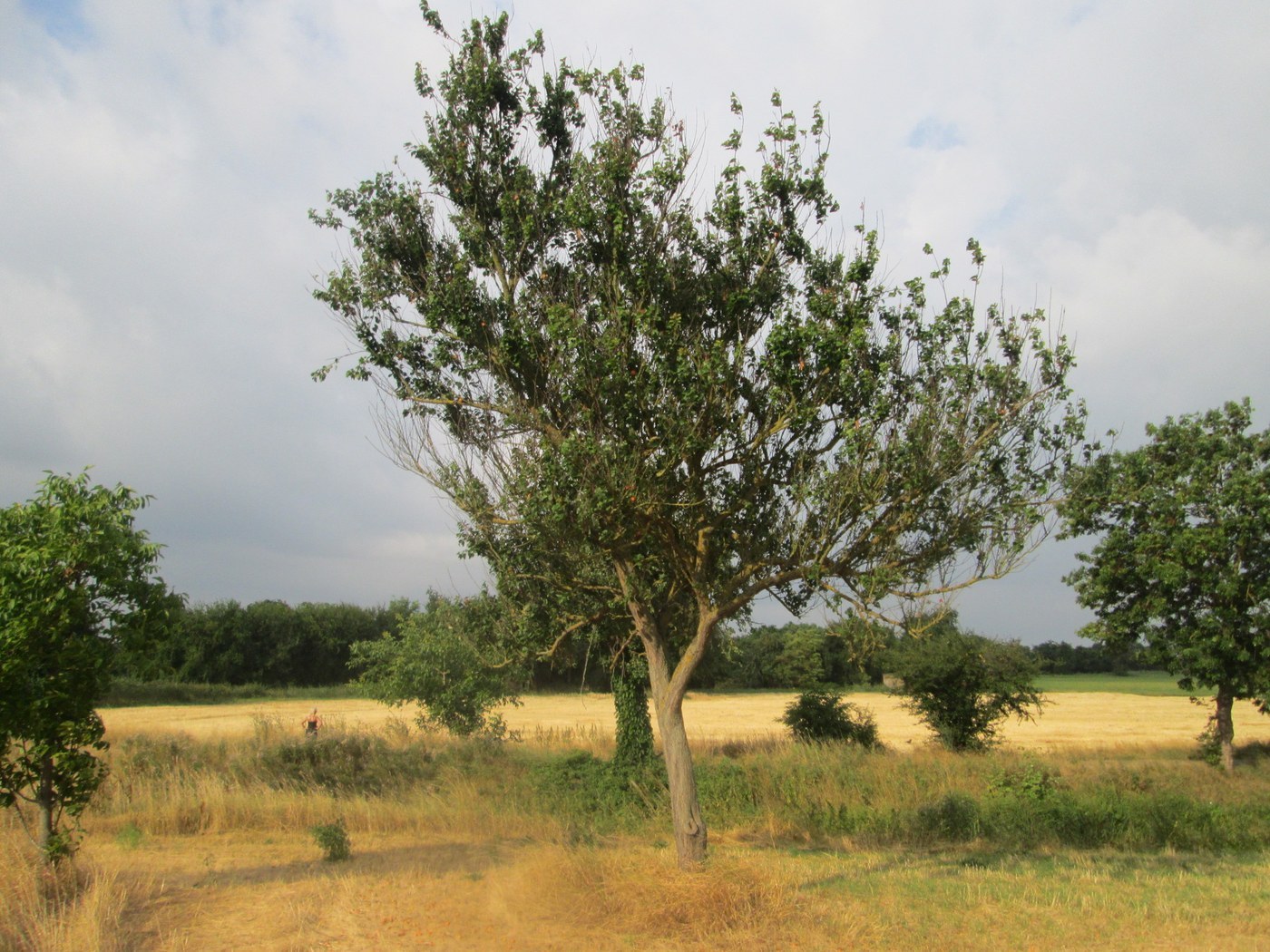
Key Identifying Features
The apricot (Prunus armeniaca) is a small, spreading deciduous tree, usually 8-12 m (25-40 ft) tall but often kept much shorter in orchards. Look for a broad, rounded crown, reddish-brown bark that grays and fissures with age, and a tendency to bloom very early in spring, often before the leaves emerge. The combination of heart-shaped leaves, early solitary blossoms, and velvety orange fruit with a single hard stone is diagnostic.
Leaves & Stems
- Leaves are broadly ovate to nearly round (cordate), 5-9 cm long, with a short pointed tip and a rounded-to-heart-shaped base.
- Margins are finely and bluntly toothed (serrate).
- The leaf surface is glossy dark green and hairless, with a reddish petiole 2-4 cm long that typically bears small glands near the blade.
- Young twigs are smooth and reddish, turning brown.
Flowers & Fruit
- Flowers appear before or with the leaves, single or in pairs, 2-4.5 cm across, with five rounded petals that are white to pale pink.
- Blossoms sit nearly stalkless against the twig, unlike the longer-stemmed flowers of cherries.
- Fruit is a drupe, 3.5-6 cm, yellow-orange often blushed red, with a distinctive velvety (downy) skin and a deep suture line down one side.
- The flesh is firm and the flat, smooth stone separates freely from the flesh (freestone); the kernel inside is bitter or sweet depending on variety.
How to Tell It Apart from Look-Alikes
- Peach (Prunus persica): peach leaves are long and lance-shaped, not round; peach fruit is larger and fuzzier. Apricot leaves are rounded.
- Plum (Prunus domestica): plum fruit is smooth (hairless) with a waxy bloom; apricot fruit is fuzzy.
- Cherry (Prunus avium): cherries hang on long stalks and the fruit is small and stalked; apricot fruit is nearly stalkless and downy.
- Almond (Prunus dulcis): flowers look similar but almond fruit is a dry, leathery hull splitting to reveal the nut.
Where You'll Find It
Apricots are cultivated in warm-temperate regions with cold winters and dry summers, classically Mediterranean, Central Asian, and continental climates (it dislikes humid summers and late frosts). You'll find it in home orchards, dry-climate gardens, and commercial groves. It needs winter chill to fruit but blooms so early that frost often destroys the crop in marginal areas.
Quick ID Checklist
- Small tree with broad rounded crown
- Round/heart-shaped, finely toothed, glossy leaves
- Reddish glandular petioles
- Early, nearly stalkless white-pink blossoms before leaves
- Velvety orange fruit with a suture line and free smooth stone
Frequently asked questions
How can I tell an apricot tree from a peach tree?
Look at the leaves: apricot leaves are broad and rounded (almost heart-shaped), while peach leaves are long and narrow like a lance. Apricot fruit is also smaller with a lighter fuzz than a peach.
What do apricot blossoms look like?
They are five-petaled, 2-4.5 cm wide, white to pale pink, and appear very early in spring, often before the leaves, sitting almost directly against the twig rather than on long stalks.
Is apricot fruit fuzzy or smooth?
Apricot fruit has a soft velvety (downy) skin, which distinguishes it from smooth plums. The fruit is yellow-orange, often with a red blush, and has a clear seam down one side.
When does an apricot tree bloom and fruit?
It blooms very early, late winter to early spring before most other fruit trees, and ripens fruit in early to midsummer depending on climate and variety.