
Baby's Breath Identification Guide
Identify baby's breath by its airy cloud of tiny white flowers on wiry, much-branched stems with narrow blue-green leaves.
Read the full Baby's Breath encyclopedia entry →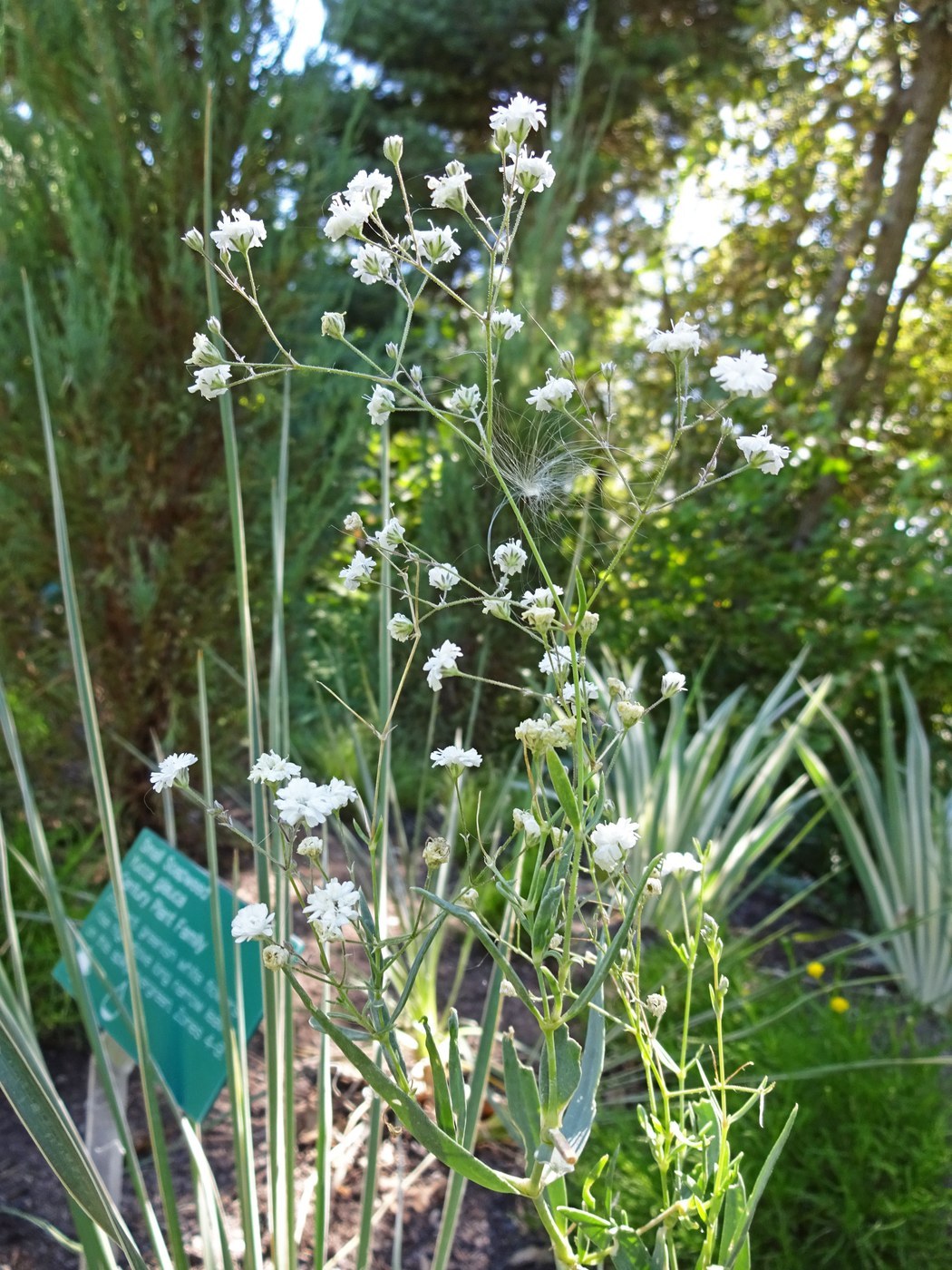
Key Identifying Features
Baby's breath (Gypsophila) is recognized by its delicate, misty cloud of countless tiny flowers on a finely branched, almost wiry frame. The overall impression is of a soft, airy haze, which is why it's a florist staple for filling bouquets.
- Masses of tiny (3–6 mm) five-petaled flowers
- Highly branched, wiry, spreading stems forming a cloud
- Narrow, blue-green leaves, sparse on the stems
- Forms a rounded, billowing mound
Leaves & Stems
Leaves are small, narrow, lance- to linear-shaped, opposite, and somewhat blue-green or grey-green, often with a slightly waxy bloom. They are sparse and inconspicuous, leaving the airy stems looking nearly bare. Stems are thin, smooth, repeatedly forked (dichotomously branched), and slightly swollen at the nodes — a pink-family trait. Perennial G. paniculata forms a large rounded bush up to 1 m across; annual G. elegans is smaller and looser.
Flowers & Fruit
Flowers are tiny but extremely numerous, each with five rounded petals (single) or many petals (double florist forms), held in loose, open, branching sprays. They are usually white, sometimes soft pink. Bloom is in summer. The sheer number of small flowers on the diffuse branches creates the signature gauzy cloud. Fruit is a tiny capsule with small seeds. The plant has the faint sweet scent typical of pinks.
How to Tell It Apart from Look-Alikes
- Other small-flowered fillers (e.g. sea lavender/statice): Statice flowers are papery and held in flat-topped or spike clusters, not a rounded airy cloud, and often colored.
- Bedstraw (Galium): Also tiny white flowers, but leaves are in whorls (rings) around the stem, not opposite pairs.
- Chickweed / other Caryophyllaceae: Have notched petals and a low sprawling habit, not the billowing branched mound.
The billowing cloud of tiny five-petaled white flowers on wiry forked stems with blue-green opposite leaves confirms baby's breath.
Where You'll Find It
Grown in cutting gardens, borders, and as dried/fresh filler, baby's breath thrives in full sun and alkaline, well-drained soil (the name Gypsophila means "gypsum/chalk-loving"). Perennial species can naturalize and become weedy or invasive in parts of North America, appearing as tumbleweed-like clouds on roadsides and rangeland.
Quick ID Checklist
- Airy cloud of many tiny flowers
- Flowers white (or pink), five-petaled
- Wiry, repeatedly forked, spreading stems
- Narrow blue-green opposite leaves, sparse
- Swollen nodes (pink-family trait)
- Rounded billowing mound habit
Frequently asked questions
How do I recognize baby's breath at a glance?
By the unmistakable airy, misty cloud of countless tiny white five-petaled flowers on thin, repeatedly forked stems. The plant looks like a soft haze, which is why florists use it as bouquet filler.
How is baby's breath different from statice?
Both are common fillers, but statice has stiff, papery, colored flowers in flat-topped or winged clusters, while baby's breath has soft white flowers in a rounded, diffuse cloud with wiry branching stems.
What soil does baby's breath prefer, and why does that help ID it?
It favors alkaline, chalky, well-drained soil — its name Gypsophila means 'gypsum-loving.' Finding billowing white-flowered mounds on dry, limy ground supports the identification.
Is baby's breath ever a weed?
Yes. Perennial Gypsophila paniculata has naturalized in parts of North America, where it breaks off and tumbles like a tumbleweed to spread seed, becoming invasive on roadsides and rangeland.