
Baby Toes Identification Guide
Identify Baby Toes (Fenestraria rhopalophylla) by its clusters of upright, club-shaped leaves with translucent flat 'window' tips.
Read the full Baby Toes encyclopedia entry →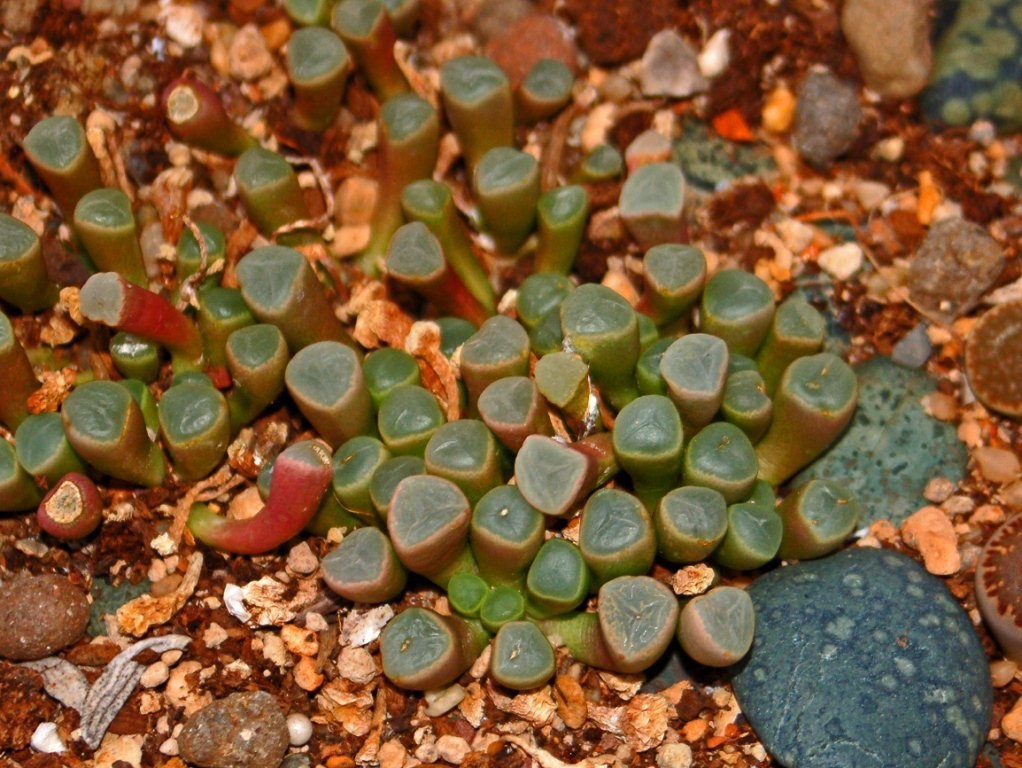
Key Identifying Features
Baby Toes (Fenestraria rhopalophylla) is a tiny, curious succulent that forms clusters of upright, finger- or toe-like leaves, each with a flattened, translucent top — a "window" through which light reaches the buried tissue. The packed leaves really do resemble a bunch of stubby baby toes poking out of the soil.
- Club-shaped (clavate) cylindrical leaves standing upright in dense clumps
- Flat, translucent leaf tips (the famous "windows" / fenestrae)
- Pale gray-green to bluish-green color
- Low, mat-forming; barely an inch or two tall
Leaves & Stems
Each leaf is smooth, fat, and rounded, widening toward a blunt, flat top. In its native habitat the leaves grow mostly buried in sand with only the glassy windowed tips exposed, letting sunlight filter down to the photosynthetic interior — an adaptation to intense desert sun. The plant is essentially stemless, spreading by offsets into tight clusters of "toes."
Flowers & Fruit
Baby Toes produces relatively large, daisy-like flowers on short stalks rising just above the leaves, typically white or yellow (var. aurantiaca is golden-yellow; var. rhopalophylla is white). Blooming usually occurs in late summer to autumn. The bright flowers, big relative to the plant, are a helpful ID feature.
How to Tell It Apart from Look-Alikes
- Living Stones (Lithops): Also windowed succulents, but Lithops are paired, flat-topped stones with a central fissure, not clusters of upright cylindrical toes.
- Haworthia cooperi / 'window' Haworthias: Form rosettes of translucent-tipped leaves but are arranged in a rosette, not as separate upright clubs.
- Conophytum / other mesembs: Various windowed forms; the distinct upright finger/toe clusters with flat clear tops identify Fenestraria.
Where You'll Find It
Native to the coastal deserts of Namibia and South Africa (Namaqualand), growing in sandy soils where the leaves stay buried. As a houseplant it needs very bright light, extremely well-drained sandy soil, and minimal water (especially in summer, its dormant period). Hardy to about USDA zones 9–11; nearly always grown as a potted specimen elsewhere. Overwatering quickly causes the toes to burst.
Quick ID Checklist
- Clusters of upright, club-shaped "toe" leaves
- Flat, translucent window tips on each leaf
- Gray-green; very small and low-growing
- White or yellow daisy-like flowers in late summer/autumn
- Sandy desert origin; needs grit and very little water
Frequently asked questions
What are the clear tips on the leaves?
They are translucent 'windows' (fenestrae). In the wild the leaves grow buried in sand with only these glassy tops exposed, letting sunlight filter down to the photosynthetic tissue inside.
How is it different from Lithops (living stones)?
Lithops form paired, flat-topped stone-like bodies with a central slit, while Baby Toes makes clusters of separate upright, cylindrical toe-shaped leaves with flat clear tips.
Why did my Baby Toes burst or turn mushy?
Almost always overwatering. The leaves store water and split if given too much, especially during their summer dormancy. Use sandy, fast-draining soil and water very sparingly.
What color are the flowers?
Depending on the variety, the daisy-like flowers are white (var. rhopalophylla) or golden-yellow (var. aurantiaca), appearing mainly in late summer and autumn.