Baby Toes
Fenestraria rhopalophylla
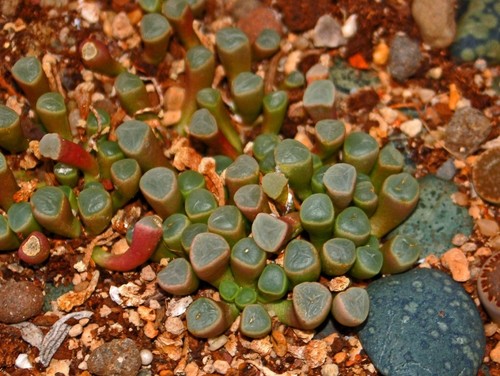
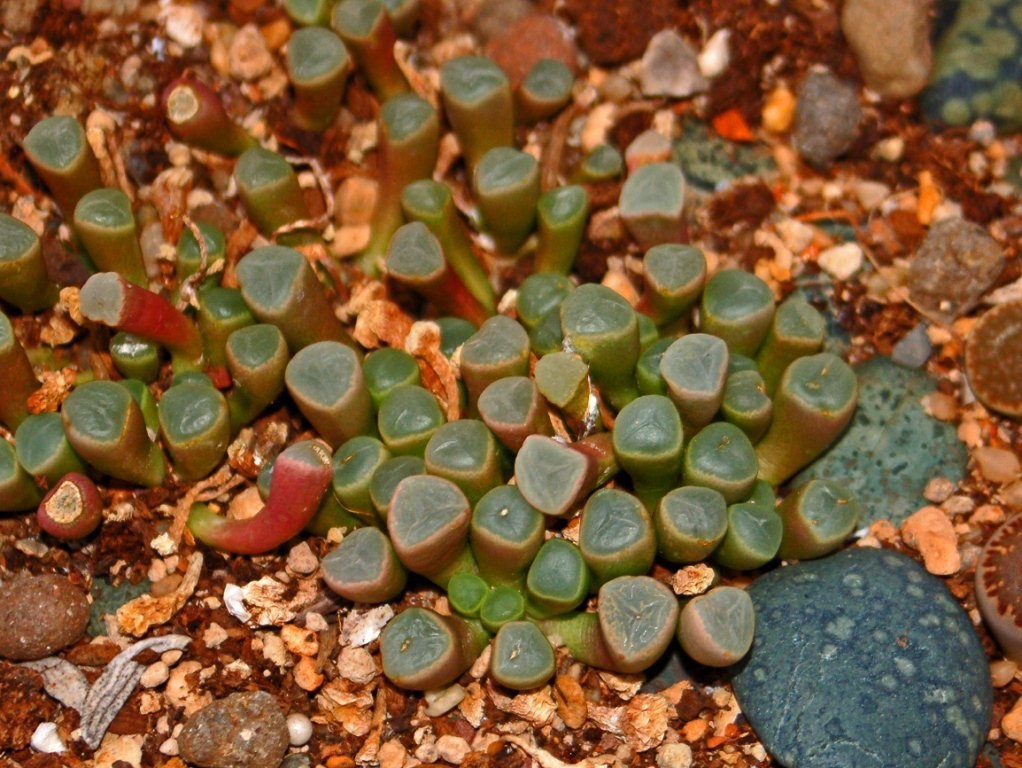
A curious dwarf succulent that forms clusters of upright, club-shaped leaves with translucent 'windows' on their flat tops, looking like rows of tiny baby toes. It bears white or yellow daisy-like flowers.
- Light
- Bright light to some direct sun
- Water
- Very sparingly; minimal water
- Difficulty
- Hard
Got a plant like this?
Identify any plant from a photo, free.
Overview
Baby Toes is a tiny, clumping succulent whose upright, finger- or club-shaped leaves cluster together to resemble a bunch of plump baby toes. Each leaf tip has a translucent panel - a 'window' - that lets light filter down into the leaf, an adaptation to its harsh, sun-bright native desert.
In the wild it grows mostly buried in sand with only the windowed tips exposed, protecting it from intense sun and heat. It produces relatively large white or yellow daisy-like flowers.
Charming but fussy, it demands gritty soil and very careful watering, as it is extremely prone to rot - making it a more advanced succulent to grow well.
How to identify it
- Leaves: Upright, cylindrical, club-shaped, pale green, clustered tightly; flat translucent 'window' at each tip
- Habit: Low clumping mats of finger-like leaves, only a couple inches tall
- Flowers: Comparatively large white or yellow daisy-like blooms
- Windows: The transparent leaf tips are a key identifying feature, allowing light into the buried leaf
- Size: Very small dwarf succulent
Care & growing
Light: Bright light with some direct sun; the windowed tips are adapted to strong light.
Water: Water very sparingly and only when soil is bone dry - this plant rots extremely easily. Keep nearly bone dry in summer dormancy and winter; water lightly in its active autumn-to-spring growth.
Soil: Extremely gritty, sandy, sharply draining mineral mix; standard potting soil will kill it.
Temperature: Warm and dry; avoid cold, wet conditions.
Feeding: Essentially none needed.
Propagation: From seed or careful division of clumps.
Tip: Underwatering is far safer than overwatering for this species.
Habitat & origin
Fenestraria rhopalophylla is native to the coastal deserts of Namibia and the northwestern Cape of South Africa, where it grows nearly buried in sandy, well-drained soils with only its leaf windows exposed at the surface.
It is grown by succulent collectors worldwide but requires conditions close to its arid native habitat to thrive.
Frequently asked questions
What are the clear tips on the leaves?
They are translucent 'windows' that let sunlight into the leaf. In the wild the plant grows buried in sand with only these tips exposed.
Why does my Baby Toes keep rotting?
Almost always overwatering or heavy soil. It needs an extremely gritty mix and only tiny amounts of water when bone dry.
Is Baby Toes hard to grow?
Yes, it is one of the trickier succulents because it rots so easily; getting the soil and watering right is essential.
Does it flower?
Yes, it produces relatively large white or yellow daisy-like flowers when conditions suit it.
Baby Toes guides
In-depth guides for identifying, growing, and caring for Baby Toes.