Tree Aeonium
Aeonium arboreum
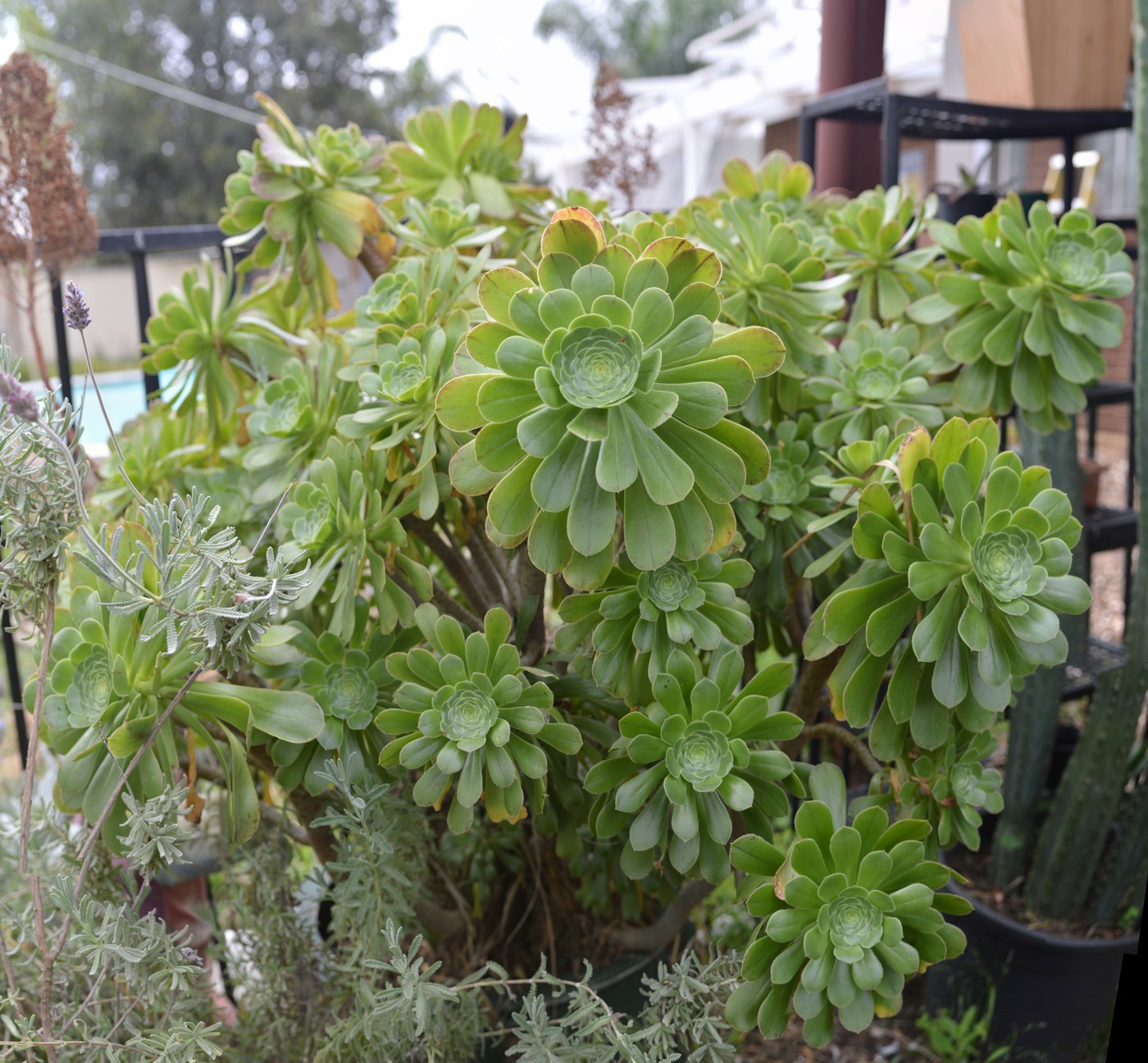
A branching, shrubby succulent that holds glossy leaf rosettes atop bare woody stems. Popular dark cultivars like 'Zwartkop' turn nearly black in strong sun.
- Light
- Full sun to bright light
- Water
- When soil dries; minimal in summer dormancy
- Difficulty
- Easy
Got a plant like this?
Identify any plant from a photo, free.
Overview
Tree aeonium is one of the most recognizable subtropical succulents, forming tall, branching stems topped with flat rosettes of spoon-shaped leaves. Unlike most succulents, it grows actively in cool, moist winters and rests during hot, dry summers.
Native to the Canary Islands, it has become a mainstay of Mediterranean and coastal gardens worldwide. Dramatic dark-leaved cultivars such as 'Zwartkop' (the "black rose") are especially prized for their near-black foliage.
It is forgiving, fast to root from cuttings, and equally at home in pots or mild-climate garden beds.
How to identify it
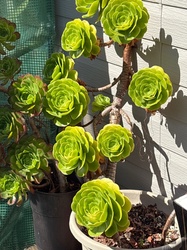
- Rosettes of flat, glossy, spoon-shaped leaves up to 6-8 in (15-20 cm) across, held at the tips of branches
- Woody, branching stems that can reach 3-4 ft (1 m), often bare below the rosettes
- Leaf color ranges from bright green to deep burgundy-black depending on cultivar and sun exposure
- Fine, harmless hairs or smooth margins; leaves shed from lower stem as it grows
- Mature plants send up large conical clusters of small yellow star-flowers; that rosette dies after blooming (monocarpic)
Care & growing
Light: Full sun to bright indirect light; dark cultivars need strong sun to keep their color.
Water: Water when the soil dries during the cool growing season (fall through spring). Cut back sharply in summer when the plant goes semi-dormant and rosettes may close up.
Soil: Fast-draining cactus or succulent mix; tolerates poorer soils than many succulents.
Temperature: Loves mild 40-70 F (4-21 C); protect from hard frost and prolonged scorching heat.
Feeding: Light feeding with diluted balanced fertilizer once or twice in the growing season.
Propagation: Extremely easy from stem cuttings — let the cut callus a day or two, then root in dry-ish mix.
Habitat & origin
Native to the Canary Islands, where it grows on rocky coastal slopes and cliffs in a mild, frost-free maritime climate with wet winters and dry summers.
It is widely naturalized and cultivated across the Mediterranean, coastal California, and other regions with mild winters. As a houseplant or patio container it thrives anywhere it can get bright light and protection from freezing.
Frequently asked questions
Why is my Tree Aeonium dropping leaves in summer?
This is normal summer dormancy. In hot, dry weather the plant sheds lower leaves and may close its rosettes to conserve moisture. It perks back up in cooler months.
Why did my rosette die after flowering?
Aeonium rosettes are monocarpic — each one dies after it blooms. On a branching plant only the flowering rosette is lost, and side branches carry on.
How do I keep 'Zwartkop' dark instead of green?
Give it more direct sun. Insufficient light makes the leaves revert toward green; strong sun intensifies the near-black coloring.
Can I grow it indoors?
Yes, in a very bright window. It tends to stretch in low light, so the sunniest spot you have is best.
Tree Aeonium guides
In-depth guides for identifying, growing, and caring for Tree Aeonium.
How to Care for Tree Aeonium
Grow Tree Aeonium (Aeonium arboreum) with full sun, sharp drainage, and a winter-growing rhythm for tidy rosette-topped stems.
Tree Aeonium Identification Guide
How to recognize Tree Aeonium (Aeonium arboreum) by its tall, branching woody stems topped with flat, spoon-shaped rosettes.
Tree Aeonium identified by the community
Real specimens identified with Plant Identifier.