Tree Aeonium Identification Guide
How to recognize Tree Aeonium (Aeonium arboreum) by its tall, branching woody stems topped with flat, spoon-shaped rosettes.
Read the full Tree Aeonium encyclopedia entry →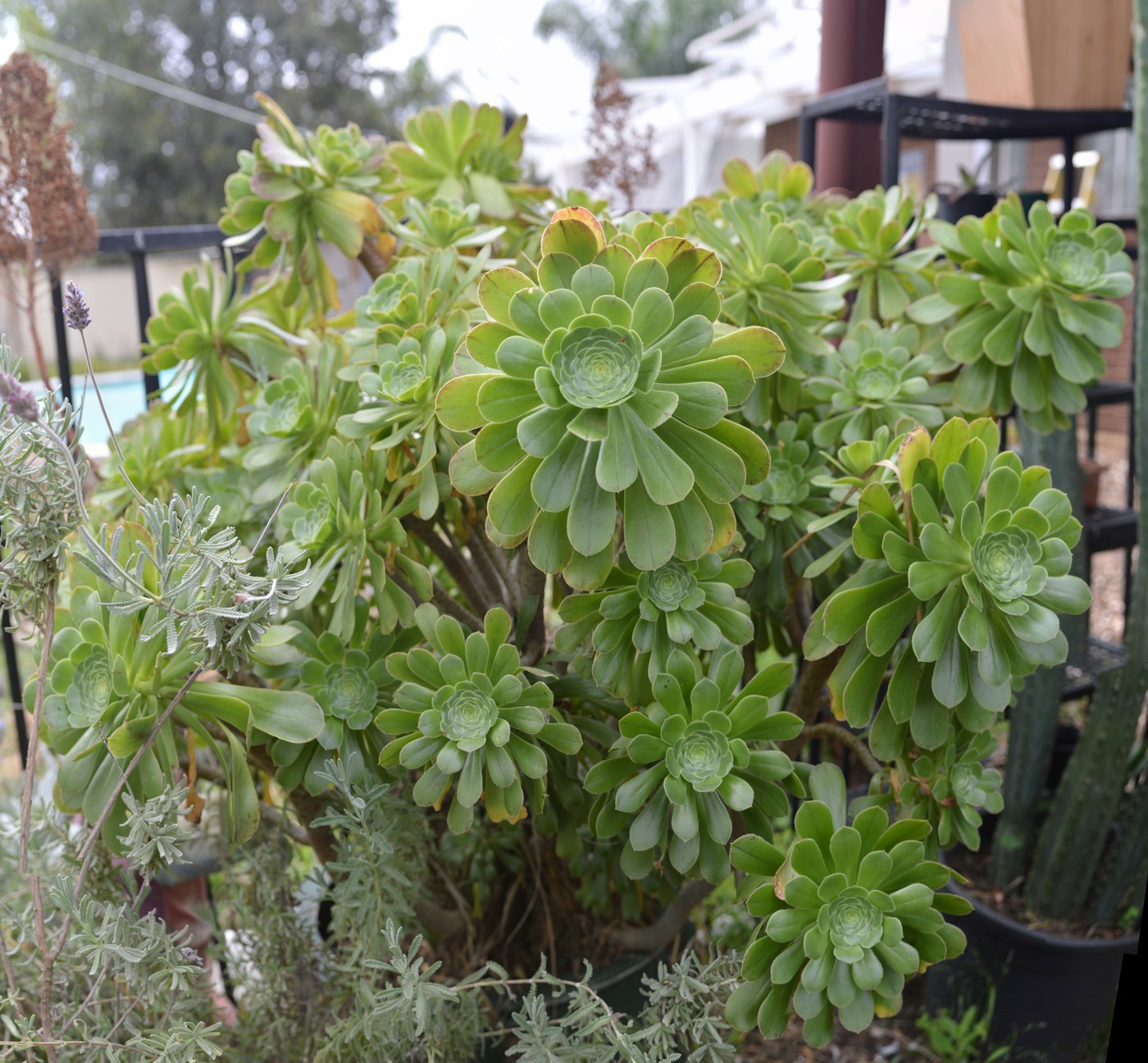
Key Identifying Features
Tree Aeonium (Aeonium arboreum) is the classic shrubby aeonium that looks like a small tree carrying flowers made of leaves. Look for:
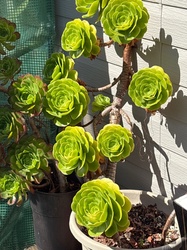
- Tall, bare woody stems that branch and can reach 3-5 ft (1-1.5 m).
- Flat, plate-like rosettes of leaves held at the tips of each stem, typically 4-8 in (10-20 cm) across.
- A distinctly top-heavy, candelabra-like silhouette as the plant ages.
Leaves & Stems
The leaves are glossy, smooth, and spoon-shaped (spatulate), tapering to a narrow base and arranged in a tight, symmetrical rosette. The green form is a fresh grass-green, while the popular cultivar 'Atropurpureum' turns deep burgundy-black in strong sun and 'Zwartkop' (Schwarzkopf) is near-black. Leaf margins often carry fine, soft hairs (cilia) visible up close. Stems are woody, gray-brown, and ringed with leaf scars where old leaves have dropped, leaving a smooth knobby trunk.
A key aeonium trait: the rosette is flat and disc-like, not ball-shaped, and the leaves are thin and flexible compared to thick-leaved echeverias.
Flowers & Fruit
Mature rosettes produce a large cone- or dome-shaped cluster of small yellow star flowers in winter to spring. Each flowering rosette is monocarpic — that rosette dies after blooming, though side branches carry on. The bright yellow conical inflorescence rising from a dark rosette is a strong confirming clue.
How to Tell It Apart from Look-Alikes
- Echeveria: has thick, fleshy leaves and stays low or short-stemmed; aeonium leaves are thinner and the plant grows tall and woody.
- Aeonium 'Sunburst'/other aeoniums: Tree Aeonium has plain green or solid dark rosettes, not the cream-and-green variegation of 'Sunburst'.
- Sempervivum (hens-and-chicks): stays in a flat ground cluster with no tall woody trunk and is cold-hardy; aeonium is frost-tender.
- Crassula ovata (jade): has paired, fingertip-sized leaves along the stems rather than terminal flat rosettes.
Where You'll Find It
Native to the Canary Islands, it is a staple of Mediterranean and coastal California gardens and a common potted houseplant. It grows actively in cool, moist seasons and often goes semi-dormant (rosettes closing up tightly) in hot, dry summers.
Quick ID Checklist
- Tall, branching woody stems topped with rosettes
- Flat, disc-shaped rosettes of thin spoon-shaped leaves
- Leaf margins with fine hairs, stems ringed with leaf scars
- Yellow conical flower clusters; rosette dies after blooming
- Frost-tender, active in cool season
Frequently asked questions
Is Tree Aeonium the same as the black rose succulent?
The dark forms ('Zwartkop'/'Atropurpureum') are cultivars of Tree Aeonium and are often sold as 'black rose'. The species itself is green; the black coloring develops in strong sunlight.
Why do the rosettes close up and look unhealthy in summer?
Aeoniums are winter growers. In hot, dry summers they go dormant and curl their leaves inward to conserve water. This is normal and not a sign of disease.
Does the whole plant die after it flowers?
No. Only the individual rosette that flowers is monocarpic and dies. Branched plants keep growing from their other rosettes.
How can I be sure it's not an Echeveria?
Check the leaves and stem. Tree Aeonium has thin, flexible spoon-shaped leaves on a tall woody trunk, while Echeveria has thick fleshy leaves on a short or absent stem.
Tree Aeonium identified by the community
Recent Tree Aeonium specimens identified with Plant Identifier.