
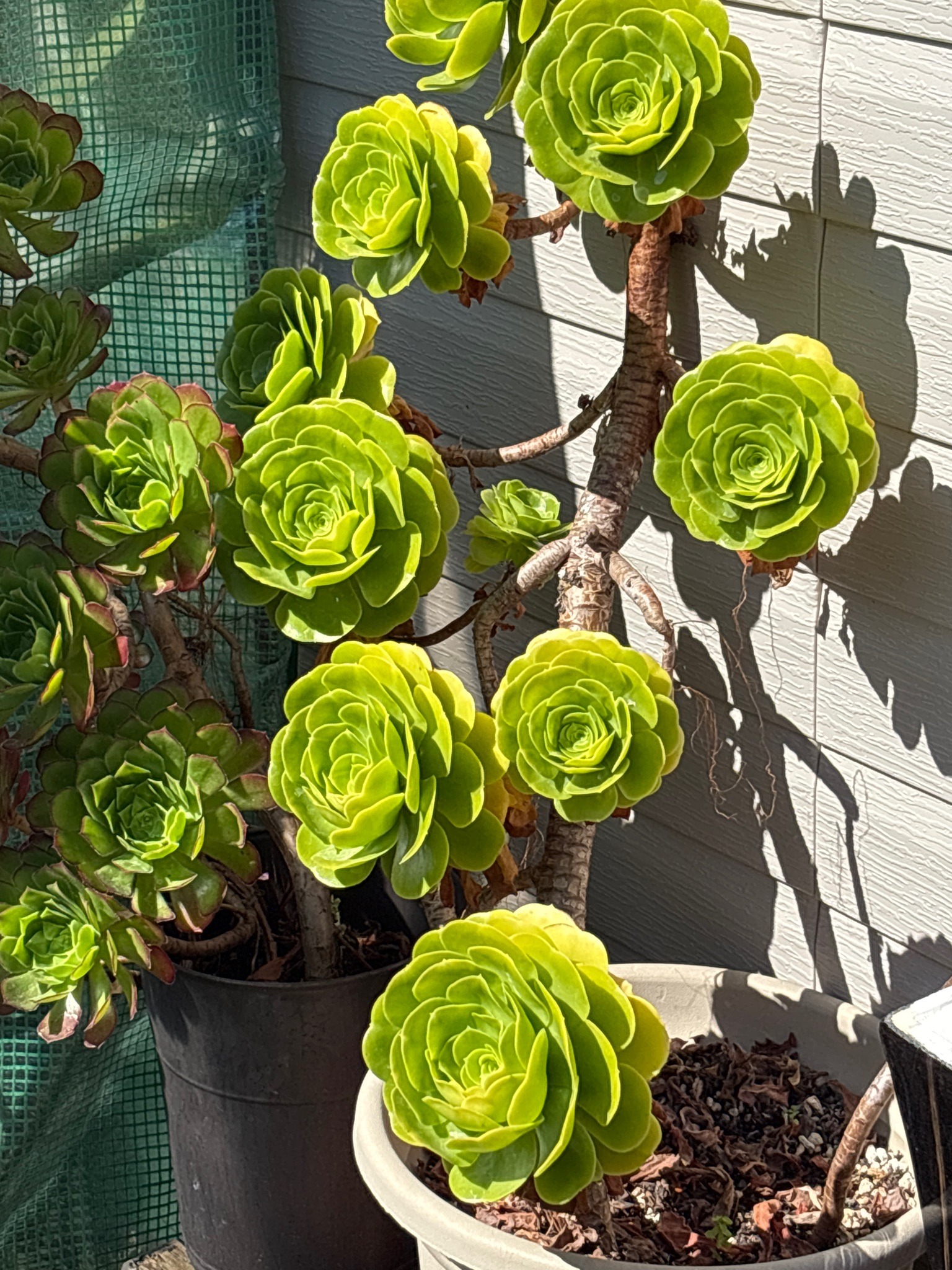
Tree Houseleek
Aeonium arboreum
A succulent subshrub featuring branching stems topped with large, symmetrical rosettes of fleshy, spoon-shaped green leaves.
- Light
- Full sun to partial shade, ideally 6 or more hours of bright sunlight daily.
- Water
- Water deeply when the soil is completely dry. Reduce watering significantly during the dormant summer period. Avoid leaving the roots sitting in standing water.
- Growth
- Perennial succulent subshrub with an upright, branching habit, growing up to 3 to 5 feet tall and spreading 2 to 3 feet wide with a moderate growth rate.
Care instructions
Provide full sun to partial shade, plant in extremely well-draining soil, and allow the soil to dry out completely between thorough waterings.
Growing details
Sunlight
Full sun to partial shade, ideally 6 or more hours of bright sunlight daily.
Watering
Water deeply when the soil is completely dry. Reduce watering significantly during the dormant summer period. Avoid leaving the roots sitting in standing water.
Soil
Fast-draining sandy or gravelly potting mix specifically formulated for succulents and cacti, with a neutral to slightly acidic pH range of 6.0 to 7.0.
Hardiness zone
USDA Hardiness Zones 9 through 11. Sensitive to frost and freezing temperatures.
Growth habit
Perennial succulent subshrub with an upright, branching habit, growing up to 3 to 5 feet tall and spreading 2 to 3 feet wide with a moderate growth rate.
Bloom season
Late winter to spring, producing large, conical clusters of bright yellow, star-shaped flowers from the center of mature rosettes.
Propagation
Easily propagated via stem cuttings taken in spring or summer, allowing the cut end to callous over for a few days before planting in dry soil.
Common pests & issues
Prone to root rot if overwatered or kept in poorly draining soil. Pests include mealybugs and aphids, which can be managed with insecticidal soap.
Similar species
Aeonium haworthii (Pinwheel Aeonium), which generally forms smaller blue-green rosettes with reddish leaf margins.