
Balsam Fir Identification Guide
Recognize balsam fir by its flat, soft, blunt needles, resin blisters on smooth gray bark, and upright purple cones. Covers needles, bark, cones, look-alikes, and habitat.
Read the full Balsam Fir encyclopedia entry →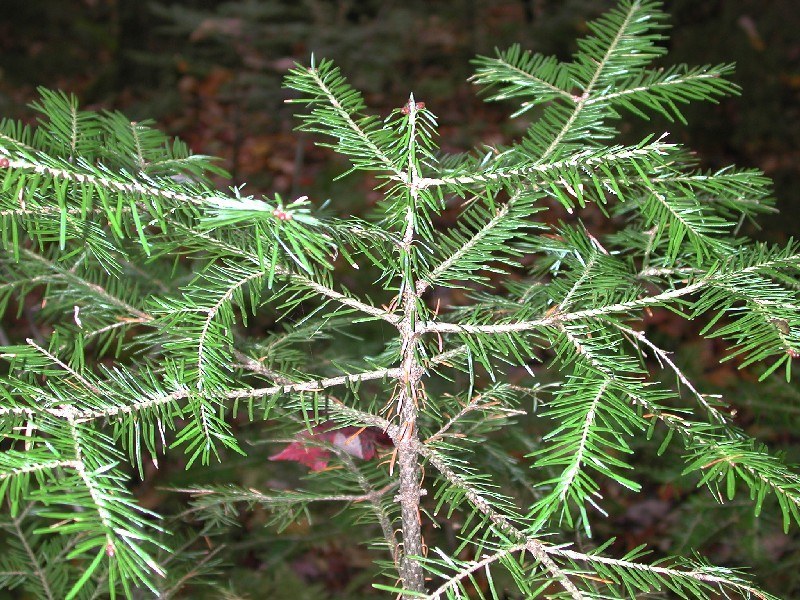
Key Identifying Features
Balsam fir (Abies balsamea) is the classic northern Christmas tree, prized for its fragrant, soft foliage and neat spire-like form. Like all true firs, its needles are attached singly and flat (not in bundles), its cones stand upright, and its bark carries resin blisters. It grows 40-60 feet tall with a narrow, pointed crown.
Needles & Twigs
- Needles are flat, soft, and blunt-tipped, about three-quarters to one inch long.
- They are dark green and shiny above with two whitish (silvery) bands of stomata below.
- Needles attach to the twig with a flat, circular base like a tiny suction cup, leaving a smooth round scar when pulled off — a key fir trait (no woody peg).
- On lower branches needles often spread in flat, 2-ranked rows; they are arranged spirally but twist to appear two-sided.
- Crushed needles release a strong, sweet balsam fragrance.
Bark
Young bark is smooth, gray, and dotted with raised resin blisters that ooze sticky, aromatic balsam when pressed. Older bark becomes scaly and reddish-brown.
Cones
- Seed cones are upright (erect), cylindrical, 2-4 inches long, purplish to greenish when young.
- True fir cones disintegrate on the tree, shedding their scales rather than falling whole, so you rarely find an intact cone on the ground.
How to Tell It Apart from Look-Alikes
- Spruces (Picea) have stiff, sharp, four-sided needles on woody pegs that make twigs rough; balsam fir needles are flat, soft, and leave smooth round scars.
- Fraser fir (Abies fraseri) is very similar but is a southern Appalachian species with cone bracts that protrude and curve back over the scales; balsam fir bracts are mostly hidden.
- Hemlock (Tsuga) has flat needles too, but they are tiny, on slender pegs, with a delicate drooping leader.
Where You'll Find It
Balsam fir thrives in cool, moist to swampy boreal and northern forests across Canada, the Great Lakes, and New England, often mixed with spruce, paper birch, and aspen. It tolerates shade and wet ground and is widely grown on Christmas tree farms.
Quick ID Checklist
- Flat, soft, blunt needles with two white bands beneath
- Needle bases leave smooth round scars (no woody pegs)
- Smooth gray bark with resin blisters
- Upright cones that fall apart on the tree
- Strong balsam scent when crushed
- Cool, moist northern forests
Flat fragrant needles, blistered gray bark, and upright cones confirm balsam fir.
Frequently asked questions
How do I tell balsam fir from a spruce?
Roll a needle between your fingers: fir needles are flat and won't roll, are soft and blunt, and leave a smooth round scar, while spruce needles are sharp, four-sided, and sit on tiny woody pegs that make the twig rough.
Why can't I find whole balsam fir cones on the ground?
True fir cones stand upright and disintegrate while still on the branch, releasing scales and seeds, so only the central spike remains and intact cones rarely drop.
How is balsam fir different from Fraser fir?
They are close relatives, but Fraser fir is a southern Appalachian tree whose cone bracts stick out and bend back over the scales, while balsam fir's bracts are mostly hidden inside the cone.
What are the blisters on balsam fir bark?
They are resin-filled pockets of fragrant balsam; pressing one releases sticky, aromatic oleoresin historically collected as Canada balsam.