
Bearberry Identification Guide
Identify Bearberry, a trailing evergreen groundcover, by its small leathery spoon-shaped leaves, pink urn flowers, and bright red berries.
Read the full Bearberry encyclopedia entry →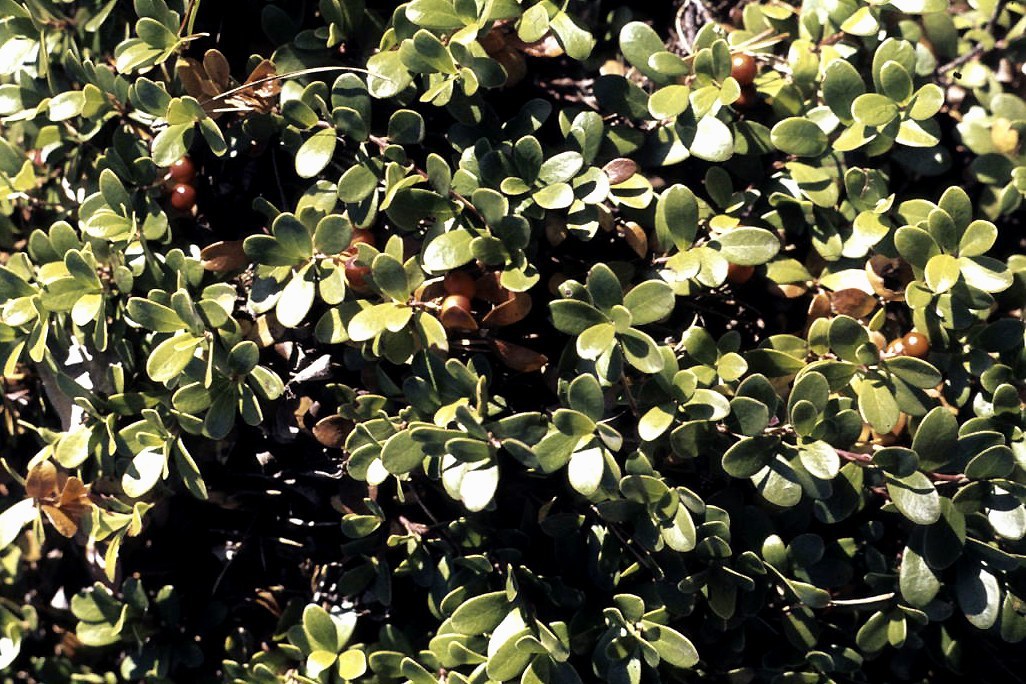
Key Identifying Features
Bearberry (Arctostaphylos uva-ursi), also called Kinnikinnick, is a low, mat-forming evergreen shrub of cold and sandy habitats. Key features:
- A trailing, ground-hugging evergreen that forms dense mats.
- Small, leathery, spoon-shaped leaves with rounded tips and smooth edges.
- Pink-to-white, nodding, urn-shaped flowers in small clusters.
- Bright red, smooth, round berries in late summer and fall.
Leaves & Stems
Stems are woody, trailing, and reddish-brown, often with shredding/flaky bark, rooting where they touch the ground. Leaves are alternate, evergreen, leathery (thick), and obovate (spoon-shaped) — broadest near the rounded tip and tapering to the base — about 1–3 cm long, dark glossy green above and paler beneath, with untoothed, slightly rolled-under margins. Foliage often bronzes or reddens in winter.
Flowers & Fruit
Flowering is in spring (April–June). The flowers are tiny urn- or bell-shaped, pink or white, nodding in small terminal clusters — typical of the heath family (Ericaceae). The fruit is a bright red (sometimes pink), smooth, round, mealy berry, 5–12 mm across, ripening late summer and persisting into winter. The dry berries are eaten by bears (hence the name) and birds.
How to Tell It Apart from Look-Alikes
- Cranberries (Vaccinium) also trail with red berries but have thinner leaves, swept-back (reflexed) flower petals, and grow in bogs.
- Cowberry/Lingonberry (Vaccinium vitis-idaea) is similar but has leaves notched at the tip and tiny black dots on the leaf underside.
- Wintergreen (Gaultheria) leaves smell of wintergreen when crushed; Bearberry leaves do not.
The pairing of spoon-shaped untoothed leathery evergreen leaves + flaky red stems + red mealy berries on dry sandy ground confirms Bearberry.
Where You'll Find It
Bearberry grows in sandy, rocky, and acidic open habitats — dunes, pine barrens, alpine and arctic tundra, and rocky slopes — across the cool Northern Hemisphere (North America, Europe, Asia). It thrives in full sun, poor dry soils, and exposed sites, often acting as a pioneering groundcover.
Quick ID Checklist
- Trailing, mat-forming evergreen shrub
- Spoon-shaped, leathery, untoothed leaves
- Reddish flaky stems that root along the ground
- Pink/white urn-shaped nodding flowers
- Bright red, smooth, mealy round berries
- Dry, sandy, rocky, or alpine open ground
Frequently asked questions
Why is it called Bearberry?
Bears (and many birds) eat the bright red berries, giving the plant its common name; the Latin uva-ursi also literally means 'bear's grape.'
How do I tell Bearberry from Lingonberry?
Bearberry leaves are spoon-shaped with rounded, un-notched tips, while Lingonberry (Cowberry) leaves are notched at the tip and have tiny dark dots on the underside.
Where is the best place to find Bearberry?
Look on dry, sandy, sunny, acidic ground — coastal dunes, pine barrens, rocky outcrops, and arctic or alpine tundra across the cool Northern Hemisphere.