
Beautyberry Identification Guide
How to identify beautyberry by its arching branches studded with tight clusters of vivid magenta-purple berries around the leaf nodes.
Read the full Beautyberry encyclopedia entry →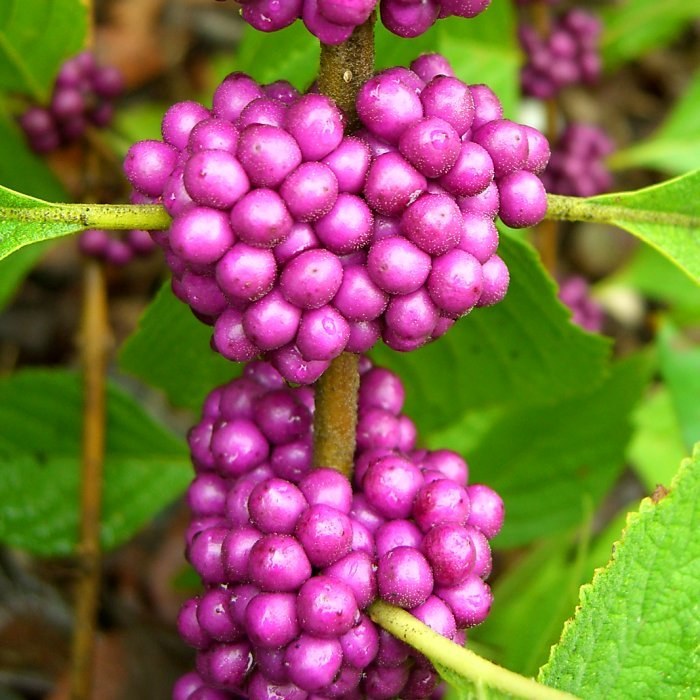
Key Identifying Features
Beautyberry (Callicarpa spp., including American C. americana and Asian C. dichotoma/bodinieri) is a deciduous shrub instantly recognized in fall by its tight clusters of brilliant metallic violet-to-magenta berries encircling the stems at each leaf node. No other common shrub has berries in quite this electric purple, ringed around the twigs. It grows as an arching, open shrub 3-8 feet tall.
- Dense clusters of vivid magenta/violet berries wrapped around the stem at leaf joints
- Opposite, toothed, oval leaves
- Arching, loosely branched habit
- Small pink-lavender flower clusters in the same axil positions in summer
Leaves & Stems
Leaves are opposite (or sub-whorled), simple, oval to elliptical, 2-6 inches long, with toothed margins, a pointed tip, and a slightly fuzzy underside; American beautyberry leaves are larger and can be aromatic when crushed. Foliage is light to medium green, turning yellowish-green in fall. Stems are slender, arching, and gracefully drooping, with branching often in opposite/forked pairs. The opposite leaves and lax arching form set the stage for the berries.
Flowers & Fruit
In summer, small clusters (cymes) of tiny pink to lavender flowers form in the leaf axils, hugging the stem. These ripen in late summer and fall into the show-stopping fruit: dense, rounded clusters of small, round, glossy berries (drupes) in an intense magenta-purple to violet (white in some cultivars), each cluster wrapped tightly around the stem at a node, with several clusters spaced along each arching branch. The berries often persist after the leaves drop, and birds eventually strip them. This berry display is essentially unmistakable.
How to Tell It Apart from Look-Alikes
- Pokeweed (Phytolacca): has dark purple berries but in hanging clusters on a soft herbaceous stem, not rings around woody twigs.
- Privet/viburnum/dogwood: have blue-black or white/red berries, never the clustered electric-magenta rings at nodes.
- Coralberry (Symphoricarpos): clustered berries at nodes too, but they are coral-pink/dull red, smaller, and the shrub is finer-twigged.
- Porcelain berry: a vine, not a shrub, with multicolored berries.
The rings of vivid magenta berries around the nodes of an arching shrub with opposite toothed leaves confirm beautyberry.
Where You'll Find It
American beautyberry is native to the southeastern United States, growing in open woods, woodland edges, and clearings; Asian species are common in gardens worldwide. All are planted for their spectacular fall berries in sun to part shade and moist, well-drained soil, and are valued for attracting birds.
Quick ID Checklist
- Arching, open deciduous shrub, 3-8 ft
- Opposite, toothed, oval leaves (sometimes aromatic)
- Tight clusters of brilliant magenta-purple berries ringing the stems at leaf nodes
- Several berry clusters spaced along each branch
- Small pink-lavender axillary flowers in summer
Frequently asked questions
What plant has bright purple berries clustered around the stem?
That is almost certainly beautyberry (Callicarpa). Its trademark is dense clusters of metallic magenta-purple berries wrapped tightly around the stems at each leaf node, spaced along arching branches in fall.
How do I tell beautyberry from pokeweed?
Beautyberry is a woody shrub with berries clustered in rings around the stems, while pokeweed is a soft herbaceous plant with dark berries hanging in elongated clusters. The woody arching stems and node-ringing berries point to beautyberry.
Why do the berries grow in rings around the branch?
The flowers, and later the berries, form in clusters in the leaf axils. Because the leaves are opposite, the fruit clusters develop on both sides of each node, appearing to encircle the stem.
What do beautyberry leaves look like?
They are opposite (sometimes sub-whorled), simple, oval to elliptical, 2-6 inches long, with toothed margins and a pointed tip, set on slender arching stems.