Beautyberry
Callicarpa americana
A deciduous shrub famous for the clusters of vivid metallic-purple berries that wrap its arching branches in fall. Native to the southeastern US, it is easy, wildlife-friendly, and unmistakable in autumn.
- Light
- Full sun to part shade
- Water
- Medium; drought-tolerant once established
- Difficulty
- Easy
Got a plant like this?
Identify any plant from a photo, free.
Overview
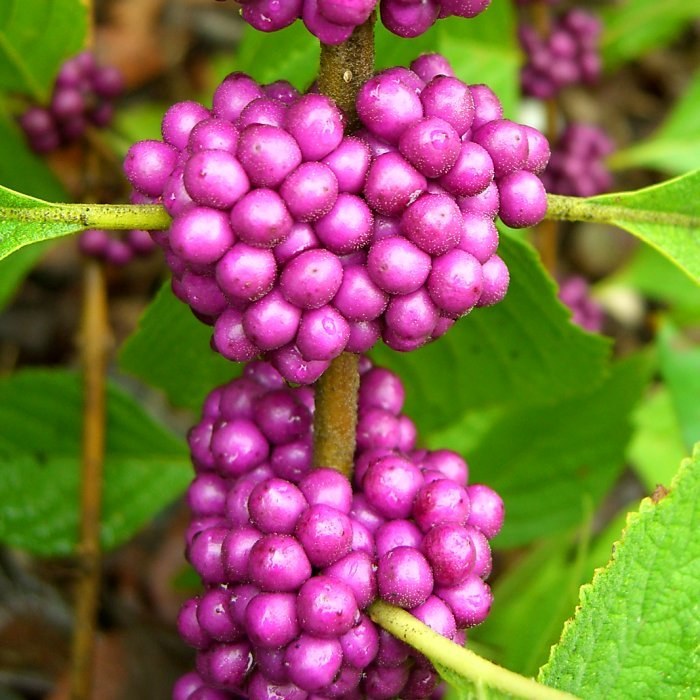
Beautyberry is a loose, arching deciduous shrub grown almost entirely for its show-stopping autumn fruit: tight clusters of small, iridescent purple-magenta berries that encircle the stems where the leaves meet them. American beautyberry (Callicarpa americana) is the native species, while Asian species like C. bodinieri are also grown.
Summer brings small, inconspicuous lavender-pink flowers in the leaf axils, but it is the brilliant berries, lasting well into fall after the leaves drop, that make the plant unforgettable. Birds eventually strip the fruit.
Tough, fast-growing, and adaptable, beautyberry is an easy native shrub for wildlife gardens and naturalistic borders.
How to identify it
- Berries: Dense, tight clusters of small, glossy, iridescent purple-magenta (rarely white) berries wrapped around the stems at the leaf nodes in fall; the key identifier
- Flowers: Small clusters of pale lavender-pink flowers in the leaf axils in summer
- Leaves: Opposite, oval, toothed, light green, 3-6 in, often with yellowish fall color, aromatic when crushed
- Habit: Open, loose, arching multi-stemmed shrub typically 3-6 ft tall and wide
- Stems: Long, gracefully arching branches
Care & growing
Light: Full sun to part shade; heaviest fruiting in sun, but tolerates light shade.
Water: Average moisture; drought-tolerant once established, with best fruiting under even moisture.
Soil: Very adaptable, tolerating poor and sandy soils; prefers moist, well-drained ground.
Temperature: Hardy roughly USDA zones 6-10 (American beautyberry); Asian species somewhat hardier.
Feeding: Minimal; avoid heavy nitrogen, which favors leaves over fruit.
Pruning: Blooms and fruits on new wood, so cut back hard in late winter or early spring to keep it dense and fruitful.
Propagation: Easy from softwood cuttings or seed.
Habitat & origin
American beautyberry is native to the southeastern United States, from Maryland to Florida and west to Texas and parts of Mexico and the Caribbean, where it grows in open woodlands, thickets, and woodland edges. Other beautyberry species are native to eastern Asia.
It is widely planted in warm-temperate gardens for fall color, in wildlife and native plantings, and in naturalistic shrub borders.
Frequently asked questions
How do I identify beautyberry?
Its unmistakable feature is the dense clusters of small, glossy, iridescent purple-magenta berries wrapped tightly around the stems at the leaf nodes in fall, on an open, arching shrub.
When and how should I prune beautyberry?
Cut it back hard in late winter or early spring. It flowers and fruits on new growth, so hard pruning encourages a fuller plant with more berries.
Why doesn't my beautyberry have many berries?
Too much shade or excess nitrogen fertilizer can reduce fruiting. Give it sun, go easy on feeding, and prune for new growth to maximize berries.
Beautyberry guides
In-depth guides for identifying, growing, and caring for Beautyberry.
How to Care for Beautyberry
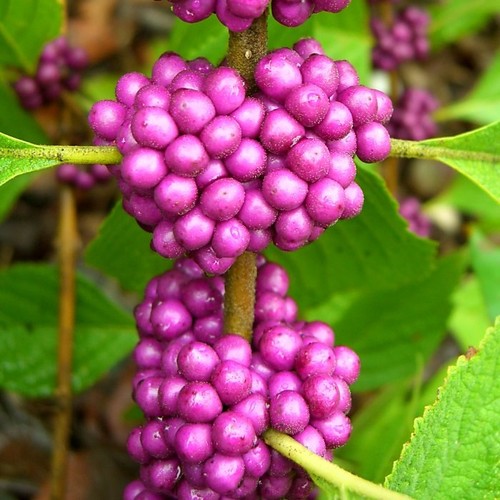
Grow easy, arching beautyberry shrubs for their spectacular clusters of vivid violet autumn berries along the stems.
Beautyberry Identification Guide
How to identify beautyberry by its arching branches studded with tight clusters of vivid magenta-purple berries around the leaf nodes.