Bindweed Identification Guide
How to identify field bindweed (Convolvulus arvensis), a twining vine weed with arrowhead leaves and white-to-pink funnel flowers.
Read the full Bindweed encyclopedia entry →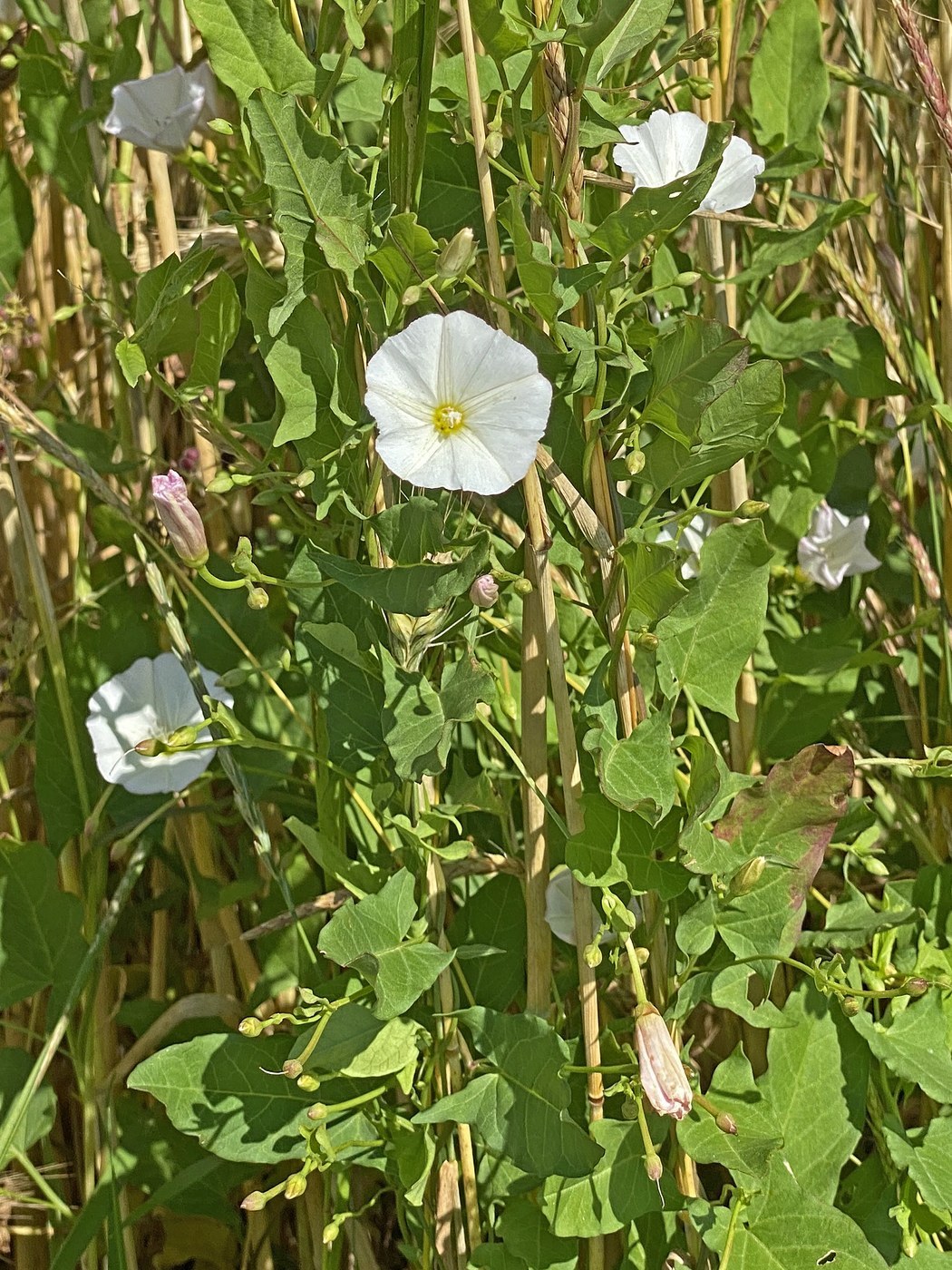
Key Identifying Features
Field bindweed (Convolvulus arvensis), often just "bindweed" or wild morning glory, is a persistent perennial twining vine that climbs and smothers other plants. Identify it by arrowhead- or spade-shaped leaves, small white to pink funnel-shaped (morning-glory) flowers, slender twining stems, and an extensive deep root system.
- Twining/trailing vine, stems to 3-6 ft long
- Arrowhead-shaped leaves with pointed basal lobes
- Funnel-shaped flowers about 1 inch across, white to pale pink
Leaves & Stems
Leaves are alternate, arrowhead (sagittate) to spade-shaped, 1-2 inches long, with two pointed or squared lobes at the base and a rounded to pointed tip. They are smooth-edged and mostly hairless. The slender, twining stems wind tightly around stems, fences, and each other, either climbing or trailing flat across the ground. Underground, bindweed has a remarkably deep, spreading root and rhizome system that makes it very hard to eradicate.
Flowers & Fruit
From late spring through fall, bindweed produces funnel- or trumpet-shaped flowers about 1 inch wide, white to pale pink, sometimes with pinkish stripes, resembling small morning glories. Each flower opens in the morning and closes by afternoon or in cloudy weather. Just below the flower are two small bracts set well down the stalk (not right under the flower), a useful detail. Fruit is a small round capsule with a few seeds.
How to Tell It Apart from Look-Alikes
- Hedge bindweed (Calystegia sepium): larger flowers (2-3 inches) and bigger leaves, with two large bracts directly clasping the base of the flower; field bindweed's flowers and leaves are small and bracts are set down the stalk.
- Morning glory (Ipomoea): annual with larger, often heart-shaped leaves and showier flowers; field bindweed is perennial with arrowhead leaves.
- Wild buckwheat: twining annual but with a papery sheath (ocrea) at nodes and tiny greenish flowers.
Where You'll Find It
Field bindweed thrives in fields, gardens, roadsides, lawns, fencerows, and disturbed ground in full sun. It is a notorious agricultural and garden weed worldwide and a listed noxious weed in many areas. It tolerates drought thanks to deep roots and quickly recolonizes broken ground.
Quick ID Checklist
- Twining vine climbing or trailing
- Arrowhead-shaped alternate leaves
- White-to-pink funnel flowers ~1 inch, closing midday
- Two small bracts set down the flower stalk
- Deep, persistent spreading roots
Frequently asked questions
How do I tell field bindweed from hedge bindweed?
Field bindweed has small (1 inch) flowers and arrowhead leaves with two bracts set down the flower stalk. Hedge bindweed has much larger (2-3 inch) flowers, bigger leaves, and two large bracts clasping right at the base of the flower.
Is bindweed the same as morning glory?
They are related and look similar, but true morning glories (Ipomoea) are usually annuals with larger heart-shaped leaves and showier flowers. Field bindweed is a perennial weed with small flowers and arrowhead leaves.
Why is bindweed so hard to get rid of?
It has a deep, extensive root and rhizome system that can regrow from small fragments and store energy, so it returns even after the top growth is removed.
What time of day are the flowers open?
The funnel-shaped flowers open in the morning and typically close by afternoon or in cloudy weather, which is why bindweed is sometimes called wild morning glory.
Bindweed identified by the community
Recent Bindweed specimens identified with Plant Identifier.