
Bishop's Cap Cactus Identification Guide
Identify the Bishop's Cap Cactus (Astrophytum myriostigma) by its spineless, star-shaped ribbed body flecked with tiny white scales.
Read the full Bishop's Cap Cactus encyclopedia entry →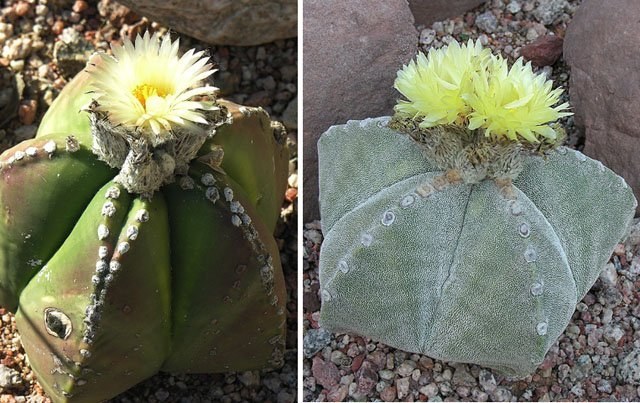
Key Identifying Features
The Bishop's Cap Cactus (Astrophytum myriostigma) is a small, spineless, star-shaped cactus whose plump ribbed body, viewed from above, looks like a five-pointed star or a bishop's miter. It typically stays globe-shaped when young, slowly becoming more columnar with age, and reaches only a few inches across to about a foot tall over many years.
- Usually 5 prominent ribs (sometimes 3–8), giving a clean star outline from the top
- No spines at all — smooth ribs
- Surface dusted with tiny white woolly scales/flecks that give a frosted gray-green look
- Wool-tufted areoles running down the rib crests
Leaves & Stems
Leafless. The body is fleshy and sharply ribbed, each rib like the segment of a star. The signature feature is the dense covering of minute white trichome scales ("myriostigma" means "countless spots") that can make the plant look almost silvery; some forms (var. nudum) lack the scales and appear plain green. Areoles sit along the rib edges as small woolly tufts but bear no spines.
Flowers & Fruit
From the woolly crown the plant produces glossy yellow, daisy-like flowers, sometimes with an orange-red throat, usually a couple of inches across. Flowering occurs on mature plants in the growing season. Fruit is a small, reddish, woolly capsule that splits to release black seeds.
How to Tell It Apart from Look-Alikes
- Astrophytum ornatum: Also star-ribbed but has spines and bolder white banding; Bishop's Cap is spineless.
- Astrophytum asterias (Star/Sand Dollar Cactus): Flat, button-shaped, ribs very low and flush; Bishop's Cap is taller with raised ribs.
- Astrophytum capricorne: Star-ribbed but with long, twisting papery spines, unlike spineless Bishop's Cap.
Where You'll Find It
Native to the highlands of northern and central Mexico on limestone soils. A prized, easy collector's cactus grown worldwide in bright light, gritty alkaline-leaning soil, and dry winters. Hardy to roughly USDA zones 9–11; elsewhere a sunny-windowsill houseplant. Slow-growing and very drought-tolerant.
Quick ID Checklist
- Star-shaped body, typically 5 raised ribs
- Completely spineless
- Frosted with tiny white scales (gray-green look)
- Woolly areoles along rib crests; yellow daisy-like flowers from the top
- Small, slow-growing, Mexican limestone origin
Frequently asked questions
Why does it look frosted or speckled white?
The surface is covered in countless tiny white woolly scales (trichomes), which give the plant its silvery, flecked appearance and inspired the name myriostigma ('countless spots').
Does Bishop's Cap have spines?
No. It is naturally spineless, which is one of the easiest ways to tell it from related Astrophytum species like A. ornatum or A. capricorne.
How many ribs should it have?
Most have 5 ribs, forming a clean star shape from above, though plants with 3, 4, 6, or more ribs occur.
What soil does it prefer?
A gritty, very well-drained mix that leans slightly alkaline suits it, reflecting its native limestone soils in Mexico.