
Black-Eyed Susan Vine Identification Guide
Recognize black-eyed Susan vine (Thunbergia alata) by its bright orange or yellow five-petaled flowers with a dark central 'eye,' on a twining vine with arrowhead leaves.
Read the full Black-Eyed Susan Vine encyclopedia entry →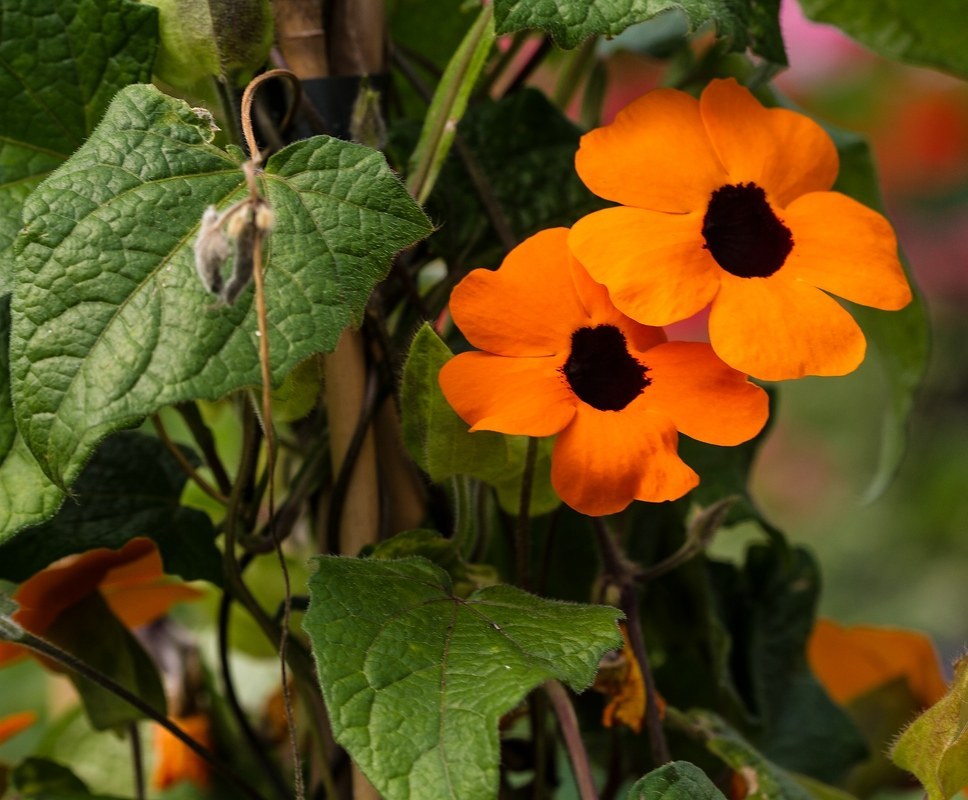
Key Identifying Features
Black-eyed Susan vine (Thunbergia alata) is identified by its cheerful flat, five-petaled flowers — typically bright orange or yellow — each centered with a dark purple-black throat or 'eye.' It is a modest twining vine with triangular, arrowhead-shaped leaves. Despite the name, it is unrelated to the true black-eyed Susan daisy (Rudbeckia).
- Flat, five-lobed flowers about 1–1.5 inches across
- Bright orange/yellow petals with a dark central eye
- Arrowhead/heart-shaped leaves with winged stalks
- Twining vine climbing 3–8 feet
Leaves & Stems
Leaves are triangular to arrowhead (hastate) or heart-shaped, opposite, with toothed or slightly lobed margins and a rough texture. The leaf stalks (petioles) often have small wings — a detail in the species name alata, meaning winged. Stems are slender, twining, and softly hairy, climbing by wrapping around supports or trailing over edges.
Flowers & Fruit
Each flower has a short tube opening into five rounded, slightly overlapping petal lobes that lie flat, in orange, yellow, cream, white, or apricot, surrounding a dark, near-black central throat that gives the plant its name (some cultivars lack the dark eye). Flowers are borne singly in the leaf axils on long stalks and bloom continuously in warm weather. A rounded, beaked seed capsule follows. Blooms from summer to frost.
How to Tell It Apart from Look-Alikes
- True black-eyed Susan (Rudbeckia): An upright daisy with many ray petals around a domed brown cone — not a vine and not five flat petals.
- Morning glory: Has funnel-shaped flowers and heart-shaped leaves, not flat five-lobed dark-eyed flowers.
- Nasturtium: Has round leaves and spurred flowers — different structure.
- The flat orange/yellow five-petaled flower with a dark eye on a twining arrowhead-leaved vine identifies Thunbergia alata.
Where You'll Find It
Black-eyed Susan vine is a popular annual climber (perennial in frost-free zones) for trellises, hanging baskets, containers, fences, and mailboxes. Native to East Africa, it likes full sun to part shade, warmth, and moist, well-drained soil, blooming nonstop through summer. It is easy from seed and a common choice for quick vertical color.
Quick ID Checklist
- Flat five-petaled flowers with a dark central eye
- Bright orange or yellow (also cream/apricot/white)
- Arrowhead/heart-shaped leaves with winged stalks
- Twining vine to 3–8 ft
- Blooms all summer; not a daisy
Frequently asked questions
Is black-eyed Susan vine the same as black-eyed Susan?
No. Despite the shared name, the vine is Thunbergia alata, a twining climber with flat five-petaled flowers, while the true black-eyed Susan (Rudbeckia) is an upright daisy. They are unrelated.
Why is it called black-eyed Susan vine?
Most flowers have a dark purple-black throat or 'eye' at the center, surrounded by bright orange or yellow petals, resembling the dark center of the daisy it is named after.
What do the leaves look like?
The leaves are triangular, arrowhead, or heart-shaped with toothed edges and often winged leaf stalks, arranged opposite on slender twining stems.
Does black-eyed Susan vine come back every year?
It is a tender perennial grown as an annual in cold climates, where frost kills it. In frost-free regions it can persist and bloom for multiple years, and it often self-sows.