Black-Eyed Susan Vine
Thunbergia alata
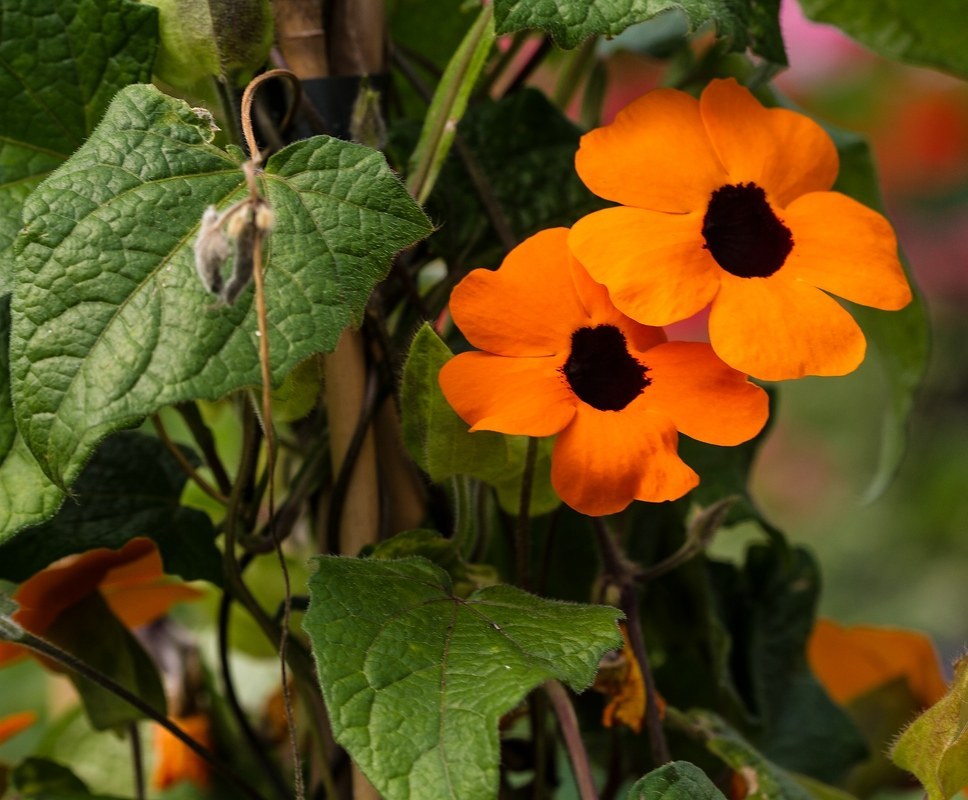
A cheerful twining vine from Africa bearing masses of flat, five-petaled flowers in orange, yellow or white, each with a dark chocolate-purple center 'eye.' It quickly covers trellises and trails from baskets through the warm season.
- Light
- Full sun to part shade
- Water
- Keep evenly moist
- Difficulty
- Easy
Got a plant like this?
Identify any plant from a photo, free.
Overview
Black-eyed Susan vine is a vigorous but well-behaved climbing annual (perennial in frost-free climates) grown for its constant display of bright, dark-centered flowers. The common name comes from the resemblance of the dark eye to the unrelated black-eyed Susan daisy.
It twines readily up supports or trails attractively from containers and baskets, blooming from summer until frost with little fuss.
How to identify it
- Twining vine climbing or trailing 3-8 ft (1-2.5 m) in a season
- Leaves are triangular to arrow- or heart-shaped, mid-green, with winged leaf stalks
- Flowers are flat, about 1.5 in across, with five rounded petals around a dark purple-black throat or 'eye'
- Petal colors are typically orange, yellow, cream or white; newer types add apricot, rose and red
- The contrasting dark eye is the signature feature
Care & growing
- Light: Full sun to partial shade; some afternoon shade helps in hot climates
- Water: Keep soil evenly moist for continuous bloom
- Soil: Fertile, well-drained soil or quality potting mix
- Temperature: Warmth-loving and frost-tender
- Feeding: Feed regularly, especially in containers, to sustain flowering
- Propagation: From seed started indoors before the last frost, or from cuttings
Provide a trellis, strings or obelisk to climb, or let it trail from a basket. Pinch young plants to encourage branching.
Habitat & origin
Native to eastern Africa, the plant grows naturally in warm, frost-free conditions and has naturalized in tropical regions worldwide.
Grown as a warm-season ornamental annual in temperate gardens and as a perennial vine in frost-free climates, popular for trellises, baskets and container combinations.
Frequently asked questions
Is black-eyed Susan vine related to the black-eyed Susan daisy?
No, despite the shared name; the vine is a Thunbergia, while the daisy is a Rudbeckia. Both simply have dark-centered flowers.
Can black-eyed Susan vine grow in a hanging basket?
Yes, it trails beautifully from baskets and containers and also climbs supports, making it versatile in the garden.
Is black-eyed Susan vine a perennial?
It is a tender perennial in frost-free climates but is grown as an annual where winters are cold.
How much sun does it need?
It blooms best in full sun but tolerates partial shade, and a little afternoon shade is helpful in very hot regions.
Black-Eyed Susan Vine guides
In-depth guides for identifying, growing, and caring for Black-Eyed Susan Vine.
How to Care for Black-Eyed Susan Vine
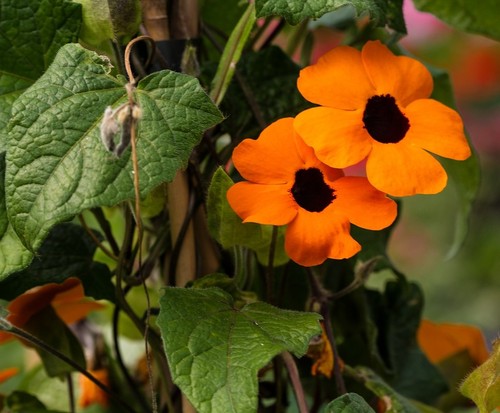
Grow the cheerful Black-Eyed Susan Vine (Thunbergia alata) with plenty of sun, steady moisture, and a sturdy trellis to climb.
Black-Eyed Susan Vine Identification Guide
Recognize black-eyed Susan vine (Thunbergia alata) by its bright orange or yellow five-petaled flowers with a dark central 'eye,' on a twining vine with arrowhead leaves.