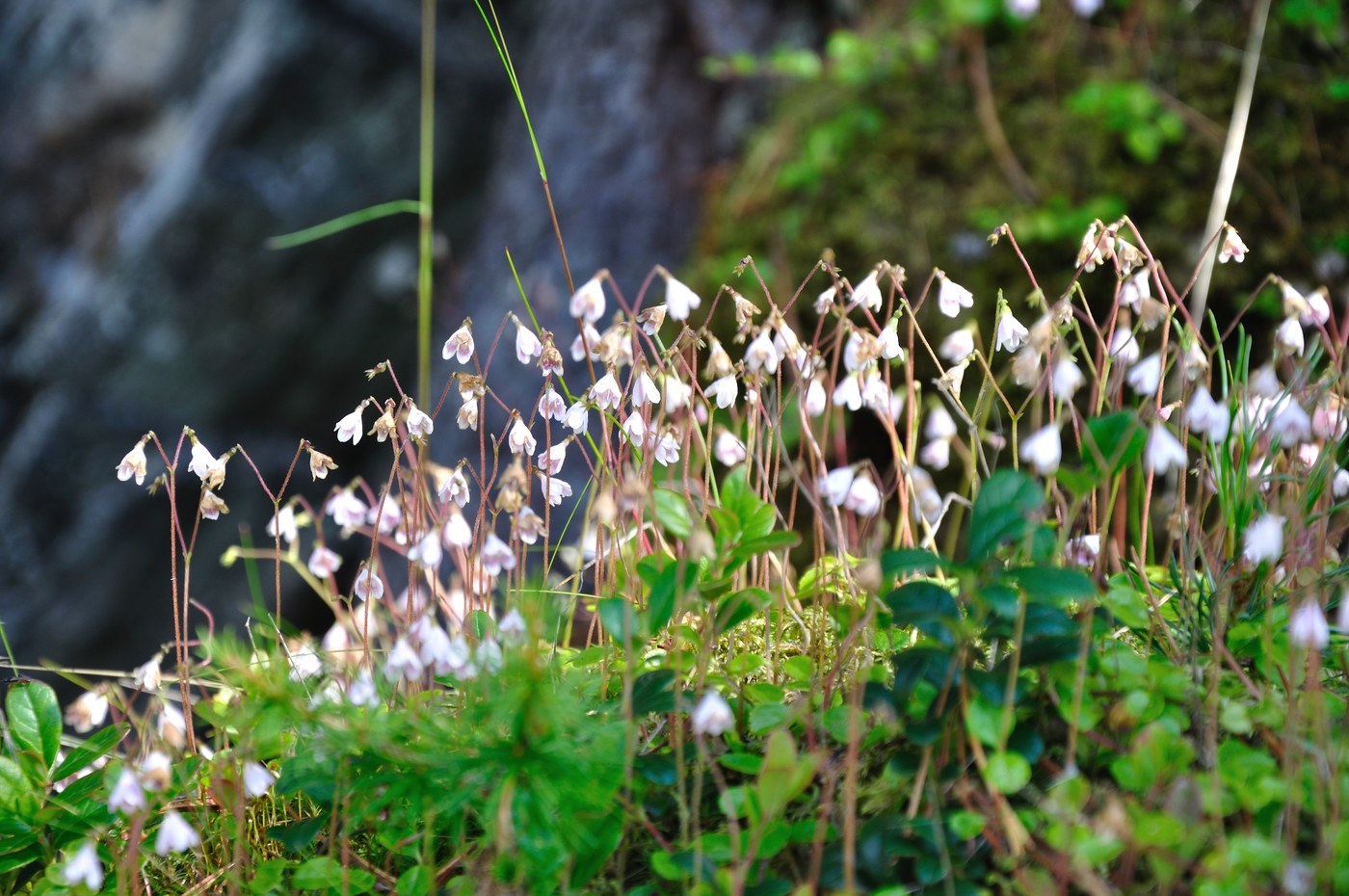
Twinflower
Linnaea borealis
A delicate, mat-forming evergreen subshrub of northern forests bearing nodding pairs of fragrant, bell-shaped pink flowers; the namesake of botanist Linnaeus.
- Light
- Partial to full shade
- Water
- Keep evenly moist; cool conditions
- Difficulty
- Moderate
Got a plant like this?
Identify any plant from a photo, free.
Overview
Twinflower is a slender, trailing, semi-evergreen subshrub that creeps across the floor of cool boreal and montane forests across the Northern Hemisphere. In early summer it raises thread-like Y-shaped stalks, each bearing two nodding, bell-shaped, pale-pink flowers — the "twin" of its name — that release a sweet, almond-like fragrance, especially in the evening.
It was the favorite plant of Carl Linnaeus, the father of modern botanical naming, and the genus Linnaea was named in his honor. Forming delicate carpets, it is a treasure of woodland and cool shade gardens but demands cool, moist, acidic conditions.
How to identify it
- Flowers: Borne in nodding pairs on a forked stalk; each bell-shaped, 1 cm long, pale pink, fragrant.
- Leaves: Small, rounded to oval, evergreen, opposite, slightly toothed.
- Stems: Thin, trailing, rooting along the ground to form mats.
- Height: Very low, the foliage mat only a few centimeters high; flower stalks 5-10 cm.
- Habit: Creeping evergreen groundcover.
Care & growing
Light: Partial to full shade.
Water: Keep evenly moist; it dislikes drying out and needs cool roots.
Soil: Cool, moist, acidic, humus-rich woodland soil; resents heat.
Temperature: A cold-climate plant; struggles in hot, humid summers.
Feeding: Minimal; an acidic leaf-mould mulch suits it.
Propagation: Easiest from rooted runners or stem layers; seed is difficult.
Habitat & origin
Native across the cool temperate and boreal zones of the Northern Hemisphere — northern Europe, Asia, and North America — where it grows in coniferous and mixed forests, on mossy banks, and in cool, shaded, acidic soils.
It is challenging to cultivate outside cool climates, but in suitable regions it is grown in woodland and rock gardens as a fragrant, delicate native groundcover.
Frequently asked questions
Why is it named after Linnaeus?
Twinflower was the favorite plant of Carl Linnaeus, founder of binomial nomenclature, and the genus Linnaea was named to honor him.
Why does it have 'twin' in its name?
Each forked flower stalk bears two nodding, bell-shaped pink flowers side by side, giving it the appearance of twin blooms.
Is twinflower hard to grow?
It can be. It demands cool, moist, acidic, shaded conditions and dislikes heat and humidity, so it thrives mainly in cool-climate woodland gardens.
How do I propagate it?
The easiest method is to detach and replant the rooted runners or layered stems rather than trying to grow it from its tricky seed.
Twinflower guides
In-depth guides for identifying, growing, and caring for Twinflower.
How to Care for Twinflower
Delicate, shade-loving Twinflower needs cool, moist, acidic woodland soil and dappled light to carpet the ground with paired pink bells.
Twinflower Identification Guide
Identify Twinflower, a trailing boreal evergreen, by its paired nodding pink bell flowers on slender forked Y-shaped stalks.