
Twinflower Identification Guide
Identify Twinflower, a trailing boreal evergreen, by its paired nodding pink bell flowers on slender forked Y-shaped stalks.
Read the full Twinflower encyclopedia entry →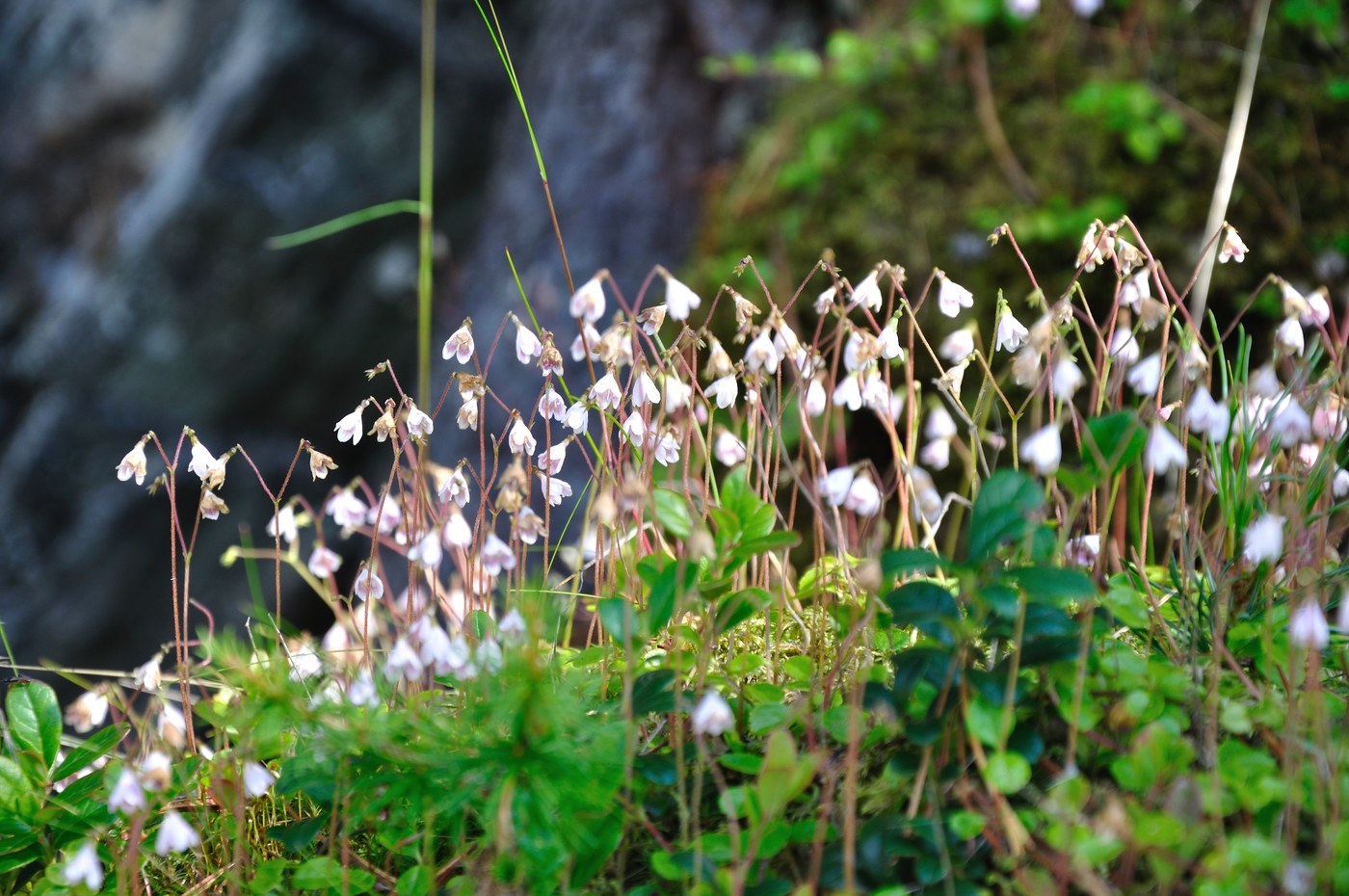
Key Identifying Features
Twinflower (Linnaea borealis) is a dainty trailing evergreen subshrub of cool northern forests, famously the favorite plant of Carl Linnaeus. Key features:
- Paired, nodding, bell-shaped pink flowers on a slender forked (Y-shaped) stalk — always in twos.
- A creeping, mat-forming, slightly woody trailing habit.
- Small rounded, opposite evergreen leaves.
- Whole plant low and delicate; flower stalks only 5–10 cm (2–4 in) tall.
Leaves & Stems
The wiry stems creep along the forest floor, rooting as they go to form low mats. From these, short upright stalks rise. Leaves are opposite, small (under 1.5 cm), rounded-to-oval, slightly toothed near the tip, leathery and evergreen, dark green and shiny. The thread-like flower stalk forks into two at the top, each fork holding a single hanging flower.
Flowers & Fruit
Flowering is in early-to-mid summer (June–August). The two matching flowers are pale to rosy pink, 5-lobed, trumpet/bell-shaped, about 1 cm long, hairy and often pinker-veined inside, and fragrant (sweetly scented, especially in evening). They hang downward facing outward. The fruit is a tiny dry burr-like achene that clings to fur or feathers for dispersal.
How to Tell It Apart from Look-Alikes
- Partridgeberry (Mitchella repens) also trails with paired flowers, but its flowers are white and fuzzy, fused at the base into one red berry, and leaves have a pale midrib.
- Trailing Arbutus (Epigaea repens) has larger, leathery leaves and clustered (not strictly paired) white-pink flowers.
- Wintergreen / Cranberries lack the Y-forked twin nodding bells.
The two pink nodding bells on a single forked stalk over a creeping evergreen mat is diagnostic and unique.
Where You'll Find It
Twinflower grows in cool coniferous and mixed boreal forests, mossy banks, and shaded peaty ground across the circumboreal north — North America, Europe, and Asia. It prefers shade, cool temperatures, and acidic, humus-rich or mossy soil, often carpeting the floor of spruce and pine woods.
Quick ID Checklist
- Two nodding pink bell flowers on a Y-forked stalk
- Creeping, mat-forming evergreen trailing stems
- Small, rounded, opposite evergreen leaves
- Flower stalks only 5–10 cm tall
- Fragrant, ~1 cm trumpet flowers
- Cool, shaded conifer/boreal forest floor
Frequently asked questions
Why is it called Twinflower?
Each slender stalk forks into a Y and carries exactly two matching nodding pink bell flowers — a 'twin' pair — which is the plant's signature feature.
Is Twinflower really Linnaeus's favorite plant?
Yes. The genus Linnaea was named after Carl Linnaeus, the father of modern taxonomy, who was often portrayed holding a sprig of this plant he especially loved.
How do I separate it from Partridgeberry?
Both trail with paired flowers, but Partridgeberry has white fuzzy flowers fused into a single red berry and a pale leaf midrib, while Twinflower has pink nodding bells on a forked stalk.
Where should I look for Twinflower?
Search the shaded, mossy floor of cool coniferous or mixed northern forests with acidic, humus-rich soil — it forms low creeping evergreen mats.