
Blackberry Identification Guide
How to identify blackberry (Rubus) by its thorny ridged canes, palmate toothed leaflets, and solid-cored black fruit.
Read the full Blackberry encyclopedia entry →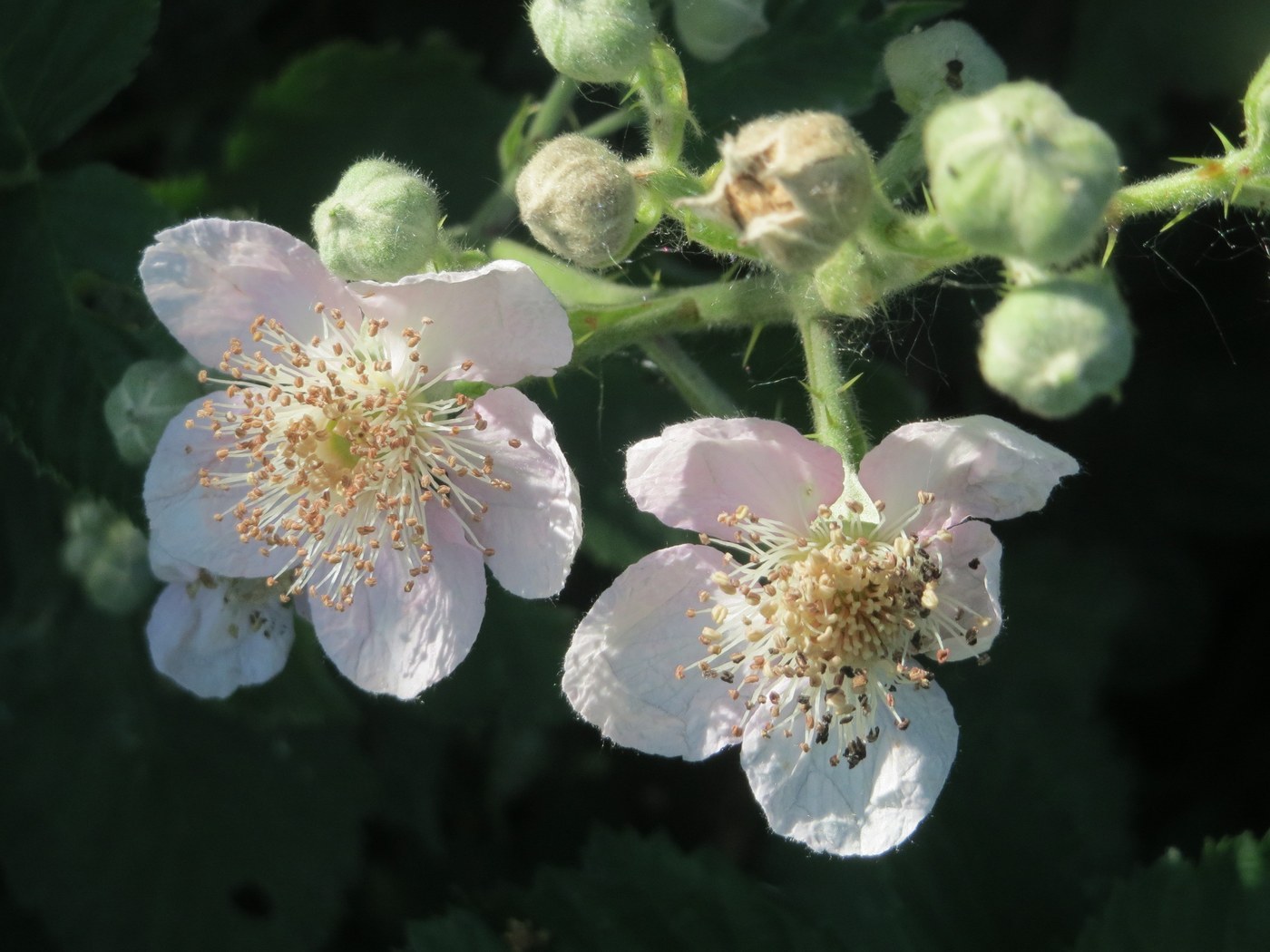
Key Identifying Features
Blackberries are vigorous bramble shrubs in the genus Rubus (subgenus Rubus). Identify them by stout, often ridged/angled canes armed with strong thorns, palmately compound toothed leaves, white-to-pink five-petaled flowers, and the key fruit trait: a glossy black berry that keeps its white core and comes off the plant solid.
- Robust, arching or trailing canes with sharp recurved thorns
- Leaves usually palmate with 3-5 toothed leaflets
- Showy white to pale-pink 5-petaled flowers in clusters
- Shiny black aggregate berry, solid (core stays in) when picked
Leaves & Stems
Canes (called brambles) are biennial and notably thick, often ridged or angular in cross-section, green to reddish or purple, and armed with stout, frequently curved thorns along the stem and even the leaf midribs. Leaves are compound, typically palmate with 3 or 5 leaflets radiating from one point (raspberry leaflets are more pinnately arranged). Each leaflet is oval, sharply toothed (serrated), deep green above and greener and less silvery beneath than a raspberry. Canes arch and can root at the tips, forming dense, hard-to-pass thickets.
Flowers & Fruit
Flowers are relatively large and showy, white to pale pink, with five petals and many stamens, borne in branched clusters in late spring and summer. The fruit is an aggregate of many shiny drupelets that ripen green to red to glossy black. The defining feature: a ripe blackberry retains its white core (receptacle) inside and detaches as a solid berry, the opposite of the hollow raspberry. Berries are firmer and shinier than raspberries.
How to Tell It Apart from Look-Alikes
- Raspberries: fruit comes off hollow leaving the core behind; canes are thinner and bristlier and leaf undersides are silvery-white. Blackberry = solid core; raspberry = hollow.
- Dewberries (Rubus trailing types): very similar but grow as low trailing vines rather than tall arching canes, with sparser fruit.
- Black raspberry: black fruit too, but it is hollow when picked and has waxy blue-white canes.
- Other thorny vines: blackberry's thorny ridged canes plus compound toothed leaves and solid black aggregate fruit are distinctive.
Where You'll Find It
Wild blackberries are abundant in hedgerows, forest edges, fields, roadsides, fence lines, and disturbed ground, often forming impenetrable brambles; some species are invasive (e.g., Himalayan blackberry). Cultivated thornless types grow on garden trellises. They favor full sun and tolerate poor soil across temperate regions.
Quick ID Checklist
- Stout, ridged/angular canes with strong curved thorns
- Palmate leaves of 3-5 toothed leaflets, greener underneath
- White to pink 5-petaled flowers in clusters
- Glossy black berry that stays solid (core inside) when picked
- Thicket-forming in sunny edges and waste ground
Frequently asked questions
What's the surest way to tell a blackberry from a raspberry?
Pick a ripe berry. A blackberry keeps its white core inside and comes off solid, while a raspberry pulls free hollow, leaving the core behind. Blackberry canes are also thicker and more thorny, and the leaf undersides are green rather than silvery.
What are blackberry thorns like?
They are sharp and often curved, easily snagging skin and clothing. The stout, recurved thorns on ridged canes are a useful identification feature, though thornless cultivated varieties exist for gardens.
Why are some berries on the same plant red and others black?
Blackberries ripen through stages: green, then red, then glossy black. Only the fully black berries are fully ripe. Red ones are simply unripe, not a different fruit.
How can I distinguish a blackberry from a dewberry?
They are close relatives, but dewberries grow as low, trailing vines along the ground with sparser fruit and slender stems, while blackberries form tall, stout, arching canes that mound into thickets.