
Bleeding Heart Identification Guide
Recognize bleeding heart by its arching stems of dangling heart-shaped pink-and-white flowers, deeply divided fern-like foliage, and shade woodland habit.
Read the full Bleeding Heart encyclopedia entry →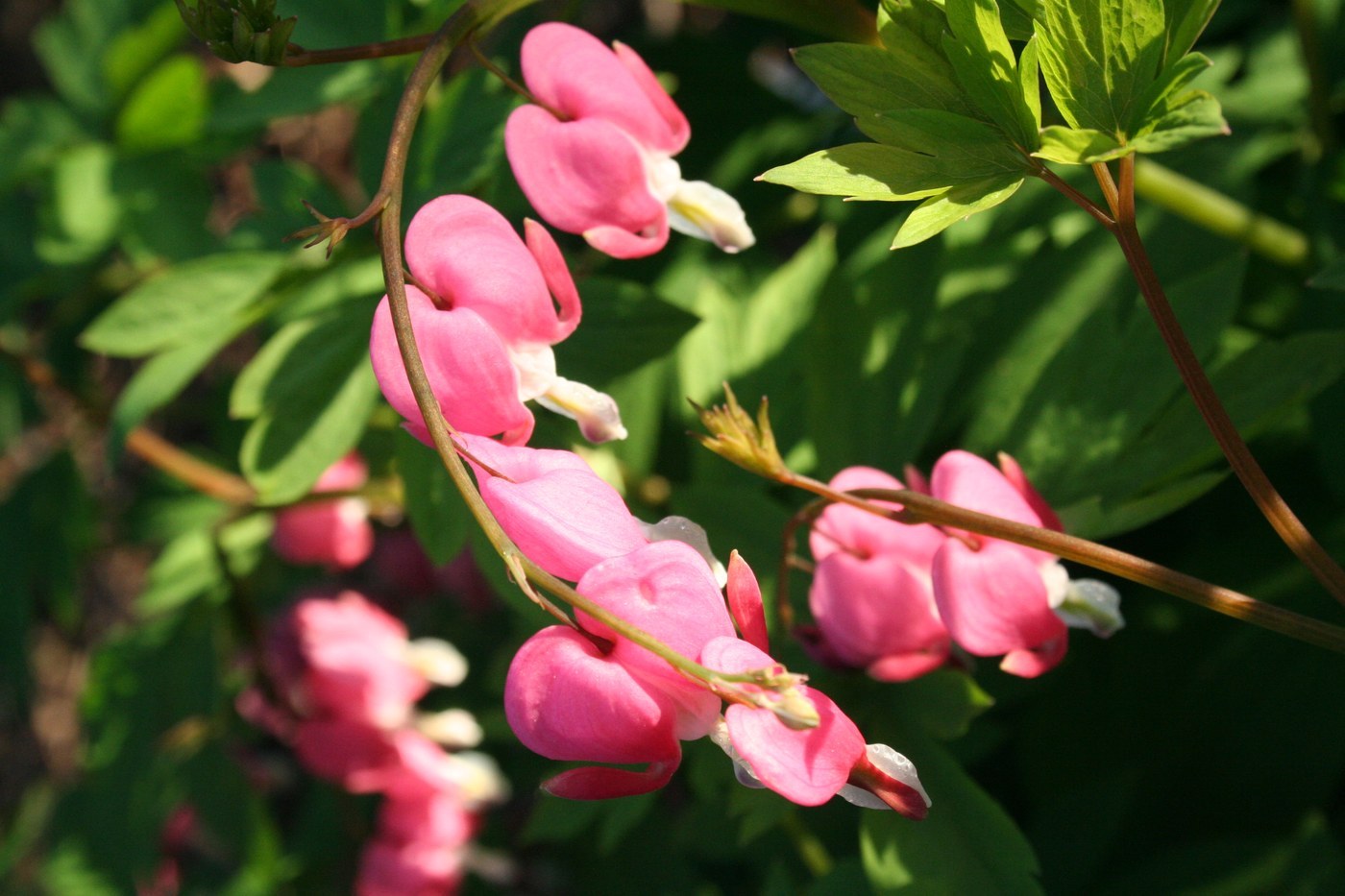
Key Identifying Features
Bleeding heart (Lamprocapnos spectabilis, formerly Dicentra spectabilis) is a shade perennial in the poppy family (Papaveraceae, fumitory group). It is one of the most distinctive spring flowers. Look for:
- Rows of dangling, heart-shaped flowers with a white "drop" protruding from the base.
- Arching, wand-like flower stems lined with blooms on one side.
- Soft, deeply divided, fern-like blue-green foliage.
Leaves & Stems
Leaves are compound and deeply divided (ternately/pinnately lobed), soft, and fern-like or parsley-like, in a fresh blue-green that emerges early in spring. They are borne on brittle, succulent, reddish-tinged stems from a clumping crown with fleshy roots. The plant grows 2–3 feet tall and wide, forming a graceful mound. The arching flowering stems (racemes) rise and curve outward, holding the dangling flowers in a neat one-sided row. Foliage often yellows and dies back (goes dormant) by midsummer.
Flowers & Fruit
Flowers are the unmistakable feature: each is a pendant, puffy, heart-shaped (cordate) bloom about 1 inch long, typically rose-pink on the outer petals with a white inner petal protruding at the bottom like a drop — hence "bleeding heart." A pure white form ('Alba') exists. The flowers hang in a single row along the arching stem, all facing downward, blooming in mid to late spring. After flowering, a slender seed capsule may form. The classic heart-with-a-drop shape is found in no other common garden plant.
How to Tell It Apart from Look-Alikes
- Fringed/wild bleeding heart (Dicentra eximia): Smaller, with clusters of narrower pink hearts held more upright above the foliage, and blooms longer through summer.
- Dutchman's breeches (Dicentra cucullaria): Related, but flowers look like tiny white upside-down pantaloons, not pink hearts.
- Astilbe / bleeding-heart fern confusion: Astilbe has similar divided leaves but plume flowers, not dangling hearts.
The one-sided arching row of pink hearts each with a white drop is diagnostic for classic bleeding heart.
Where You'll Find It
Bleeding heart is a beloved woodland and shade-garden perennial, planted in partial to full shade with moist, rich, well-drained soil. You'll find it in cottage gardens, along shaded borders, and beneath trees, often paired with hostas and ferns. It thrives in cool temperate climates and goes dormant in summer heat.
Quick ID Checklist
- Heart-shaped pendant flowers with a white protruding drop
- Flowers in a one-sided row on arching stems
- Soft, deeply divided fern-like blue-green leaves
- Clumping 2–3 ft mounded perennial
- Spring bloom, summer dormancy
- Shade and moist rich soil
Frequently asked questions
Why is it called bleeding heart?
Each pendant flower is shaped like a puffy heart, and a white inner petal protrudes from the bottom like a falling drop or droplet of blood. This heart-with-a-drop shape gives the plant its name and makes it easy to identify.
How do I tell classic bleeding heart from fringed bleeding heart?
Classic bleeding heart (Lamprocapnos spectabilis) has large pink hearts hanging in a one-sided row on arching stems and blooms in spring. Fringed bleeding heart (Dicentra eximia) has smaller, narrower flowers in upright clusters and blooms longer into summer.
Why does my bleeding heart disappear in summer?
It is a spring ephemeral that naturally goes dormant after flowering, with the foliage yellowing and dying back in summer heat. The plant is not dead and will return the following spring.