
Bloodroot Identification Guide
Identify Bloodroot (Sanguinaria canadensis) by its solitary white flower, single wrapping lobed leaf, and red-orange sap. This guide covers its early-spring bloom and woodland habitat.
Read the full Bloodroot encyclopedia entry →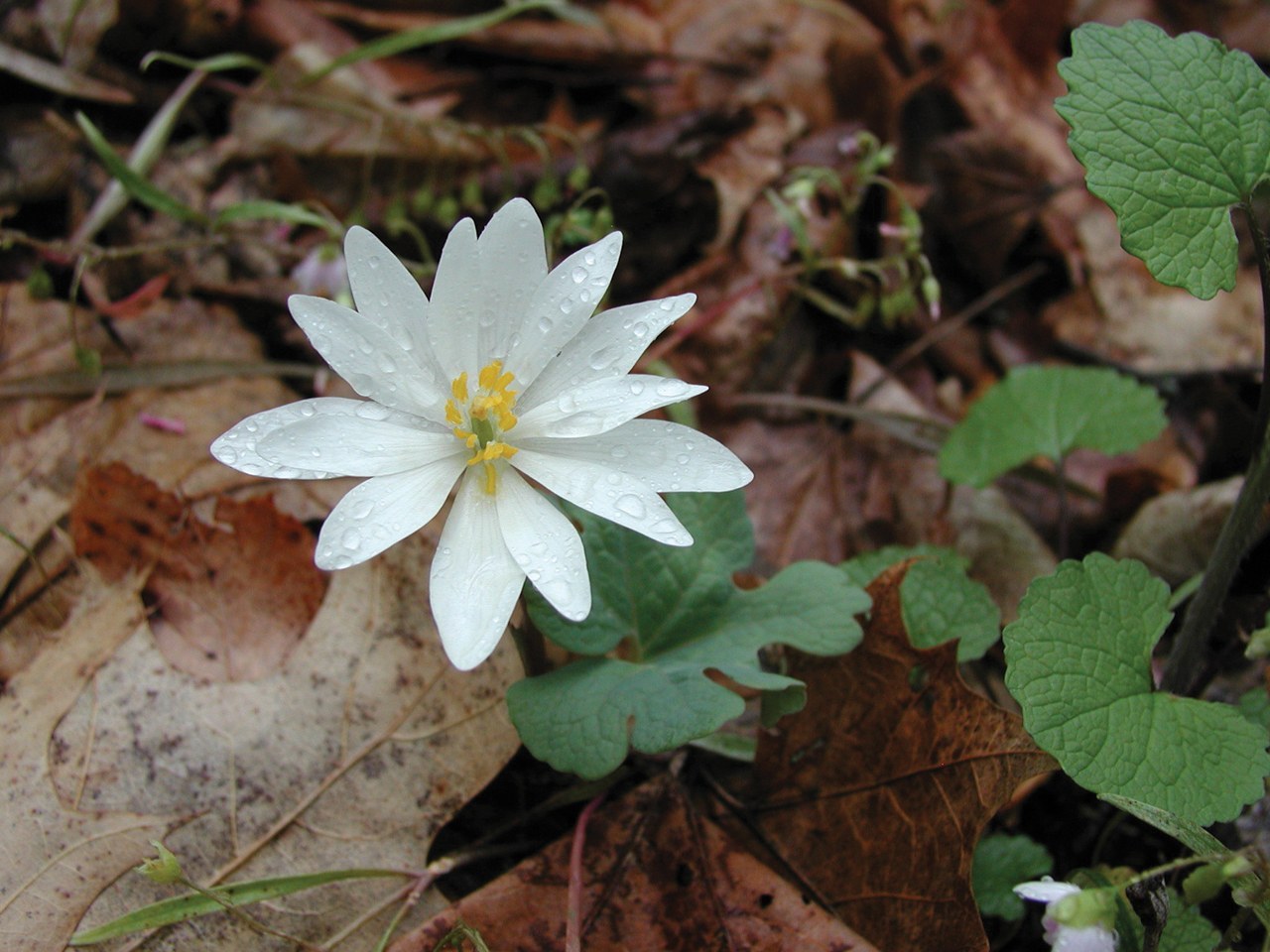
Key Identifying Features
Bloodroot (Sanguinaria canadensis) is an early spring woodland wildflower famous for its pure white flower with a golden center and for the red-orange sap that bleeds from its roots and stems. Each plant is low, 6 to 10 inches (15 to 25 cm) tall, producing a single flower wrapped by a single distinctive leaf.
- A solitary white flower with 8 to 12 petals and a yellow center
- A single deeply lobed, rounded leaf that wraps the flower stem
- Red-orange sap in roots and stems
- Among the earliest spring woodland bloomers
Leaves & Stems
A single basal leaf emerges wrapped around the flower stalk, then unfurls. The leaf is rounded, blue-green, and palmately lobed with 5 to 9 scalloped lobes, somewhat resembling a hand or fan. Both the leaf stalk and the underground rhizome exude a bright red-orange juice when cut, giving the plant its name. The leaf often continues to enlarge after flowering.
Flowers & Fruit
The flower has 8 to 12 (often around 8) brilliant white petals of slightly uneven length around a cluster of golden-yellow stamens. Blooms are delicate and short-lived, often lasting only a day or two and closing at night and in cloud. Flowering is very early spring (March to April), before most trees leaf out. The fruit is an elongated green seed pod; seeds bear fleshy appendages that attract ants for dispersal.
How to Tell It Apart from Look-Alikes
- Rue anemone / wood anemone: white flowers but with whorled, divided leaves and no red sap.
- Bloodroot vs. trillium: trillium has three petals and three leaves; bloodroot has many petals and one wrapping leaf.
- Twinleaf (Jeffersonia): similar white flower but a leaf split into two mirror halves.
The surest test is the red-orange sap combined with the single lobed wrapping leaf and many-petaled white flower.
Where You'll Find It
Bloodroot grows in rich, moist deciduous woodlands, slopes, and stream banks across eastern and central North America. It prefers dappled spring sunlight and humus-rich soil. As a spring ephemeral the flower is fleeting, so look in early spring.
Quick ID Checklist
- Single white flower, 8 to 12 petals, yellow center
- One rounded, lobed leaf wrapping the stem
- Red-orange sap when broken
- Very early spring bloom
- Flowers short-lived, close at night
- Rich, shaded woodland
Frequently asked questions
Why is it called bloodroot?
Because its roots and stems contain a bright red-orange sap that bleeds out when the plant is cut or broken. This distinctive sap is one of the most reliable ways to confirm the plant's identity.
How long do bloodroot flowers last?
Not long. The delicate white flowers are short-lived, often lasting only a day or two, and they close at night and in cloudy weather. This is why they are easy to miss in early spring.
What does the leaf look like?
Each plant has a single rounded, blue-green leaf with 5 to 9 scalloped lobes that initially wraps around the flower stalk before unfurling and enlarging after the bloom fades.