
Blue-eyed Grass Identification Guide
Identify Blue-eyed Grass (Sisyrinchium) by its small six-petaled blue-violet flowers with yellow centers on flat, grass-like stems. This guide explains why it is an iris, not a grass.
Read the full Blue-eyed Grass encyclopedia entry →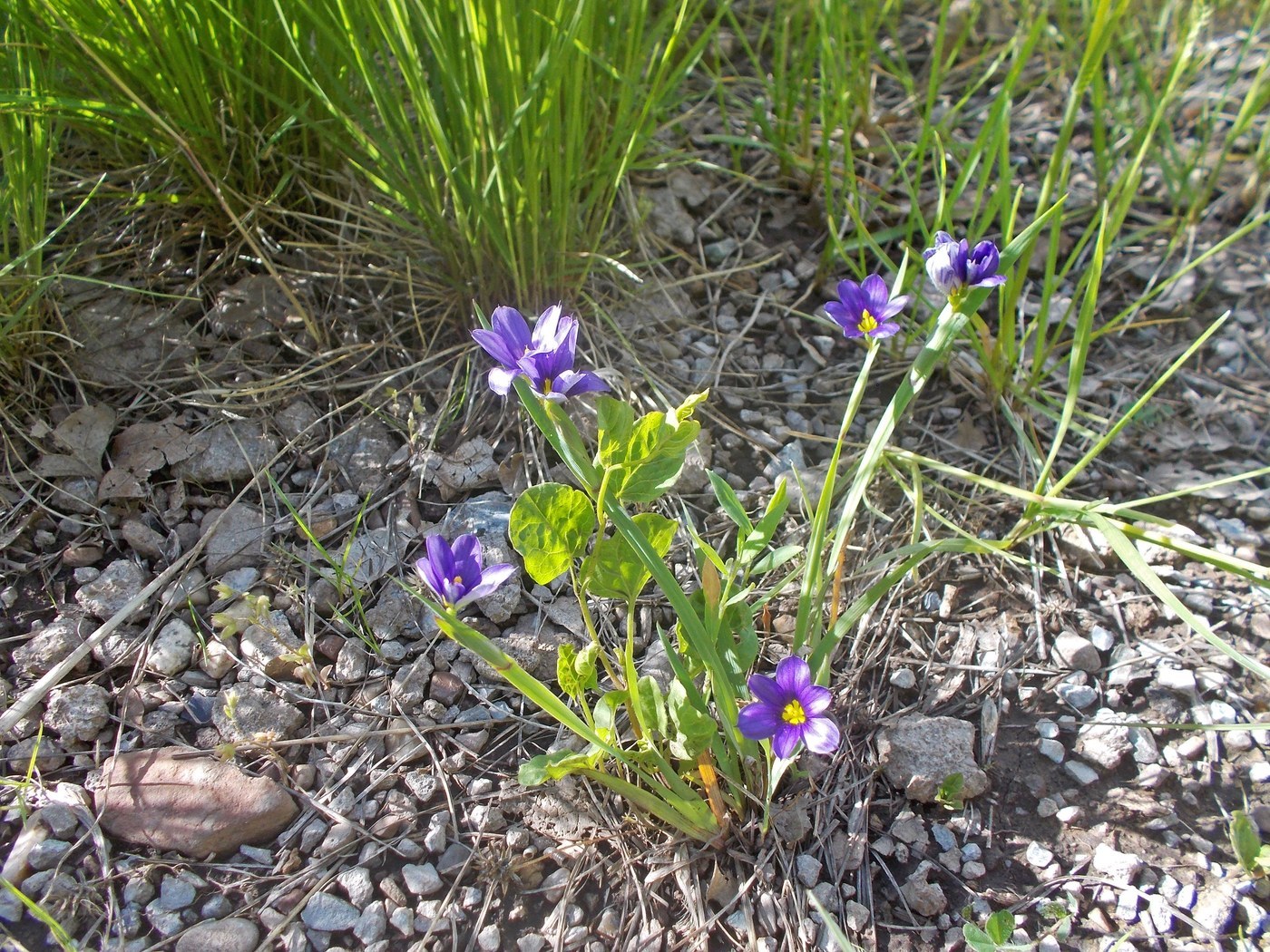
Key Identifying Features
Blue-eyed Grass (genus Sisyrinchium) is a dainty perennial that looks grassy but is actually a member of the iris family. It forms tufts of narrow, flat grass-like leaves topped by small, star-shaped blue to violet flowers with bright yellow centers ("eyes"). Plants are low, usually 6 to 20 inches (15 to 50 cm) tall.
- Small six-tepaled blue-violet flowers with a yellow center
- Each tepal often tipped with a tiny bristle point
- Flat, narrow, grass-like leaves and stems
- Grows in clumps or tufts
Leaves & Stems
The leaves and flowering stems are flat, narrow, and grass-like (iris-like), giving the plant its name. The flowering stems are often winged or flattened rather than round. Foliage is bluish-green and grows in dense tufts from fibrous roots. This flat, two-edged stem is a good clue that it is an iris relative, not a true grass.
Flowers & Fruit
The flowers are about 0.5 to 1 inch (1 to 2.5 cm) across with six tepals (three petals and three sepals that look alike), colored blue, violet, or occasionally white, with a vivid yellow center. Each tepal frequently ends in a small abrupt bristle tip. Flowers open in sunshine and may close in dull weather. Blooming runs late spring into summer. The fruit is a small round capsule.
How to Tell It Apart from Look-Alikes
- True grasses: have inconspicuous greenish flowers and round, jointed stems; blue-eyed grass has showy blue flowers and flat stems.
- Wild flax (Linum): has blue flowers but five rounded petals and round wiry stems.
- Spiderwort (Tradescantia): blue three-petaled flowers but much larger and with grass-like but rounded leaves.
The six-tepaled blue flower with a yellow eye on a flat iris-like stem is the key combination.
Where You'll Find It
Blue-eyed Grass grows in moist meadows, prairies, open woods, stream banks, and roadside grass across North America. It favors sunny, damp to average soil and often hides among true grasses until it blooms. Look closely in late spring and early summer for the tiny blue stars.
Quick ID Checklist
- Small blue-violet flowers with a yellow center
- Six tepals, each often bristle-tipped
- Flat, grass-like, sometimes winged stems
- Grows in tufts among grasses
- Member of the iris family, not a grass
- Blooms late spring to summer
Frequently asked questions
Is blue-eyed grass actually a grass?
No. Despite its grassy leaves, it belongs to the iris family (Iridaceae). The giveaway is its showy six-tepaled blue flower with a yellow center and its flat, often winged stems, unlike true grasses.
What does the yellow eye refer to?
The center of each blue-violet flower is bright yellow, creating an eye-like contrast that gives the plant its common name. This yellow center is a reliable identification feature.
Why are the flowers sometimes closed?
Blue-eyed grass flowers open in bright sunshine and tend to close in cloudy or dull weather and in the late afternoon. The best time to see and identify the open blooms is on sunny mornings.
Where should I look for blue-eyed grass?
Search moist meadows, prairies, open woods, and grassy roadsides in late spring and early summer. The plants often blend in with surrounding grass until their small blue flowers appear.