
Bluebeard Identification Guide
Identify Bluebeard (Caryopteris) by its late-summer clusters of fringed blue flowers, aromatic gray-green leaves, and compact mounded form.
Read the full Bluebeard encyclopedia entry →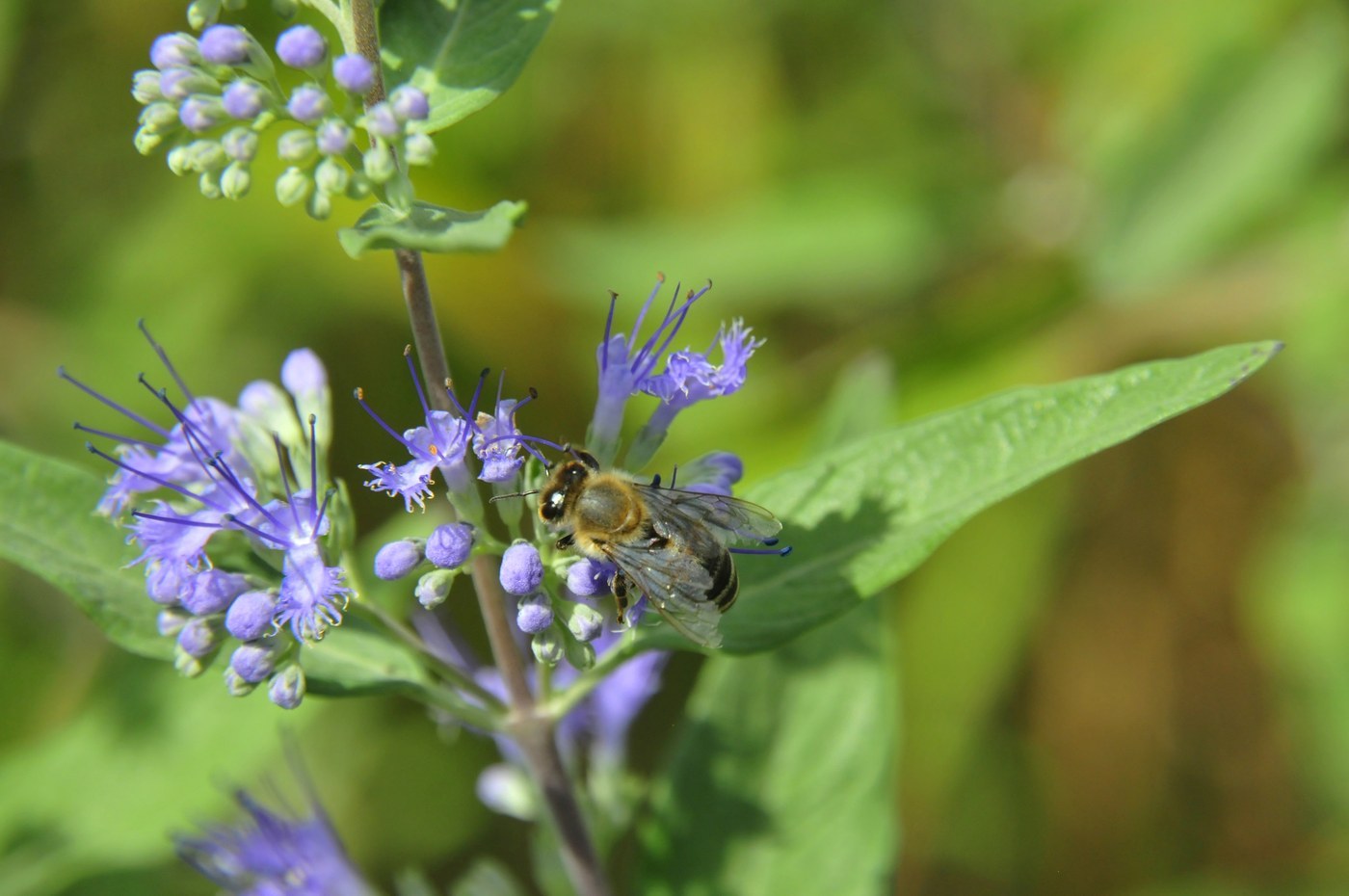
Key Identifying Features
Bluebeard (Caryopteris × clandonensis), also called blue mist shrub or blue spirea, is a small deciduous subshrub in the mint family (Lamiaceae). It is easily recognized by clusters of fuzzy blue to violet-blue flowers in late summer, aromatic gray-green leaves that smell when crushed, and a tidy mounded form roughly 2–4 ft tall.
- Compact, rounded subshrub, 2–4 ft tall and wide
- Blue/violet flowers in dense clusters along the stems in late summer/early fall
- Aromatic foliage with a sage-like or eucalyptus-like scent
- Square stems (mint family trait)
Leaves & Stems
Leaves are opposite, lance-shaped to narrowly ovate, 1–3 in long, with shallowly toothed margins. The upper surface is gray-green and the underside is often silvery-gray and softly hairy, giving the whole plant a slightly silvery cast. Crushing the leaves releases a pungent, aromatic scent. Stems are square in cross-section (a Lamiaceae hallmark) and somewhat woody at the base; the plant often dies back in winter and regrows. Golden-leaf cultivars ('Worcester Gold', 'Sunshine Blue') exist.
Flowers & Fruit
Flowers are borne in dense whorled clusters (cymes) at the leaf axils and stem tips, creating a hazy mist of blue. Each small flower is tubular with a fringed, frilly lower lip and protruding stamens, in shades of clear blue, lavender-blue, or violet (rare cultivars are pink/white). Bloom is late summer into fall — unusually late, which is a key clue. The flowers are very attractive to bees and butterflies. Fruit is a small dry capsule.
How to Tell It Apart from Look-Alikes
- Russian sage (Perovskia): Also has blue late-summer flowers and aromatic gray foliage, but Russian sage is taller, airier, with finely dissected leaves and flowers along long wand-like spikes rather than tight axillary clusters.
- Lavender: Has narrow needle-like leaves and flowers on slender spikes; Bluebeard has broader toothed leaves and clustered flowers.
- Vitex (chastetree): Much larger, with palmately compound leaves and elongated flower spikes.
The mounded habit + aromatic gray-green opposite toothed leaves + fringed blue flower clusters in late summer is the signature.
Where You'll Find It
A garden hybrid (parent species native to East Asia) grown across USDA zones 5–9 in perennial borders, pollinator gardens, and sunny dry beds. It thrives in full sun and well-drained soil, tolerates drought, and is often treated like a perennial, cut back hard in late winter.
Quick ID Checklist
- Compact mounded subshrub, 2–4 ft
- Square stems (mint family)
- Opposite, gray-green, toothed, aromatic leaves with silvery undersides
- Dense clusters of fringed blue/violet flowers in late summer–fall
- Bee and butterfly magnet
- Often cut back to the ground each year
Frequently asked questions
When does Bluebeard bloom?
It flowers in late summer into early fall, which is unusually late and a helpful clue for distinguishing it from spring- and early-summer-blooming blue flowers.
How is Bluebeard different from Russian sage?
Russian sage is taller and airier with finely cut leaves and flowers strung along long wands, while Bluebeard is a compact mound with toothed leaves and tight clusters of blue flowers at the leaf joints.
Why do my Bluebeard leaves smell?
Bluebeard is in the mint family; its foliage contains aromatic oils that release a sage-like scent when crushed, which helps confirm the ID.
Should I cut Bluebeard back?
It blooms on new wood and often dies back in winter, so gardeners typically cut it close to the ground in late winter to encourage fresh, floriferous growth.