
Borage Identification Guide
How to identify borage (Borago officinalis) by its bristly hairy leaves, drooping star-shaped blue flowers with black anther cones, and cucumber scent.
Read the full Borage encyclopedia entry →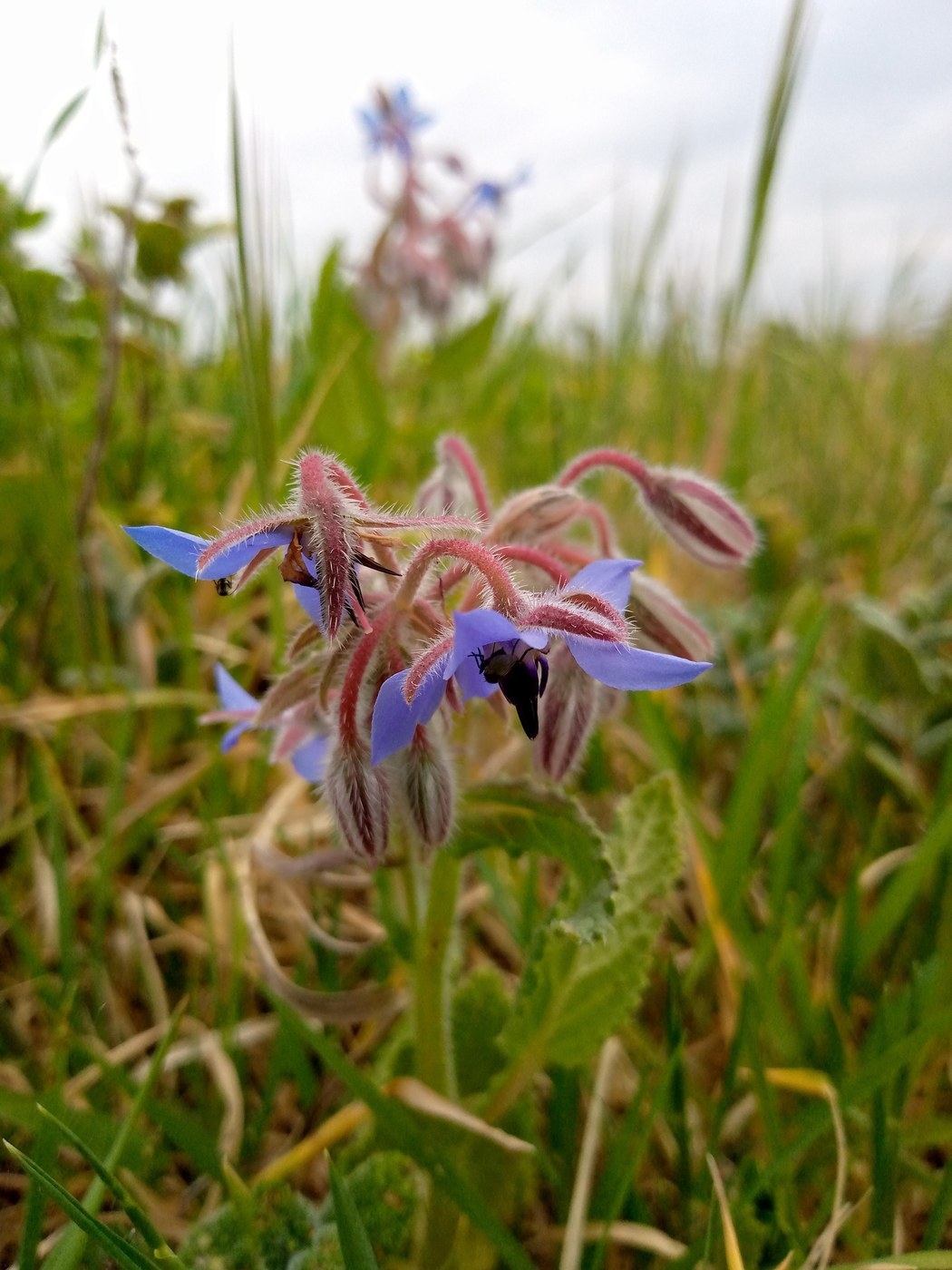
Key Identifying Features
Borage (Borago officinalis), or starflower, is an annual herb instantly recognizable by its bright blue star-shaped flowers. Identify it by:
- Vivid blue, five-pointed star-shaped flowers with a central black/dark cone of anthers.
- Coarse, bristly white hairs covering the whole plant.
- A faint cucumber scent from crushed leaves.
- A sprawling, branching annual habit, 30–80 cm tall.
Leaves & Stems
The entire plant is roughly hairy (hispid) — leaves and stems bristle with stiff, prickly white hairs that you can feel. Leaves are oval to lance-shaped, 5–15 cm, with wrinkled, deeply veined surfaces and wavy margins; lower leaves have stalks, upper ones clasp the hollow, branching stem. Crushed foliage smells cool and cucumber-like — a useful confirming clue. Stems are thick, succulent, hollow, and very bristly.
Flowers & Fruit
The flowers are diagnostic: borne in drooping, branched clusters (cymes), each flower is a perfect five-pointed star, about 2 cm, usually brilliant sky-blue (occasionally pink or white), with swept-back pointed petals. At the center, the dark purple-to-black stamens form a distinctive protruding cone around the style. Flowers nod downward on hairy stalks and bloom from late spring through summer/autumn. The fruit is a set of small nutlets. Bees are strongly attracted to the flowers.
How to Tell It Apart from Look-Alikes
- Comfrey (Symphytum): same borage family and hairy, but has drooping bell- or tube-shaped flowers (not flat stars) in pink/purple/cream, and larger leaves.
- Green alkanet (Pentaglottis) / forget-me-nots (Myosotis): blue flowers too, but small and flat-faced without the black anther cone or star shape.
- Viper's bugloss (Echium): bristly and blue, but funnel-shaped flowers with protruding stamens, not flat five-pointed stars.
- The flat blue star + black central cone + bristly hairs + cucumber scent combination is unique to borage.
Where You'll Find It
Native to the Mediterranean, borage is widely grown in herb and vegetable gardens and frequently self-seeds and naturalizes on waste ground, field margins, and roadsides. It likes full sun and well-drained soil and pops up readily where it has grown before.
Quick ID Checklist
- Bright blue five-pointed star-shaped flowers
- Black/dark protruding cone of anthers at flower center
- Whole plant covered in stiff white bristly hairs
- Wrinkled oval leaves with cucumber scent
- Drooping flower clusters; sprawling annual habit
A blue star with a black cone on a bristly plant confirms borage.
Frequently asked questions
What makes borage flowers distinctive?
They're bright blue, perfectly five-pointed stars with swept-back petals and a prominent cone of dark purple-black anthers at the center, hanging in nodding clusters.
Does borage really smell like cucumber?
Yes. Crushed borage leaves and flowers give off a fresh, cool cucumber-like scent, which is a useful confirming clue when identifying the plant.
How do I tell borage from comfrey?
Both are bristly relatives, but borage has flat, blue, star-shaped flowers with a black central cone, while comfrey has drooping bell- or tube-shaped flowers in pink, purple, or cream.
Where does borage usually grow?
In herb and vegetable gardens and on disturbed ground, roadsides, and field edges, where it readily self-seeds in sunny, well-drained soil.