Boston Fern Identification Guide
Identify the Boston fern (Nephrolepis exaltata) by its long, gracefully arching fronds of small toothed leaflets and round spore dots beneath, and separate it from similar ferns.
Read the full Boston Fern encyclopedia entry →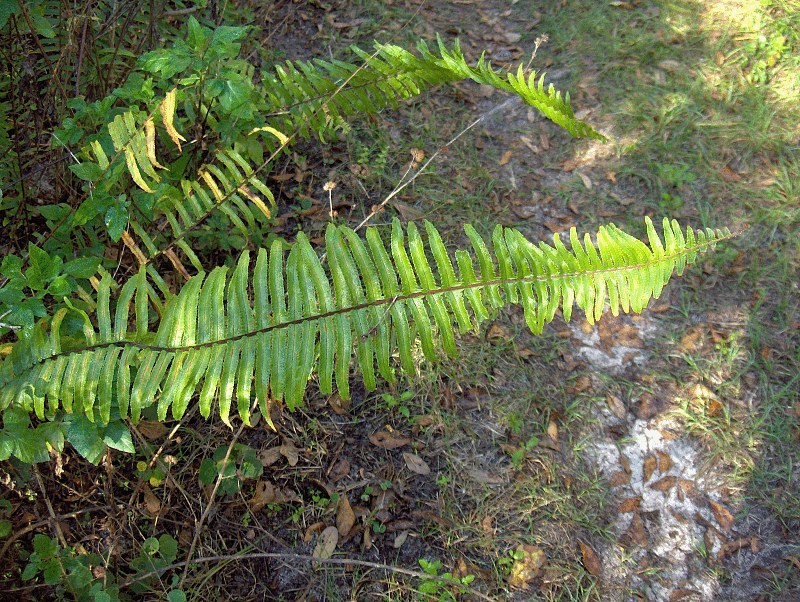
Key Identifying Features
The Boston fern (Nephrolepis exaltata, especially the cultivar 'Bostoniensis') is identified by:
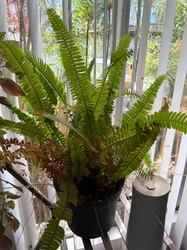
- Long, gracefully arching fronds that spray out from a central crown.
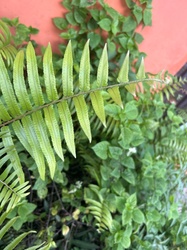
- Each frond is once-divided into many small, oblong leaflets (pinnae).
- A lush, fountain-like form ideal for hanging baskets.
Leaves & Stems
Fronds reach 30–90 cm (1–3 ft) long, narrow and tapering, arching outward and downward. Each frond bears 40+ pairs of leaflets that are light-to-medium green, soft, and slightly toothed/wavy along the edges, with a small ear-like lobe at the base of each leaflet. Unlike many ferns, the division is single (pinnate), not finely lacy.
The plant grows from a crown of scaly, fibrous rhizomes and sends out wiry runners (stolons) that produce new plantlets — a useful ID and propagation trait. There is no woody stem. Fronds are the only above-ground structure.
Flowers & Fruit
Like all ferns, Boston fern does not flower or set seed. It reproduces by spores borne in round structures (sori) arranged in a single row near the leaflet margins on the underside. The kidney-shaped indusium covering each sorus is a Nephrolepis hallmark. Seeing the orderly rows of round spore dots underneath confirms the genus.
How to Tell It Apart from Look-Alikes
- Sword fern / other Nephrolepis (N. cordifolia): very similar but more upright and stiff, with rounder leaflets and sometimes tuberous roots; Boston fern arches gracefully and has the wavy 'Bostoniensis' look.
- Kimberly Queen fern (N. obliterata): stiffer, more upright fronds, neater habit.
- Maidenhair / lacy ferns: fronds are finely twice- or thrice-divided and delicate, not the simple single division of Boston fern.
- Asparagus fern (Asparagus setaceus): not a true fern; needle-like "leaves" and produces berries.
The clincher: arching, once-divided fronds with soft toothed leaflets and marginal round sori = Boston fern.
Where You'll Find It
Native to humid tropical and subtropical forests of the Americas, Africa, and Polynesia, growing in moist, shaded, humid conditions. Worldwide it's a classic indoor and porch fern for filtered light and high humidity. Outdoors it thrives in frost-free shade (USDA zones 9–11).
Quick ID Checklist
- Long, arching fronds in a fountain shape
- Once-divided fronds with many small leaflets
- Leaflets soft, slightly toothed, with a basal ear lobe
- Round sori in a row near leaflet margins underneath
- Spreads by wiry runners; no flowers or seeds
A fountain of soft, arching, single-divided fronds with rows of round spore dots beneath is the Boston fern.
Frequently asked questions
Does a Boston fern ever flower?
No. Like all true ferns, it never produces flowers or seeds. Instead it reproduces by spores held in round structures called sori, arranged in a neat row near the edges on the underside of each leaflet.
What are the brown dots on the underside of the leaves?
Those are sori, clusters of spore cases, and they're completely normal. In Boston fern they sit in a single row near the leaflet margins, which helps confirm the genus Nephrolepis. They're often mistaken for pests or disease.
How is a Boston fern different from a lacy maidenhair fern?
Boston fern fronds are once-divided into rows of small oblong leaflets, giving a fairly simple, arching look. Maidenhair and many other ferns have finely twice- or thrice-divided, delicate, lacy fronds.
What are the fuzzy runners coming out of the pot?
Those are stolons or runners, wiry stems that the Boston fern sends out to produce new plantlets. They're a normal part of its growth and can be used to propagate the plant.
Boston Fern identified by the community
Recent Boston Fern specimens identified with Plant Identifier.