
Bottlebrush Tree Identification Guide
Recognize the bottlebrush (Callistemon/Melaleuca) by its cylindrical bristly red flower spikes, narrow aromatic leaves, and woody seed capsules clustered along the stems.
Read the full Bottlebrush Tree encyclopedia entry →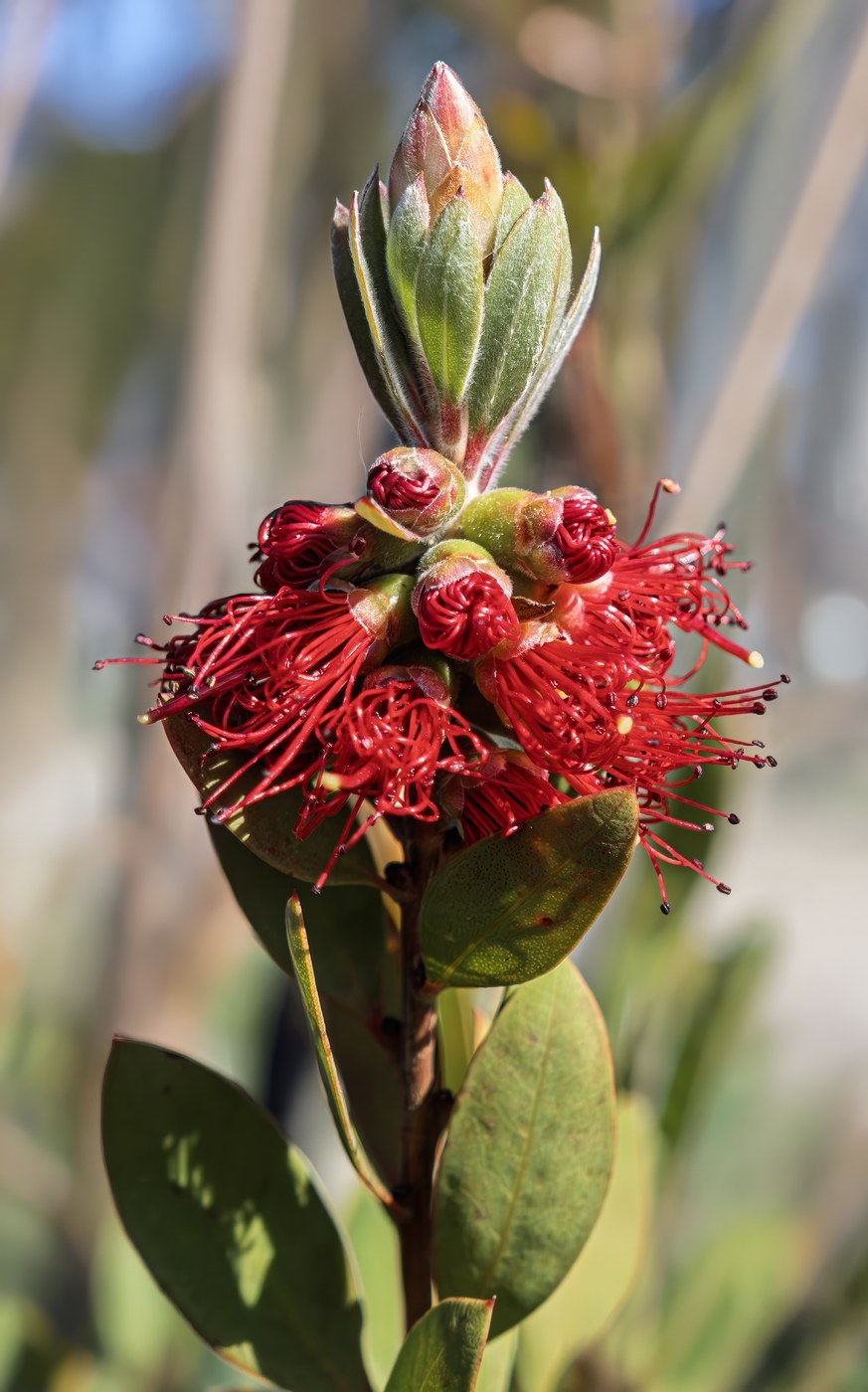
Key Identifying Features
The bottlebrush (Callistemon, now often classified within Melaleuca) is an Australian evergreen shrub or small tree named for its unmistakable flower spikes that look exactly like a brush for cleaning bottles. If you see a dense cylinder of bright red bristles on a branch tip, you've found it.
- Size & form: Ranges from a 3-ft shrub to a 25-ft tree depending on species; weeping bottlebrush has gracefully drooping branches.
- Evergreen: Holds its narrow leaves year-round.
- Aroma: Crushed leaves are resinous and lemony/eucalyptus-scented (it's in the myrtle family).
Leaves & Stems
Leaves are simple, alternate, narrow, and lance-shaped to linear, 1–4 inches long, leathery, with a pointed tip and a single prominent midvein. New growth is often soft, silky, and pinkish or coppery before hardening to green. The leaves contain oil glands—hold one to the light to see tiny translucent dots, and crush it for the spicy aroma.
Flowers & Fruit
- Flowers: The showy part is not petals but masses of long, brightly colored stamens arranged in a dense cylindrical spike 2–6 inches long. Most are brilliant red or crimson, though pink, mauve, yellow, and white forms exist. Bees and birds love them.
- Growth quirk: After flowering, the branch tip keeps growing past the spike, leaving leaves beyond the old flower zone—a distinctive habit.
- Fruit: Hard, woody cup-shaped seed capsules that cling to the stem in tight clusters for years, looking like beads strung along the wood—diagnostic year-round.
How to Tell It Apart from Look-Alikes
- Grevillea / banksia: Other Australian natives, but their flowers form different shapes (spider-like or large cone-brushes) and leaves often differ.
- Paperbark melaleuca: A close relative; bottlebrush spikes are denser and brighter, and paperbarks have spongy peeling bark.
- Conifers/pines: Sometimes confused at a glance for the needle-like foliage, but conifers never produce red brush flowers.
- The cylindrical bristle flower + woody beaded seed capsules combination is essentially unique.
Where You'll Find It
Native to Australia, bottlebrush is widely planted in warm-temperate and subtropical regions—California, the U.S. South, the Mediterranean, and frost-free gardens worldwide (USDA 9–11). It tolerates heat, poor soil, and some drought, and is common as a street tree, hedge, and specimen shrub.
Quick ID Checklist
- Evergreen shrub/small tree, often weeping
- Narrow leathery aromatic leaves, coppery new growth
- Cylindrical bristly flower spikes, usually bright red
- Branch grows on past the old flower spike
- Woody seed capsules clustered tightly along stems
Frequently asked questions
Why is it called a bottlebrush?
The cylindrical flower spike is densely packed with stiff, colorful stamens radiating in all directions, giving it the exact look of a brush used to scrub the inside of a bottle.
What are the bead-like lumps along the branches?
Those are the woody seed capsules that form after flowering and remain attached to the stems for years. They're a reliable way to identify a bottlebrush even when it isn't in bloom.
Are bottlebrush flowers red only?
Red and crimson are most common, but cultivars and species also come in pink, mauve, lavender, creamy yellow, and white. The brush shape stays the same across all colors.
Is bottlebrush related to eucalyptus?
Yes, both are in the myrtle family (Myrtaceae). That's why bottlebrush leaves have oil glands and a similar resinous, eucalyptus-like scent when crushed.