
Bouncing Bet Identification Guide
Identify Bouncing Bet (Soapwort) by its clusters of pale pink five-petaled flowers, swollen-jointed stems, and soapy lather from crushed leaves.
Read the full Bouncing Bet encyclopedia entry →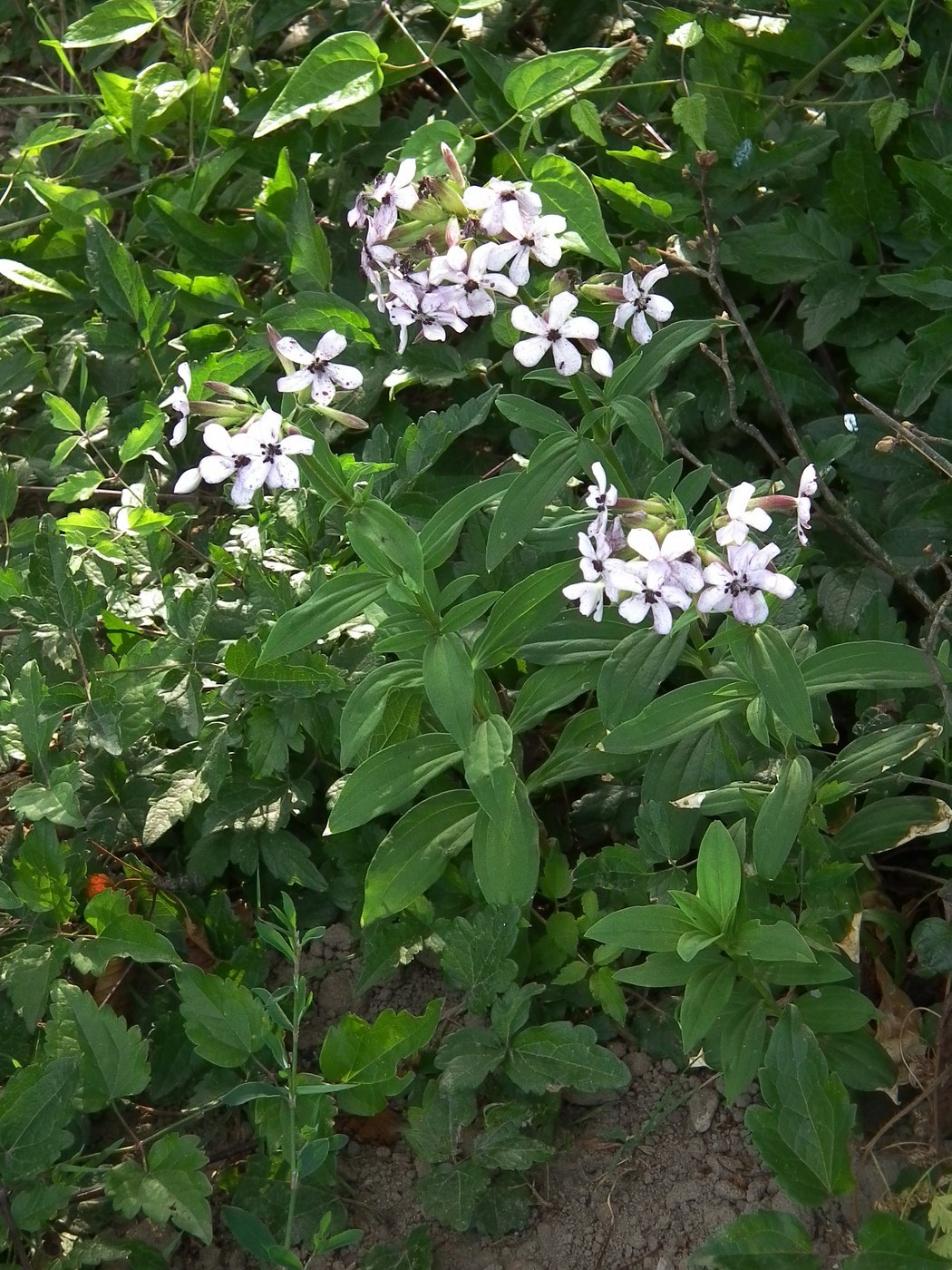
Key Identifying Features
Bouncing Bet (Saponaria officinalis), also called Soapwort, is a sturdy roadside perennial in the pink family (Caryophyllaceae). Recognize it by:
- Clusters of pale pink to white, five-petaled flowers, often slightly ragged or with petals reflexed.
- Swollen, jointed nodes on smooth stems.
- Opposite, prominently 3–5-veined leaves.
- Crushed leaves produce a soapy lather in water — the source of 'Soapwort.'
Leaves & Stems
Stems are upright, smooth, and unbranched below, conspicuously swollen at the leaf nodes, growing 40–90 cm (1.5–3 ft) tall and forming spreading colonies from rhizomes. Leaves are opposite, lance-shaped to elliptic, smooth-edged, and marked with 3 to 5 strong parallel veins running lengthwise — a helpful detail. There are no leaf stalks; leaf pairs clasp the stem.
Flowers & Fruit
Flowering is in mid to late summer (July–September). Flowers are 2.5 cm across, with five pale pink or whitish petals that are often notched and may bend backward, set in a long tubular calyx. They are fragrant, especially in the evening, attracting night-flying moths. Double-flowered forms exist in old gardens. The fruit is a small oblong capsule opening by teeth at the top.
How to Tell It Apart from Look-Alikes
- Phlox (Phlox) has similar pink five-petaled flowers but a flat-faced corolla with a slender tube, and entire (unswollen) stem nodes; phlox petals are not soap-lathering.
- Campions and Catchflies (Silene) have inflated or sticky calyxes and usually deeply notched petals.
- Deptford Pink is much smaller and brighter pink.
Quick test: crush a leaf in wet hands — Bouncing Bet lathers; the swollen nodes and 3–5-veined opposite leaves seal the ID.
Where You'll Find It
A Eurasian native now widely naturalized in North America, Bouncing Bet grows along roadsides, railway banks, riverbanks, waste ground, and old homesteads. It favors full sun and disturbed, well-drained soil, often forming large patches. It was historically cultivated as a natural soap and cleaning agent.
Quick ID Checklist
- Pale pink/white five-petaled flowers in clusters
- Swollen jointed nodes on smooth stems
- Opposite leaves with 3–5 strong veins
- Crushed leaves lather like soap in water
- Fragrant, especially in the evening
- Roadsides, railways, waste ground, old gardens
Frequently asked questions
Why is it called Soapwort?
The leaves and roots contain saponins that produce a soapy lather when crushed in water. The plant was historically used as a gentle soap for cleaning skin and delicate textiles.
How do I tell Bouncing Bet from garden phlox?
Crush a leaf — Bouncing Bet lathers and has swollen stem nodes and 3–5-veined leaves. Phlox flowers have a flat face on a slender tube and smooth, unswollen nodes.
Why do the flowers smell stronger in the evening?
Bouncing Bet is partly moth-pollinated, so it releases its sweet fragrance most strongly at dusk and night to attract night-flying pollinators.
What does the seed capsule look like?
After flowering it forms small oblong capsules that split open by tiny teeth at the top, releasing the seeds. The capsule sits inside the persistent tubular calyx.