
Brain Cactus Identification Guide
Identify the Brain Cactus (crested Mammillaria elongata 'Cristata') by its wavy, undulating, brain-like ridges of fused stems covered in fine spines.
Read the full Brain Cactus encyclopedia entry →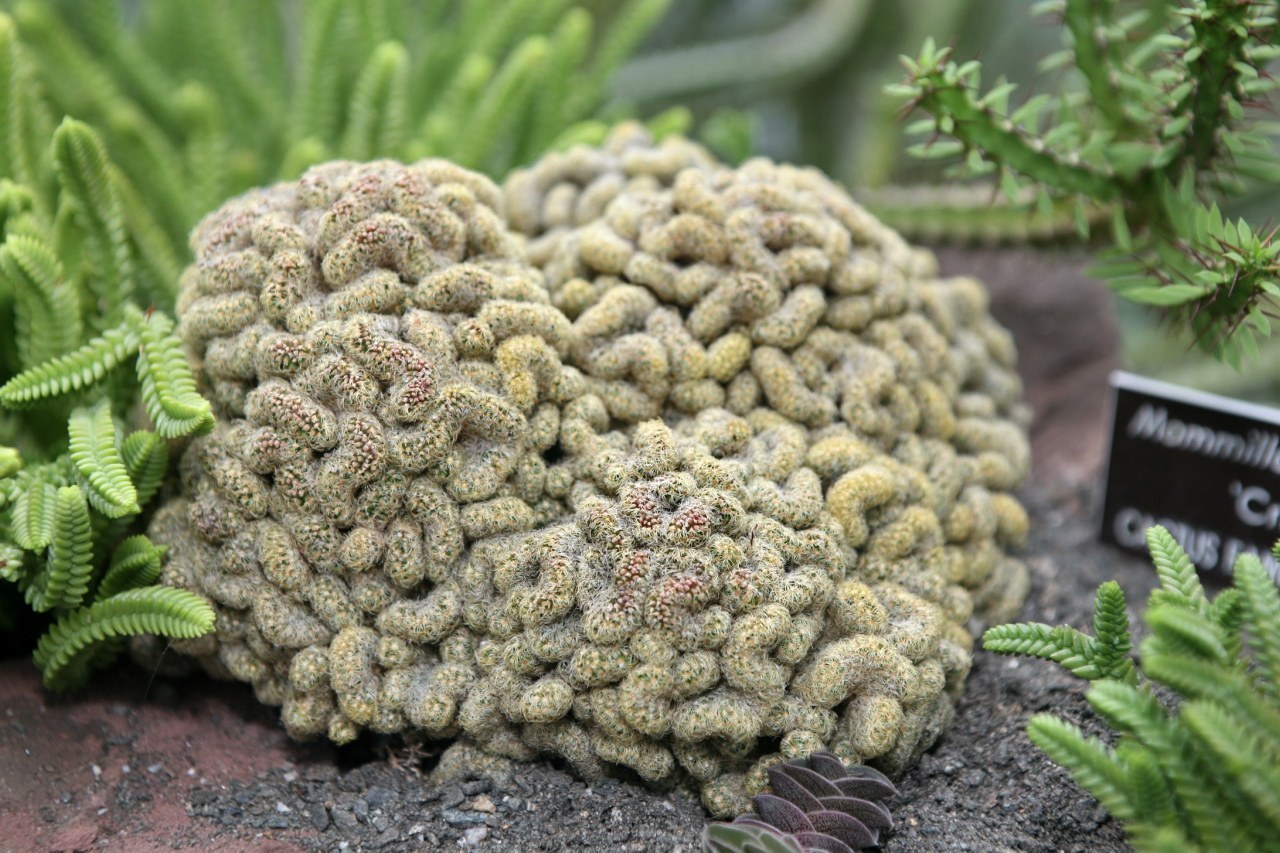
Key Identifying Features
The Brain Cactus is the crested (cristata) form of Mammillaria elongata, sometimes also referring to crested Stenocactus. Its defining feature is the convoluted, folding, brain-like surface created when the growing point fasciates (flattens and proliferates into a fan) instead of growing as normal cylindrical stems. The result is a green mound of undulating ridges that genuinely resembles the folds of a brain.
- Wavy, contorted ridges fused into a fan- or mound-shaped mass
- Surface covered in fine, often golden or yellow spines arranged in star-like clusters
- Slow-growing, compact, ground-hugging habit
- Bright to grayish-green body color
Leaves & Stems
Like all cacti, Brain Cactus has no true leaves; the photosynthetic body is the stem. In the normal (non-crested) Mammillaria elongata (Ladyfinger Cactus), stems are slender finger-like columns. In the crested form, the apical growing line fasciates and folds back on itself repeatedly, producing the signature wrinkled, meandering ridges. Each ridge is studded with tubercles (small bumps) bearing areoles that produce radiating clusters of fine spines, typically yellow, gold, amber, or white. The spines are usually soft to the touch compared with large desert cacti but can still prick.
Flowers & Fruit
Crested Mammillarias bloom less reliably than normal forms, but when they do, expect tiny cream, pale-yellow, or pinkish flowers emerging in a line along the crest folds, often in spring. Flowers are small (under half an inch). Fruit, if it forms, is a small elongated reddish berry.
How to Tell It Apart from Look-Alikes
- Crested Echeveria or other crested succulents: those have leaf-like fan growth but no spines or areoles; Brain Cactus has true spine clusters on tubercles.
- Crested Euphorbia (e.g., 'Coral Cactus'): superficially brain-like and fan-shaped, but Euphorbia has milky sap and no areoles/spine clusters, while cacti have areoles and clear sap.
- Normal Mammillaria elongata: if the plant grows as upright cylindrical fingers rather than folded ridges, it's the standard form, not the crested Brain Cactus.
Where You'll Find It
Brain Cactus is grown as a novelty houseplant and collector's succulent worldwide. The parent species is native to central Mexico. It's typically seen in small decorative pots indoors, in bright sunny windows, or in protected outdoor rock gardens in warm, frost-free climates (USDA zones 9-11).
Quick ID Checklist
- Folded, undulating, brain-like ridges fused together
- Areoles with fine star-shaped spine clusters (true cactus)
- Yellow, gold, or white spines on small tubercles
- Clear (not milky) sap
- Compact, slow-growing mound
- Tiny cream/pink flowers in a line along the crest
Tip: Confirm it's a cactus, not a crested Euphorbia, by checking for spine-bearing areoles and the absence of milky sap.
Frequently asked questions
What makes a cactus grow into a brain shape?
The brain shape comes from fasciation (cresting), where the normal single growing point mutates into a line that folds and proliferates, producing wavy, fan-like ridges instead of cylindrical stems.
Is Brain Cactus the same as Coral Cactus?
No. Coral Cactus is a crested Euphorbia and has milky sap with no areoles. Brain Cactus is a true crested cactus (Mammillaria) with spine-bearing areoles and clear sap.
Does Brain Cactus have spines?
Yes. Its surface is covered with fine, star-shaped clusters of spines, usually golden, yellow, or white, arising from tubercles along the folded ridges.
Will my Brain Cactus flower?
It can, though crested forms bloom less reliably. When it does, small cream, yellow, or pinkish flowers appear in a line along the crest, typically in spring.