
Bromeliad Identification Guide
Identify Bromeliads by their rosette of stiff strap leaves forming a central water-holding tank and a long-lasting, brightly colored flower spike.
Read the full Bromeliad encyclopedia entry →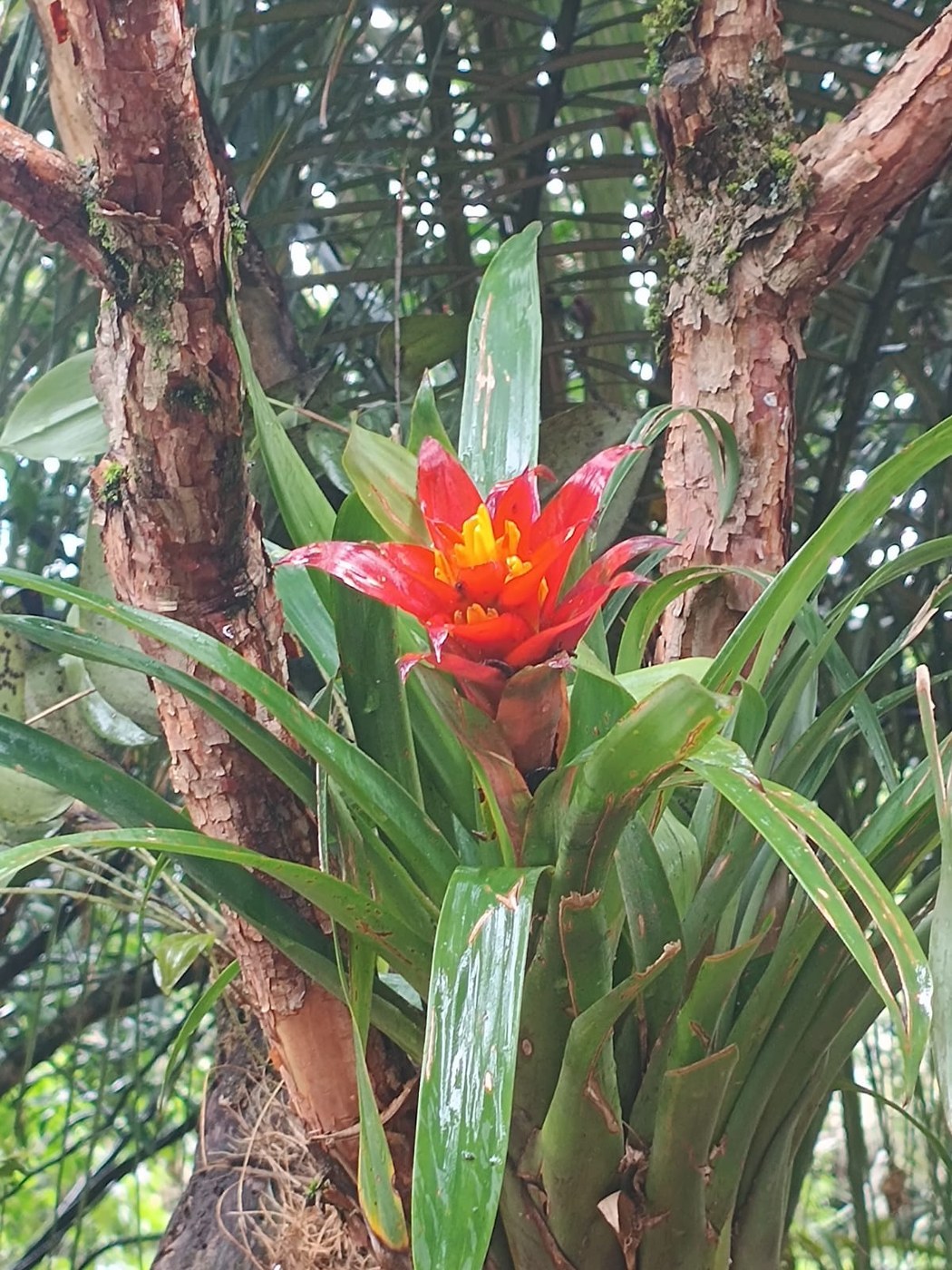
Key Identifying Features
Bromeliads (family Bromeliaceae) are a large group of tropical plants — including Guzmania, Aechmea, Neoregelia, and the pineapple — recognized by a rosette of stiff, strap-shaped leaves that often form a central watertight cup or 'tank'. From this rosette rises a vivid, long-lasting flower structure.
- Rosette of overlapping leathery leaves
- Many form a central 'tank' that holds water
- Showy, persistent colored bracts in red, pink, orange, or yellow
Leaves & Stems
The rosette is the core ID feature across the family:
- Leaves are long, stiff, strap- or sword-shaped, arranged in a spiral rosette
- Texture varies from smooth and glossy (Guzmania) to banded or spiny-edged (Aechmea, Neoregelia)
- Some have silvery cross-banding or marbled coloring; Neoregelia leaves flush bright red at the center before blooming
- Most are nearly stemless, with leaf bases overlapping to form the water-holding cup
- Many are epiphytes, gripping trees with wiry roots
Flowers & Fruit
The inflorescence is dramatic and long-lasting:
- A central spike or head of brightly colored bracts — often scarlet, pink, orange, or yellow — that stays colorful for weeks to months
- The true flowers are small (often blue, purple, or white) and tucked among the bracts
- Each rosette flowers once, then slowly dies, producing offsets (pups) around its base
- The pineapple is the most famous bromeliad fruit; most ornamentals form dry capsules
How to Tell It Apart from Look-Alikes
- Agave/Aloe: also rosette-forming but have thick succulent leaves and lack the central water tank and colorful bract spike.
- Air plants (Tillandsia): are bromeliads too, but smaller, soilless, and tankless.
- The classic bromeliad signature is the leaf rosette + central water cup + bold persistent flower bract.
Where You'll Find It
Sold as colorful flowering houseplants and used in tropical landscaping, bromeliads are popular for their long-lasting color. In the wild, the family is almost entirely native to the Americas, growing as epiphytes on rainforest trees or terrestrially from Florida to Argentina.
Quick ID Checklist
- Rosette of stiff strap-shaped leaves
- Central water-holding cup/tank (in many species)
- Brightly colored, long-lasting flower bracts
- Small true flowers tucked among bracts
- Produces offset pups; rosette blooms once
A leafy rosette with a water-filled center and a vivid bract spike marks a bromeliad.
Frequently asked questions
What is the 'tank' in the middle of a bromeliad?
Many bromeliads have overlapping leaf bases that form a watertight central cup, or tank, which collects rainwater and debris for the plant to absorb. This water-holding rosette is a key family identification trait.
Is the colorful part of a bromeliad the flower?
Usually not. The long-lasting red, pink, orange, or yellow display is made of modified leaves called bracts. The true flowers are small and tucked among the bracts, often blue, purple, or white.
Why is my bromeliad dying after it bloomed?
Each bromeliad rosette flowers only once in its life and then gradually declines, but before dying it produces offsets called pups around its base that grow into new plants. This is normal and helps confirm the ID.
Is a pineapple really a bromeliad?
Yes. The pineapple (Ananas comosus) is a terrestrial bromeliad, and its spiny rosette and central fruiting spike show the family's classic rosette-and-inflorescence structure.