
Brussels Sprouts Identification Guide
How to identify the Brussels sprouts plant (Brassica oleracea) by its tall stalk lined with miniature cabbage-like buds.
Read the full Brussels Sprouts encyclopedia entry →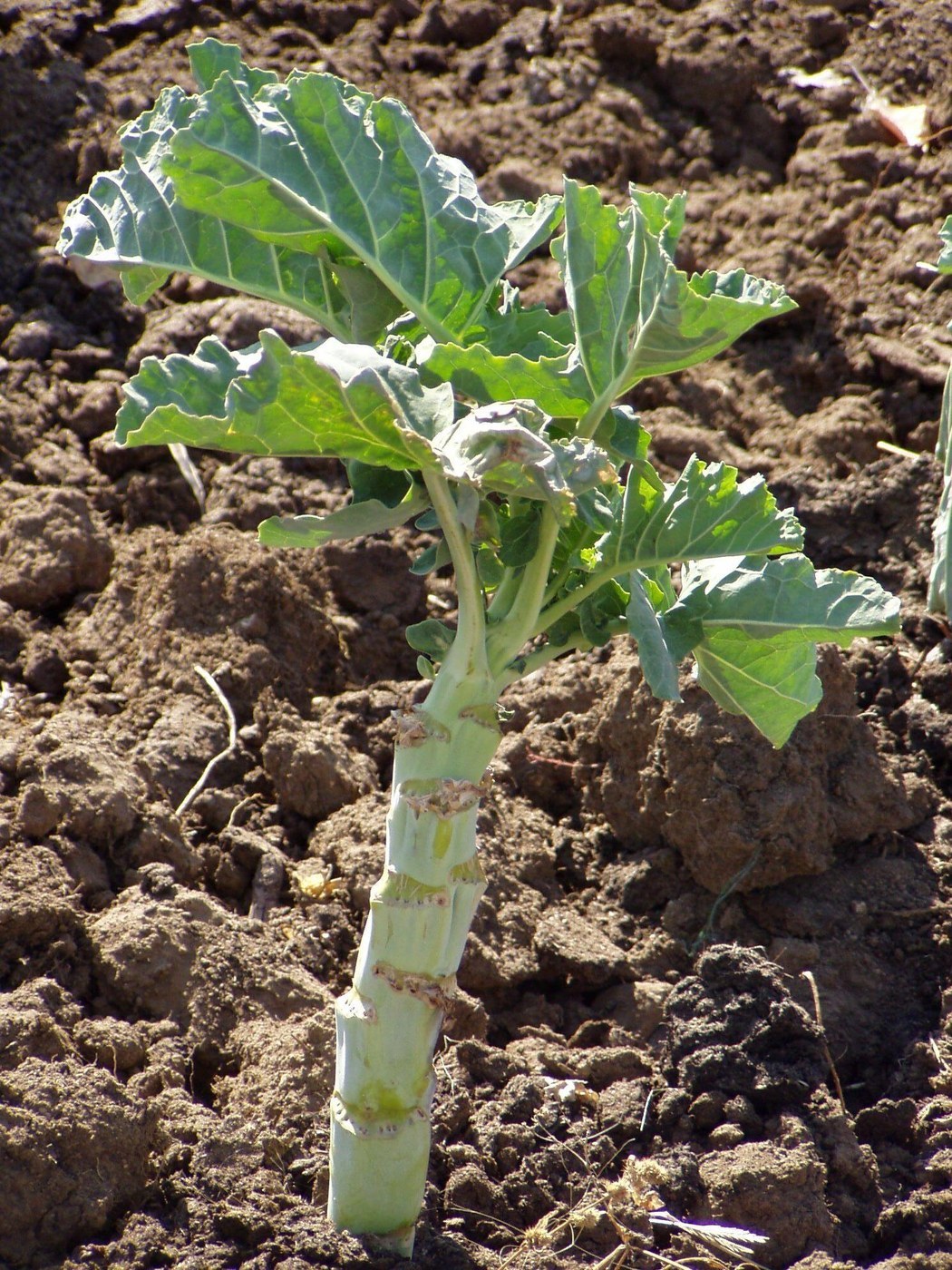
Key Identifying Features
Brussels sprouts are a cultivar of Brassica oleracea (Gemmifera group), the same species as cabbage and kale. The plant is unmistakable once mature: a tall, thick, upright stalk studded along its length with dozens of small, tight, cabbage-like buds ("sprouts"), each in a leaf axil, topped by a loose rosette of large leaves.
- Single thick vertical stalk, 2-3 ft tall
- Rows of golf-ball-sized leafy buds spiraling up the stem
- Large, rounded blue-green cabbage-type leaves at the crown
- Waxy bloom and a faint cabbage smell when cut
Leaves & Stems
The stalk is stout, woody, and pale green to purplish, growing upright. Large leaves emerge in a spiral up the stem; each leaf is broad, paddle-shaped to rounded, blue-green with a waxy coating, on a long stalk, with smooth or slightly wavy edges and a prominent pale midrib (typical of the cabbage clan). The crown is a loose tuft of leaves resembling a small open cabbage or collard. In the axil where each leaf meets the stem, a tight little bud forms, which swells into the sprout.
Flowers & Fruit
Brussels sprouts are biennial and only flower in their second year or when they bolt. The plant then sends up branching stalks of small four-petaled yellow flowers in elongating clusters, the classic cross-shaped (cruciferous) flower of the mustard family. Flowers mature into slender pods (siliques) containing round seeds. Sprouts left on the plant will eventually open and bolt to flower.
How to Tell It Apart from Look-Alikes
- Cabbage: same species, but cabbage forms a single large head at the base rather than many small buds up a tall stem.
- Collards and kale: also tall-stemmed B. oleracea, but they lack the row of axillary sprouts; their value is the leaves alone.
- Other brassicas (broccoli, kohlrabi): broccoli forms a terminal flower head; kohlrabi swells the stem base into a bulb. Only Brussels sprouts line the stalk with miniature heads.
Where You'll Find It
A cool-season crop grown in vegetable gardens and farm fields; it tolerates frost, so it is a fall and winter crop in temperate climates. The tall studded stalks are commonly sold whole at autumn markets.
Quick ID Checklist
- Tall single woody stalk, 2-3 ft
- Dozens of small cabbage-like buds in the leaf axils
- Large waxy blue-green cabbage leaves spiraling up and crowning the top
- Faint cabbage smell when cut
- If flowering: yellow four-petaled crucifer flowers in year two
Frequently asked questions
What makes the Brussels sprouts plant easy to identify?
The signature feature is a single tall stalk lined with dozens of small, tight, cabbage-like buds growing in the leaf axils, topped by a rosette of large blue-green leaves. No other common vegetable looks like that.
Are Brussels sprouts the same plant as cabbage?
They are the same species, Brassica oleracea, but different cultivar groups. Cabbage forms one large head at the base, while Brussels sprouts form many miniature heads along a tall stem.
Why is there a leafy cabbage-like top on my Brussels sprouts plant?
That loose rosette of leaves at the crown is normal. The plant photosynthesizes through these large leaves while the sprouts develop in the leaf axils down the stalk.
What do Brussels sprouts flowers look like?
If the plant bolts or reaches its second year, it produces clusters of small yellow four-petaled flowers, the cross-shaped blooms typical of the mustard family, followed by slender seed pods.