
Buffalo Berry Identification Guide
Identify buffalo berry (Shepherdia argentea) by its silvery scaly leaves and twigs, spiny branch tips, opposite leaf arrangement, and clusters of small red berries on a thorny shrub.
Read the full Buffalo Berry encyclopedia entry →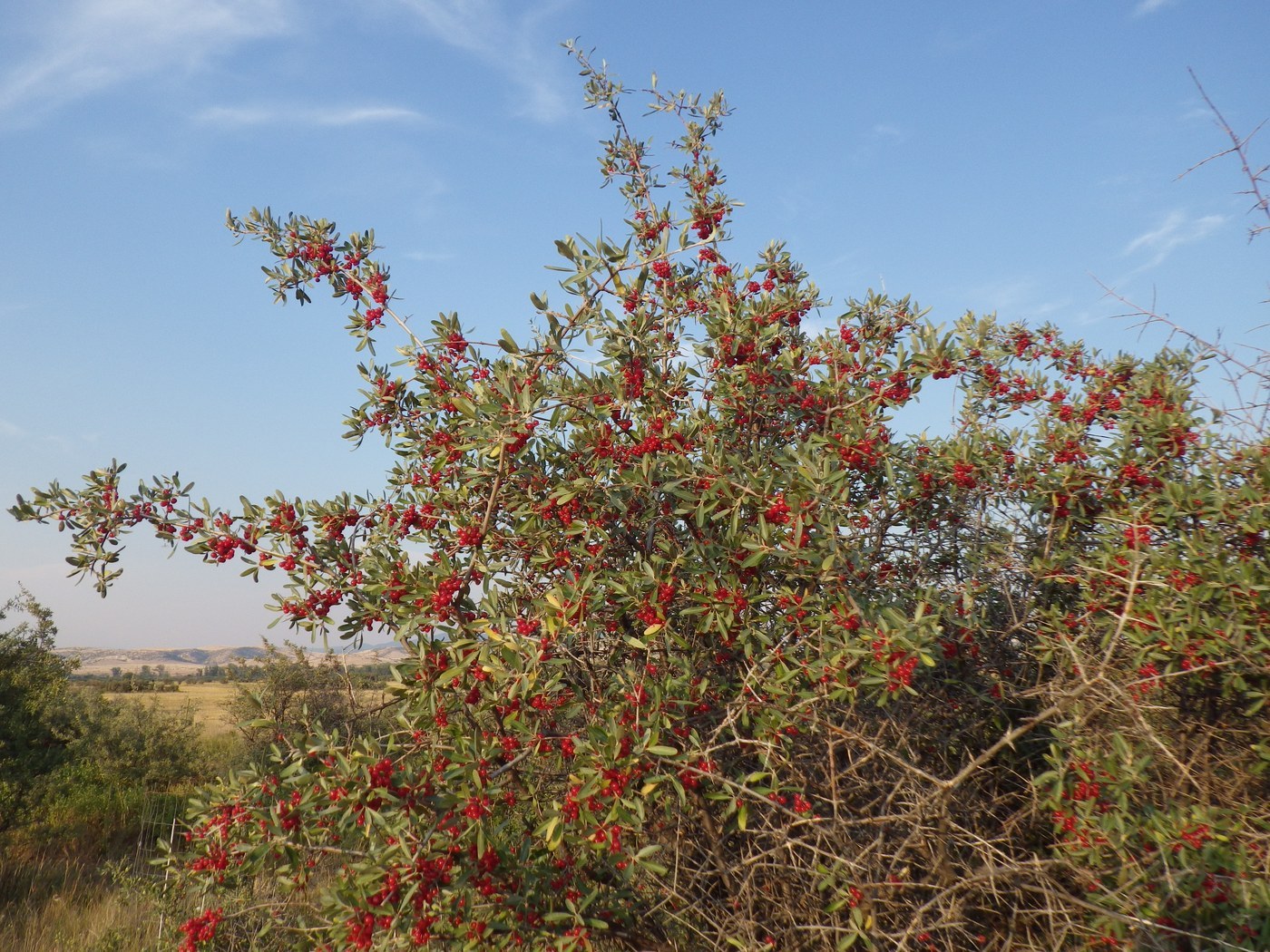
Key Identifying Features
Silver buffalo berry (Shepherdia argentea) is a deciduous, thorny shrub or small tree in the oleaster family, typically 6–18 feet tall, often forming dense thickets. The clearest identification marks are its overall silvery appearance, opposite leaves and branches, spine-tipped twigs, and clusters of small, scarlet-red berries. A close relative, russet buffalo berry (S. canadensis), is thornless with greener leaves.
- Overall silvery-gray, scaly foliage and twigs
- Opposite leaves and branches with stiff spiny tips
- Dense clusters of small red (sometimes yellow) berries
Leaves & Stems
Leaves are opposite, simple, narrow, and oblong, about 1–2.5 inches long, with smooth (untoothed) margins. Both surfaces are densely covered in tiny silvery scales (stellate hairs), giving the whole plant a frosted, silver-gray sheen—most pronounced on the underside. Twigs are likewise silvery-scaly and often end in a sharp spine, and the branching is distinctly opposite, which together with the spines is a strong field clue. The bark is gray and somewhat shaggy on older stems. Like other oleasters, buffalo berry fixes nitrogen via root nodules and thrives on poor soils.
Flowers & Fruit
Buffalo berry is dioecious—separate male and female plants—so only females bear fruit. Flowers are tiny, yellowish-brown, and inconspicuous, appearing before or with the leaves in early spring along the twigs. The fruit is a small, round, juicy berry about 1/4 inch across, ripening bright red to scarlet (occasionally orange or yellow), borne in dense clusters tight against the stems. The silver scaly background makes the red fruit stand out vividly.
How to Tell It Apart from Look-Alikes
- Russian olive (Elaeagnus angustifolia) shares silvery scaly leaves but has alternate leaves and produces dry, olive-like yellow-brown fruit, not juicy red berries.
- Russet buffalo berry (Shepherdia canadensis) is thornless, with green upper leaf surfaces and brown-scaly (rusty) undersides rather than uniformly silver.
- Currants/gooseberries have alternate, lobed (maple-like) leaves, unlike buffalo berry's narrow opposite silver leaves.
The opposite silver leaves + spiny twigs + clustered red berries identify silver buffalo berry.
Where You'll Find It
Native to central and western North America, buffalo berry grows in prairies, streambanks, coulees, foothills, and dry open slopes, often in alkaline or sandy soils where few shrubs thrive. Its nitrogen-fixing ability lets it colonize poor ground. Look for it along riverbanks, fencerows, and rangeland thickets across the Great Plains and intermountain West.
Quick ID Checklist
- Thorny deciduous shrub/small tree, dense thickets
- Silvery scaly leaves and twigs (frosted look)
- Opposite leaves and branches with spine-tipped twigs
- Narrow, smooth-margined leaves
- Dense clusters of small red berries (female plants)
- Prairie, streambank, or dry open western habitat
Frequently asked questions
How do I distinguish buffalo berry from Russian olive?
Both are silvery and scaly, but buffalo berry has opposite leaves and juicy red berries, while Russian olive has alternate leaves and dry, mealy yellow-brown olive-like fruit.
Why doesn't my buffalo berry shrub produce fruit?
The species is dioecious, meaning male and female flowers occur on separate plants. Only female shrubs bear berries, and they need a nearby male for pollination.
What is the difference between silver and russet buffalo berry?
Silver buffalo berry (S. argentea) is thorny with uniformly silvery leaves, while russet buffalo berry (S. canadensis) is thornless with green upper leaf surfaces and rusty-brown scaly undersides.
What is the best way to recognize a buffalo berry shrub?
Look for the combination of opposite, narrow, silvery-scaly leaves, spine-tipped twigs, and an overall frosted gray sheen on a thorny thicket-forming shrub. The opposite branching plus spines separates it from most other silvery shrubs.