
Bull Thistle Identification Guide
How to identify bull thistle (Cirsium vulgare) by its spiny winged stems, prickly deeply lobed leaves, and large purple flower heads with spine-tipped bracts.
Read the full Bull Thistle encyclopedia entry →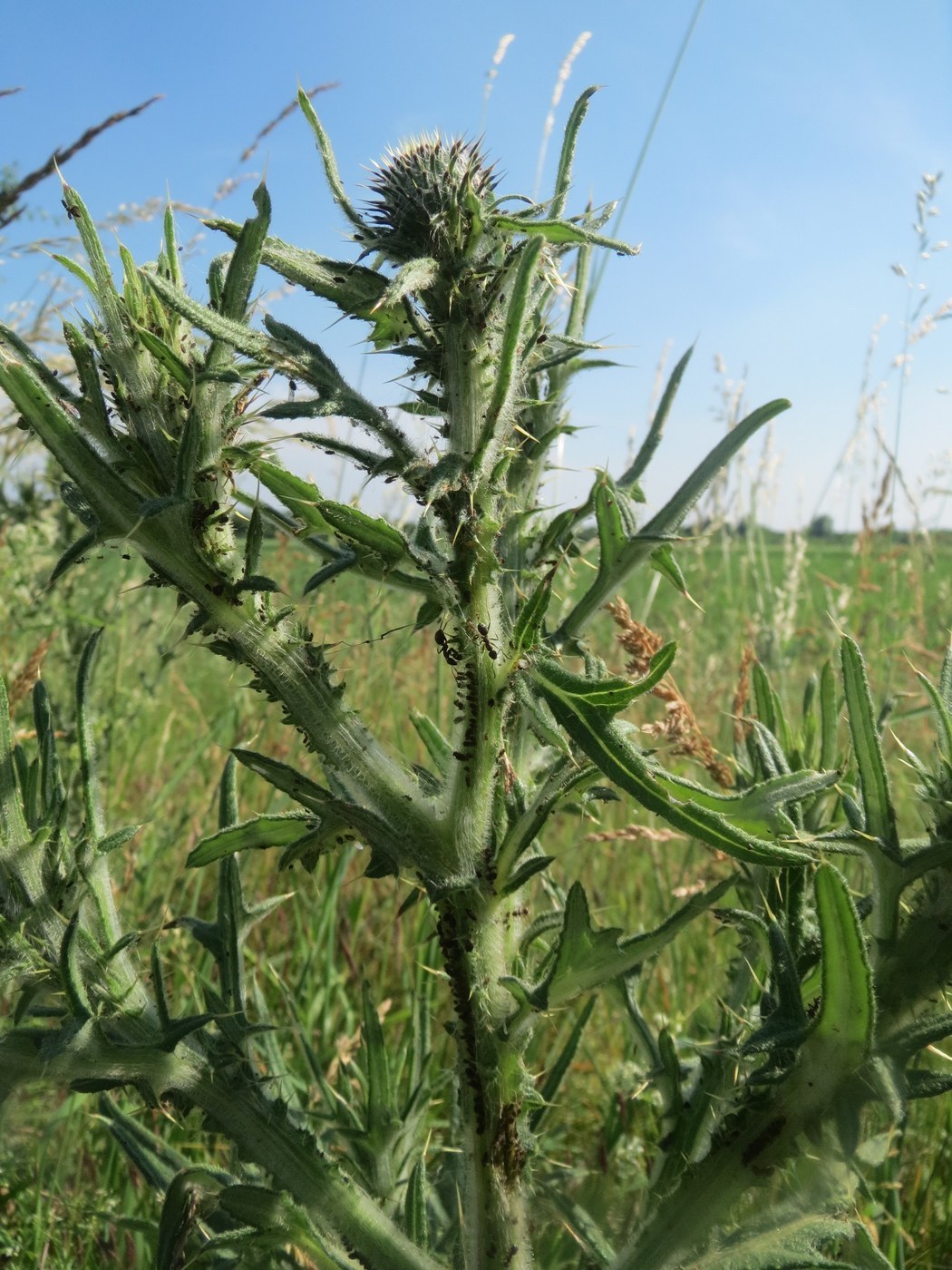
Key Identifying Features
Bull thistle (Cirsium vulgare) is a robust biennial thistle armed with spines. Recognize it by:
- Large, fluffy, pink-purple flower heads atop very spiny bases
- Deeply lobed leaves, each lobe tipped with a stiff yellow spine
- Spiny wings running down the stem between the leaves
- A rough, prickly-hairy upper leaf surface (unlike many smooth thistles)
Mature plants reach 2-6 feet tall.
Leaves & Stems
In the first year, bull thistle forms a flat rosette of deeply lobed, spine-tipped leaves. In the second year it bolts into a tall, branched stem. The leaves are deeply pinnately lobed and notably rough and bristly on top — running a finger over the surface feels like sandpaper, which distinguishes it from smoother thistles. Each lobe ends in a sharp spine. The stems bear spiny, leaf-like wings that extend down from the leaf bases, making the whole stalk prickly.
Flowers & Fruit
Flower heads are large (1.5-2 inches across), solitary or in small clusters, and bright pink to reddish-purple. The base of each head (the involucre) is a gumdrop-shaped cluster of green bracts, each tipped with a sharp spine. After flowering, heads produce fluffy white pappus (thistledown) that carries the seeds on the wind. Flowering occurs in summer.
How to Tell It Apart from Look-Alikes
- Canada thistle (Cirsium arvense): Smaller flower heads (under 1 inch), spreads by creeping rhizomes forming colonies, and has smooth (not bristly) upper leaf surfaces and spineless stems. Bull thistle is a non-colonial biennial with spiny winged stems.
- Musk/nodding thistle (Carduus nutans): Has large nodding (drooping) flower heads and broad spine-tipped bracts; bull thistle heads are more upright with narrower spiny bracts.
- Milk thistle: Has white-marbled veins on glossy leaves.
- Scotch thistle: Covered in dense white woolly hairs and broader stem wings.
The rough sandpapery leaf tops plus spiny stem wings plus spine-tipped flower bracts identify bull thistle.
Where You'll Find It
Bull thistle colonizes pastures, roadsides, overgrazed fields, clearings, ditches, and disturbed ground throughout temperate regions. It prefers full sun and tolerates a range of soils. As a biennial it relies entirely on seed, so it favors recently disturbed sites.
Quick ID Checklist
- Spiny wings along the stem
- Deeply lobed leaves with stiff spine tips
- Rough, bristly (sandpapery) upper leaf surface
- Large pink-purple flower heads with spine-tipped bracts
- First-year rosette, second-year tall flowering stalk
- Not colony-forming (no creeping rhizomes)
A tall, intensely spiny thistle with winged stems, sandpaper-rough leaves, and large purple flower heads with spiny bracts is bull thistle.
Frequently asked questions
How do I tell bull thistle from Canada thistle?
Bull thistle is a biennial with large purple flower heads, spiny winged stems, and rough sandpapery leaf surfaces, and it does not form colonies. Canada thistle has smaller heads, spreads aggressively by creeping rhizomes into large patches, and has smoother leaves and largely spineless stems.
Is bull thistle a biennial or perennial?
Bull thistle is a biennial. It forms a low spiny rosette the first year, then bolts to flower, set seed, and die in the second year, reproducing entirely by seed.
What is the fluffy white material on bull thistle?
That is the pappus, or thistledown, a parachute of fine white hairs attached to each seed. It allows the seeds to disperse long distances on the wind, helping the plant colonize new disturbed ground.